
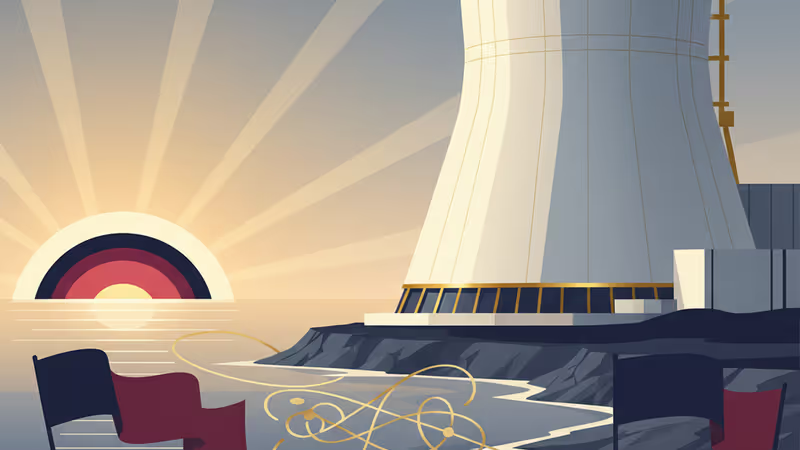
Japan Clears Path to Restart World's Largest Nuclear Plant, Testing Post-Fukushima Resolve
The Niigata assembly has cleared the final hurdle for restarting the Kashiwazaki-Kariwa facility, the world's largest nuclear plant, nearly 15 years after the Fukushima disaster.
Nearly 15 years after the Fukushima disaster, Japan took a pivotal step toward re-embracing nuclear power on Monday as the Niigata prefecture's assembly gave its effective approval to restart the world's largest nuclear plant. The decision on the Kashiwazaki-Kariwa facility marks a watershed moment, pitting the nation's urgent energy security needs against the deep-seated trauma of its recent past.
A Community Divided
The assembly's vote of confidence in Governor Hideyo Hanazumi, who endorsed the restart last month, was seen as the final local hurdle for the plant's operator, Tokyo Electric Power Co (TEPCO). The company also ran the doomed Fukushima Daiichi plant, a fact not lost on opponents.
Ahead of the vote, about 300 protesters, mostly elderly, gathered in 6-degree Celsius temperatures outside the Niigata prefectural assembly building. According to Reuters, they held banners reading "No Nukes" and chanted "Never forget Fukushima’s lessons!"
"We know firsthand the risk of a nuclear accident and cannot dismiss it."— Ayako Oga, Fukushima evacuee and anti-nuclear activist
Ayako Oga, 52, who was among the 160,000 people evacuated from the Fukushima area in 2011, joined the protest. "As a victim of the Fukushima nuclear accident, I wish that no one, whether in Japan or anywhere in the world, ever again suffers the damage of a nuclear accident," she said. Her sentiment reflects broader local skepticism; a prefectural survey in October found 60% of residents felt conditions for a restart hadn't been met, and nearly 70% were worried about TEPCO operating the plant.
The Push for Energy Security
The government's push to restart Kashiwazaki-Kariwa is driven by stark economic and strategic realities. Japan relies on imported fossil fuels for 60-70% of its electricity generation, spending 10.7 trillion yen last year on liquefied natural gas and coal alone.
Prime Minister Sanae Takaichi has championed nuclear restarts to bolster energy security. The urgency is compounded by a projected surge in energy demand over the next decade, fueled by a boom in power-hungry AI data centers. To meet these needs and its decarbonization commitments, Japan has set an ambitious goal.
Japan's Nuclear TargetThe government aims to double nuclear power's share in its electricity mix to 20% by 2040. Restarting just one of Kashiwazaki-Kariwa's seven reactors could boost the electricity supply to the Tokyo area by 2%, according to Japan's trade ministry.
TEPCO has pledged 100 billion yen to the prefecture over 10 years and insists it's committed to safety. "We remain firmly committed to never repeating such an accident," said spokesperson Masakatsu Takata. While TEPCO declined to comment on timing, public broadcaster NHK reported the company is considering reactivating the first reactor on January 20.
PRISM InsightThe Kashiwazaki-Kariwa decision is a microcosm of a global trend. Faced with volatile energy markets, geopolitical instability, and the massive power demands of AI, nations are reconsidering nuclear energy. The 'nuclear renaissance' is no longer a theoretical debate; it's becoming a policy imperative. Japan’s move signals that for advanced economies, the perceived risks of energy dependency and failing to power future technologies are beginning to outweigh the lingering fears of nuclear accidents. The key challenge ahead will be whether technological safeguards and corporate governance can win public trust where memory of disaster remains vivid.
本コンテンツはAIが原文記事を基に要約・分析したものです。正確性に努めていますが、誤りがある可能性があります。原文の確認をお勧めします。
関連記事
中国がヒューマノイドロボット特許で米国を5倍上回る。モルガン・スタンレーの分析は、米中技術競争の新たな焦点とサプライチェーンの地政学的課題を浮き彫りにする。

米国の対中AI半導体規制強化を深掘り分析。地政学的影響、サプライチェーンの分断、そして「技術の鉄のカーテン」がもたらす未来とは。
韓国防衛事業庁は、7兆ウォン規模の次期国産駆逐艦6隻の建造事業について、制限付き入札方式で造船会社を選定すると発表しました。造船大手間の法的紛争で停滞していた計画が、ついに前進します。
米国の情報提供を受け、中国が麻薬関連の資金洗浄事件で2名を起訴・判決したと国営メディアが報じました。緊張が続く米中関係の中で、この異例の司法協力が示す意味を解説します。