
Anarchy in Dhaka: Assassination Unleashes Mob Violence as Bangladesh's Government Stands By
Following the assassination of politician Sharif Osman Hadi, Bangladesh's capital, Dhaka, has descended into violence. The interim government's failure to stop attacks on media outlets raises questions of complicity and state failure.
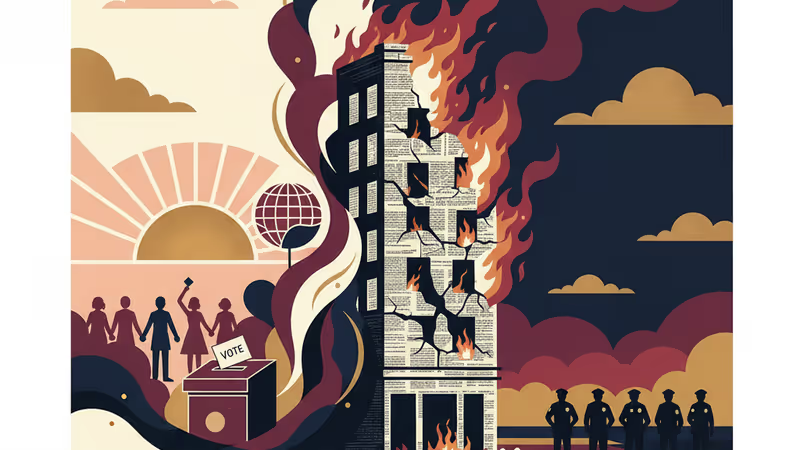
The assassination of a rising political figure, Sharif Osman Hadi, has plunged Bangladesh's capital into chaos. But the riots that erupted following his death on December 18 weren't the most alarming part. As organized mobs burned down media offices with journalists trapped inside, the interim government led by Dr. Muhammad Yunus and its security forces conspicuously failed to act, revealing a profound crisis of state responsibility and pushing the nation towards anarchy.
A Predictable Inferno, An Inactive State
The violence was neither spontaneous nor sudden. According to observers, it was the expected culmination of months of rising tension. Right-wing groups, including Chhatra Shibir—the student wing of Bangladesh's largest Islamist party, Jamaat-e-Islami (BJI)—had openly called for the shutdown of the targeted newspapers. Their plans to attack were reportedly an "open secret," yet the government took no preventative measures.
Even after attackers set the Prothom Alo building ablaze, they were allowed to march unimpeded to the Daily Star office. Journalists were forced to shelter on the roof for hours as the mob below blocked the army, police, and fire services from entering. Security forces, eyewitnesses said, appeared to be mere spectators.
Selective Inaction and Political Calculation
Critics argue the interim government's inaction isn't a sign of incapacity, but a conscious political choice. The Yunus administration has demonstrated it can act decisively when it wants to, particularly against its critics. Respected journalist Anis Alamgir was recently arrested under anti-terrorism laws for criticizing the government. Meanwhile, leftist protestors and teachers pressing for legitimate demands have been brutally dispersed by police.
This stark contrast—swift action against dissidents versus passivity towards violent mobs—leads to an unsettling conclusion: the interim government appears to have deliberately chosen not to intervene. This absence of punishment has normalized violence and sent a clear message: the state will not protect media and cultural institutions from its political allies. If crimes go unpunished, violence becomes the norm.
The crisis in Bangladesh transcends a simple breakdown of law and order; it's spiraling into a crisis of state legitimacy. Allowing such violence to go unchecked may offer short-term political advantages for certain factions, but it guarantees the long-term erosion of the rule of law and public trust. This instability has a direct effect on regional security in South Asia. A state that watches a media building burn with journalists inside loses the moral authority to govern.
Questions also swirl around Hadi's assassination itself. The killers, who struck in broad daylight, remain at large. Allegations have surfaced that the assassins escaped to India, but the government has reportedly not issued a request for cooperation or even alerted its border guards. This lack of interest suggests the government may not want the assassins found. Hadi's death and the ensuing violence stand as a damning indictment of the Bangladeshi state's failure.
本コンテンツはAIが原文記事を基に要約・分析したものです。正確性に努めていますが、誤りがある可能性があります。原文の確認をお勧めします。
関連記事

米国の有力保守系シンクタンク、ヘリテージ財団で職員十数人が集団離職。反ユダヤ主義などを唱える右派インフルエンサーの処遇を巡る内部の路線対立が表面化し、米保守運動全体の分裂を象徴している。
韓国の与党「共に民主党」が、これまで反対してきた「統一教会」疑惑に関する特別検察官の導入を電撃的に受け入れた。与野党間の政治的計算が交錯する中、世論の強い支持を背景に政界を揺るがす捜査が本格化する見通しだ。

ガザ地区で約2000年の歴史を持つ大オマリ・モスクが、続く紛争の中で廃墟と化しました。この文化遺産の破壊が意味するものと、紛争下における歴史的建造物保護の課題について解説します。

2025年の会期末を迎え、米連邦議会の立法実績は乏しく、引退議員が増加しています。複数の元議員が「議会は昏睡状態にある」と現状に深刻な懸念を表明し、問題は長年かけて形成されたものだと指摘しています。