
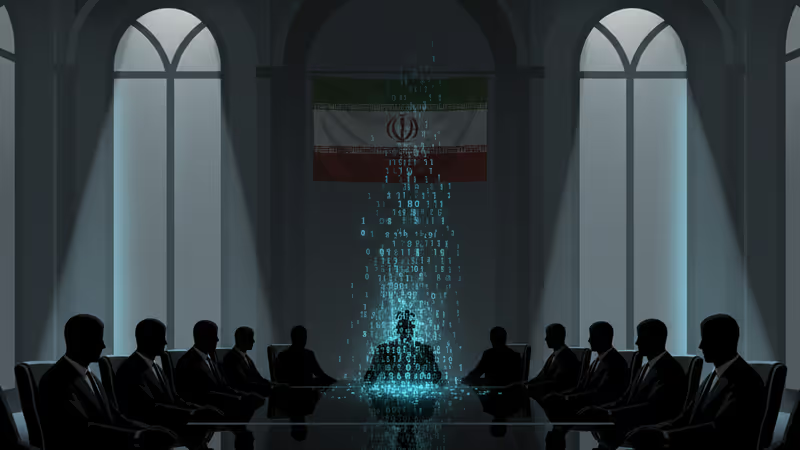
Iran's Digital Purge: Why Tehran's Spy Executions Are a New Front in the Shadow War
Iran's execution of an alleged Israeli spy signals a strategic shift. Our analysis explores the geopolitical fallout, the tech-fueled purge, and what it means for global risk.
The Lede: A Signal in the Noise
Iran's execution of a 27-year-old student for spying for Israel is more than a grim headline; it's a critical signal for global leaders and executives. It marks Tehran's strategic shift from a clandestine shadow war to a public, technology-fueled internal purge. This isn't just about retribution for the recent conflict with Israel and the U.S. — it's a calculated demonstration of domestic control and a new, heightened risk profile for any entity operating in the region. The methods alleged, involving cryptocurrency and encrypted apps, reveal that the new geopolitical battlefield runs through every smartphone.
Why It Matters: The Ripple Effects of a Hardened Regime
The intensification of Iran's internal security measures has tangible second-order effects beyond its borders. For international organizations and businesses, this signals a drastically elevated operational risk.
- Human Capital Risk: Dual nationals, foreign contractors, and even local staff are now at unprecedented risk of being used as geopolitical pawns. The vague and sweeping nature of espionage charges creates a chilling effect on recruitment and operations.
- Tech Sector as a Battleground: The explicit mention of encrypted messaging and cryptocurrency as tools of espionage puts global tech platforms in the crosshairs. Expect increased pressure on these companies for data access or outright bans within Iran, further splintering the global internet and creating compliance nightmares.
- Market & Supply Chain Instability: A regime focused on a brutal internal crackdown is not one seeking de-escalation. This posture ensures continued tension in the Persian Gulf, directly threatening key shipping lanes like the Strait of Hormuz and creating persistent volatility in global energy markets.
The Analysis: From Shadow War to 'Show War'
For decades, the Iran-Israel conflict was a 'shadow war' fought with targeted assassinations, cyberattacks, and sabotage. The direct military exchange earlier this year shattered that paradigm. These public executions represent the conflict's next evolution: a 'show war'. Unable to match the conventional military and technological might of the U.S.-Israel alliance, Tehran is shifting the conflict to a domain it completely controls — its own domestic territory.
This strategy serves two key purposes. Externally, it's a form of asymmetric deterrence, signaling to its adversaries that it can and will exact a high price for any perceived infiltration. Internally, it's a powerful tool for consolidating power. By linking internal dissent — whether over economic hardship or human rights — to foreign espionage, the regime can legitimize a brutal crackdown on all opposition. The narrative that protestors and collaborators are one and the same is a classic authoritarian playbook, now supercharged in a post-war environment.
PRISM Insight: The Gig Economy of Espionage
The details of the case against Aghil Keshavarz point to a disturbing trend in modern intelligence: the 'gig-ification' of espionage. The alleged tasks — photographing buildings, monitoring traffic, conducting opinion polls — are low-level intelligence-gathering activities. The payment method — cryptocurrency — allows for anonymous, cross-border transactions.
This suggests state actors like Mossad may be moving towards a decentralized model, crowdsourcing tactical intelligence from a network of loosely-affiliated, often financially motivated, local contacts rather than relying solely on deeply embedded, long-term agents. This model is cheaper, more scalable, and harder to dismantle than a traditional spy ring. For security agencies, it presents a nightmare scenario of countless individual threats managed through secure, commercial technologies.
PRISM's Take: A Strategy of Hardened Resolve
Viewed through a strategic lens, these executions are not a sign of a regime flailing in panic. They are a calculated policy of hardening. Tehran is demonstrating its unwavering control over the domestic front, making it clear that it can absorb external pressure without fracturing. By making the price of collaboration a public spectacle, it aims to inoculate itself against future intelligence breaches and popular uprisings.
For the West, this should be a sobering realization. Sanctions and military strikes have not produced a pliable or collapsing regime; they have forged a more ruthless and insular one. This new phase of internal conflict, fought with digital tools and public executions, signals that Iran is digging in for a long, generational struggle, and it is willing to sacrifice its own citizens to win it.
関連記事

シドニー・ボンダイビーチでの銃乱射事件を深く分析。テロがオーストラリアの銃規制、社会の結束、そして世界の地政学に与える影響を考察します。

バチカンが韓国水原教区に新補佐司教を任命。この人事が示す教皇フランシスコのアジア戦略と、朝鮮半島における教会の役割、地政学的な影響を深く分析します。

パキスタン総選挙直前、イムラン・カーン前首相への追加有罪判決の深層を分析。軍の権力闘争と地政学的リスク、そして国の未来への影響を解説します。

中国・南京で発生したGPS/北斗の同時ジャミング事件を分析。現代社会の脆弱性を露呈させ、米中間の電子戦リスクと代替PNT技術の重要性を浮き彫りにします。