
Imran Khan's Conviction: The Algorithm Behind Pakistan's Election
Imran Khan's latest conviction is no mere legal drama. It's a calculated move by Pakistan's military to engineer an election, with major geopolitical and economic risks.
The Lede: Beyond the Verdict
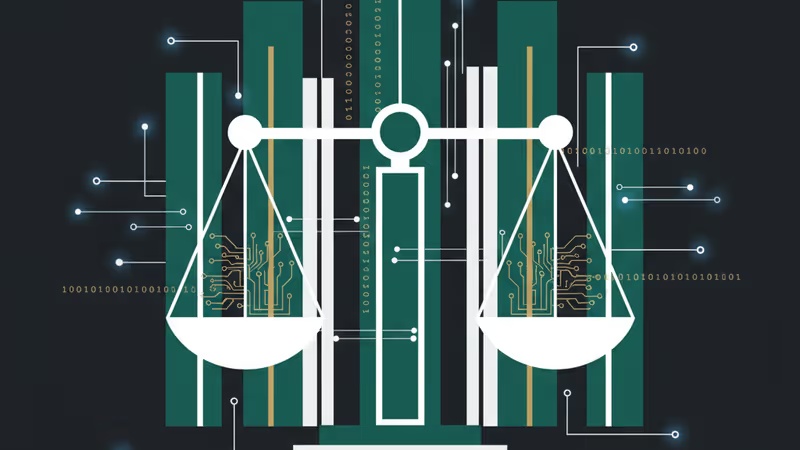
The latest conviction of former Prime Minister Imran Khan is not a simple corruption case; it is the final, decisive input into a political algorithm designed to produce a predictable election outcome in a nuclear-armed state of 240 million people. For global executives and strategists, this is a critical signal: Pakistan’s powerful military establishment is reasserting total control, systematically dismantling its most popular political challenger. The verdict's true purpose is to neutralize Khan and his PTI party ahead of the February 8th general election, creating a veneer of judicial process over a calculated political maneuver. The resulting stability is fragile, and the long-term risks are mounting.
Why It Matters: The Ripple Effects of a Controlled Election
The systematic legal campaign against Khan—now facing a cumulative 31 years in prison from three separate cases in a single week—has profound second-order effects that extend far beyond Islamabad.
- Legitimacy Crisis: An election where the most popular leader is jailed and his party is effectively barred from campaigning will produce a government with a severe legitimacy deficit. This sets the stage for persistent political instability and potential civil unrest.
- Economic Headwinds: Pakistan is navigating a precarious economic recovery with the IMF. A weak, unpopular government will struggle to implement the tough, unpopular fiscal reforms required, jeopardizing economic stability and spooking foreign investors.
- Geopolitical Realignment: For Washington, Beijing, and Riyadh, the key question is predictability. While the military's preferred candidate, Nawaz Sharif, is seen as a more traditional and pliable partner, the deep public resentment against this process could make the country an unreliable ally. China's CPEC investments and the US's counter-terrorism interests both rely on a stable, functioning state, which is now in question.
The Analysis: The 'Hybrid Regime' Playbook Rebooted
This is a familiar cycle in Pakistani politics, but executed with unprecedented speed and force. Khan himself rose to power in 2018 with the tacit backing of the military in a so-called “hybrid regime.” The alliance fractured when Khan sought to assert civilian authority over key military appointments and foreign policy, particularly concerning the United States.
What we are witnessing is the establishment's forceful reboot of its playbook. Having lost control of its political project, the military is now dismantling it and returning to more traditional, controllable partners like the Sharif family's PML-N party. The sheer volume of cases against Khan—over 100—is a classic example of 'lawfare,' using the state's legal apparatus to exhaust and eliminate a political threat. The goal is not just to jail Khan, but to disqualify him from public life and break the morale of his massive support base. The verdicts, delivered just days before the election, are timed for maximum political impact, leaving no room for a judicial or popular comeback.
PRISM Insight: The Digital Insurgency vs. The State
The real battleground in this conflict is not the courtroom, but the digital domain. While the state has cracked down on Khan's party on the ground, PTI has pivoted to a sophisticated digital-first campaign. This presents both a fascinating tech trend and a major risk for global platforms.
- AI in Politics: In a global first, Khan’s party used AI to clone his voice, delivering a campaign speech from behind bars. This demonstrates how generative AI can be used to circumvent state censorship and maintain a political leader's presence, a tactic likely to be replicated in other restrictive environments.
- Platform Risk: The Pakistani state has repeatedly throttled internet services and blocked social media platforms like X (formerly Twitter) during PTI’s online events. This forces tech companies into a difficult position, caught between upholding free expression and complying with state directives in a major market. The political instability directly translates to operational and regulatory risk for Big Tech.
PRISM's Take: A Pyrrhic Victory for the Establishment
The military establishment will likely achieve its short-term goal: a controlled election and a friendly government in Islamabad. However, this is a strategic miscalculation that trades short-term control for long-term instability. By creating a political martyr and disenfranchising millions of voters, particularly the youth, they are fueling a deeper, more resilient opposition that now lives online, beyond their direct control. The next government will inherit a polarized country, a fragile economy, and a legitimacy crisis from its first day in office. The attempt to engineer stability may have inadvertently laid the foundation for a more volatile and unpredictable future.
関連記事
世界の分断、ガザの人道危機、ウクライナ紛争、国内政治の課題を分析。地政学、人権、そしてテクノロジーが交差する現代のグローバル課題と、投資・技術トレンドをPRISMが解説します。
イスラエル軍のシリア領内進攻と1974年兵力引き離し合意の破棄は、アサド政権崩壊後のシリア情勢を不安定化させ、国際秩序に影響を与える。地政学リスクと技術・投資への波紋をPRISMが分析。
北朝鮮が国連憲章を盾に「西側の強制」に対抗を呼びかけ、グローバルサウスとの連携を強化。多極化する国際秩序における地政学的意味合いとビジネスへの影響を分析。
DRC東部紛争が米国仲介の和平を崩壊させ、国連安保理はルワンダを非難。地政学的リスクと重要鉱物サプライチェーンへの影響、今後の展望を分析。