
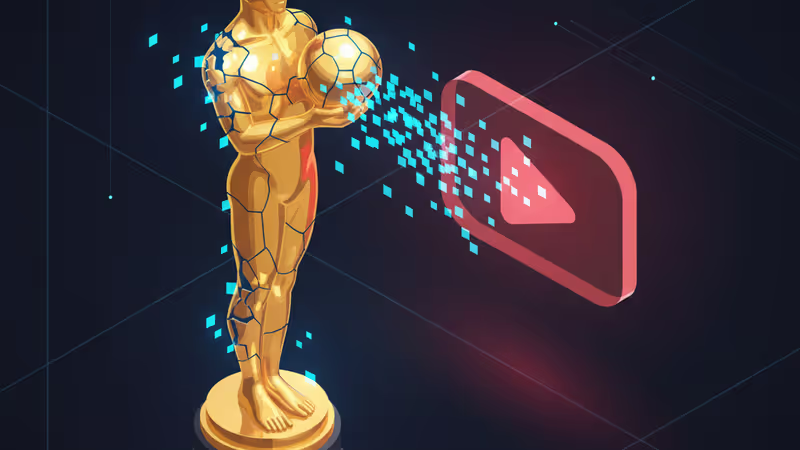
Hollywood's Final Bow: Why The Oscars' YouTube Pivot Signals The End of an Era
The Oscars' move to YouTube in 2029 isn't a programming change; it's Hollywood's surrender to the algorithm. A deep-dive analysis on the future of media.
The Lede: A Surrender, Not a Strategy
When Hollywood’s most prestigious institution, the Academy Awards, ditches broadcast television for YouTube in 2029, it’s not a forward-thinking programming choice. It's a strategic surrender. For any executive in media, advertising, or technology, this move is a blaring siren signaling the final, irreversible power shift from legacy gatekeepers to digital platforms. The era of appointment television is officially over, and the 'cultural moment' will now be served, clipped, and monetized by the algorithm.
Why It Matters: The Ripple Effect
This isn't just about where you'll watch the Best Picture award. This decision fundamentally rewrites the rules for high-value live events and the ecosystems they support.
- For the Media Industry: The 'broadcast tentpole' is dead. If the Oscars, the crown jewel of live award shows, can't sustain its value on a traditional network, what can? The Super Bowl, the Olympics, and royal weddings are now on the clock. This forces a painful re-evaluation of multi-billion dollar broadcast rights deals across the board.
- For Advertisers: The $2 million, 30-second Oscar spot is an artifact. The new playbook is global, data-driven, and fragmented. Think brand integrations with creators co-streaming the red carpet, shoppable links on celebrity outfits, and dynamically inserted ads targeted to viewers in Mumbai as precisely as those in Montana. The game shifts from buying mass attention to winning micro-moments.
- For Hollywood: The Academy is trading the curated environment of a primetime broadcast for the chaotic, competitive arena of YouTube. It will no longer be the main event; it will be one content stream among millions, competing in real-time against gaming streams, video essays, and MrBeast. This forces Hollywood to learn a new language: the language of digital engagement, not just broadcast appeal.
The Analysis: A Decades-Long Decline Meets an Undeniable Force
The Academy's move wasn't made in a vacuum. It’s the logical conclusion of a two-decade trend. Oscar viewership has been in a near-terminal decline, plummeting from over 43 million viewers in 2014 to struggling to clear 18 million in recent years. The younger demographics that advertisers covet have already left broadcast TV; they live on platforms like YouTube, TikTok, and Twitch.
This isn't just ABC's loss; it's YouTube's coronation. Google's video platform has strategically moved from a repository of user-generated content to a premier destination for live culture. By securing rights for events like Coachella and the NFL Sunday Ticket, YouTube has proven its technological prowess and its ability to command massive, concurrent global audiences. The Oscars are simply the most prestigious validation of this strategy.
The key detail is the implicit acknowledgment that the show will be consumed in "10 minute segments." This reveals the core truth: the 3-hour, self-congratulatory telecast is an anachronism. The future value of the Oscars lies not in the live event itself, but in its ability to be a content engine—generating dozens of viral clips, memes, and reaction videos that will be algorithmically distributed for days. The 'show' is now raw material for the internet's content machine.
PRISM Insight: The Rise of 'Live Event as a Service' (LEaaS)
This move solidifies the emergence of a new tech category: Live Event as a Service. Platforms like YouTube are no longer just distributors; they are full-stack partners providing the global infrastructure, monetization tools, and data analytics required to execute a world-class live event.
Investment Implication: The smart money is not on the content itself, but on the picks and shovels building this new ecosystem. Watch for accelerated investment in companies specializing in:
- AI-powered clipping services that can identify and distribute viral moments in real-time.
- Interactive overlay technologies for live polling, commenting, and commerce.
- Next-generation ad-tech focused on dynamic insertion and creator-brand partnerships within live streams.
PRISM's Take: An Uncomfortable New Reality
Let's be clear: this is an act of desperation, not innovation. The Academy is not bravely stepping into the future; it is being dragged there by the collapse of its old model. The true test will not be in 2029's stream quality, but in Hollywood's ability to adapt its culture. For over 50 years, the Oscars have delivered a monologue from a pedestal. YouTube is a sprawling, chaotic, and deeply interactive conversation.
Will the Academy embrace this, allowing creator commentary, live chats, and a degree of digital messiness? Or will it try to deliver a polished, hermetically sealed broadcast inside a YouTube wrapper? The former is a chance at renewed relevance; the latter is a recipe for being ignored. The Oscars are no longer just competing with other TV channels; they're competing for attention against the entire internet. Welcome to the main event.
関連記事
アカデミー賞のYouTube移行は単なる放送局変更ではない。メディア消費、広告、文化のあり方が根本から変わる、放送時代の終焉を告げる象徴的事件を分析。

アカデミー賞が2029年からYouTubeで独占配信へ。これは単なる放送局の変更ではなく、巨大テックが文化の頂点を掌握するメディア新時代の幕開けを意味します。PRISMが徹底分析。

YouTubeがビルボードチャートへのデータ提供を停止。音楽の価値を巡る「無料 vs 有料」の対立は、K-POPファンダムや音楽業界にどう影響するのか。その深層を分析します。

SpaceX初のロケット着陸成功。その裏には壮絶な打ち上げ失敗があった。書籍『Reentry』が明かす、絶望から革新を生む組織文化の秘密とは。