

Geopolitical Crossroads: How Domestic Dissent and Global Demands Are Reshaping US Foreign Policy
Progressive voices and global demands are challenging US foreign policy. This analysis unpacks how internal shifts and external pressures are reshaping America's global role.
The Shifting Tides of American Influence: A PRISM Analysis
For decades, the bedrock of U.S. foreign policy has often been viewed through a lens of strategic national interest, economic leverage, and sometimes, military intervention. However, a confluence of rising progressive voices within the United States and persistent demands for sovereignty and human rights from global actors is fundamentally challenging this established paradigm. This isn't merely political noise; it represents a systemic recalibration with profound implications for global stability, economic partnerships, and the very nature of international diplomacy.
Why It Matters: Beyond Traditional Geopolitics
For any executive navigating the global landscape, understanding these shifts is crucial. The traditional geopolitical playbook is being rewritten. Increased domestic scrutiny of U.S. actions abroad, particularly concerning human rights and self-determination, translates directly into potential changes in sanctions regimes, trade agreements, and alliance structures. Furthermore, the rise of whistleblowers and activist movements, amplified by digital platforms, can rapidly expose perceived inconsistencies, leading to significant reputational risks for nations and corporations alike. Supply chains, market access, and even investor confidence are increasingly susceptible to the ripple effects of a more ethically conscious and internally divided foreign policy apparatus.
The Analysis: Interconnected Struggles and the Demand for Accountability
A Challenging of Old Orders
The narratives emerging from various global flashpoints — from the sustained U.S. pressure on Venezuela to Haiti's tenacious struggle for genuine sovereignty — highlight a common thread: a pushback against perceived external manipulation and a demand for self-determination. Figures like Jemima Pierre articulate Haiti’s call to be 'left alone,' reflecting a broader sentiment among nations weary of interventionist policies that often prioritize external agendas over local needs.
The Progressive Insurgency in Domestic Politics
Domestically, a vibrant progressive wing is increasingly influencing the Democratic Party's discourse. The rise of figures like Zohran Mamdani, as debated by commentators like Briahna Joy Gray, signifies a generational shift. These voices frequently connect domestic issues like workers' rights with global struggles for liberation, as powerfully articulated by Chris Smalls. This interlinking creates a potent political force, challenging the bipartisan consensus that has historically shaped U.S. foreign policy.
This movement is not just about specific policy choices but a fundamental re-evaluation of historical injustices and a demand for accountability. The recent exposure by a U.S. whistleblower regarding the Biden administration's actions on the Israel-Palestine conflict underscores the internal pressure to align policy with stated human rights principles. Critics like Norman Finkelstein further amplify this by asserting that traditional 'plans' often lack grounding in the reality on the ground, calling for a more empathetic and pragmatic approach.
The Geopolitical Repercussions
This internal friction within the U.S. is not occurring in a vacuum. Global competitors keenly observe and exploit perceived vulnerabilities or hypocrisy, potentially eroding U.S. moral authority and diplomatic leverage. The debate around colonialism, brought into sharp relief by scholars like Mahmood Mamdani, provides a critical historical context, framing current U.S. foreign policy actions within a longer narrative of power imbalances. As these internal debates escalate, the predictability of U.S. global engagement diminishes, forcing allies and adversaries alike to adapt to a more volatile policy environment.
PRISM Insight: Navigating the Ethical Economy and Digital Activism
The convergence of progressive politics and global demands for sovereignty ushers in an era where ethical considerations are paramount for investment and business strategy. Companies operating internationally must scrutinize their supply chains and partnerships for alignment with human rights and fair labor practices, as ESG (Environmental, Social, Governance) metrics become increasingly critical for investor attraction and brand reputation. Furthermore, the role of digital platforms in facilitating whistleblowing and organizing global activism means that policy shifts and public opinion can mobilize at unprecedented speeds. Businesses need robust geopolitical risk intelligence systems that account for this new layer of domestic political pressure and citizen-led scrutiny, leveraging AI and data analytics to predict and respond to shifts in policy and public sentiment.
PRISM's Take: An Inflection Point for American Global Leadership
The United States stands at an inflection point. The traditional mechanisms of its global power are being questioned not just by rival nations, but by a powerful, organized, and increasingly effective progressive movement at home, alongside persistent demands for self-determination from nations historically subject to its influence. This dynamic heralds a future where U.S. foreign policy will be more heavily scrutinized, more contested, and potentially more aligned with global human rights and justice principles. For global leaders, this means anticipating a period of policy recalibration, heightened geopolitical risk, and an imperative to factor ethical considerations deeply into every international strategy. The era of unquestioned U.S. unilateralism is giving way to a more complex, multi-polar world shaped as much by domestic dissent as by traditional statecraft.
関連記事

ノースカロライナ州ラウンビー族が132年越しに連邦公認を獲得。この歴史的決定が先住民族の権利、経済、そして米国社会にもたらす多角的な影響をPRISMが分析します。
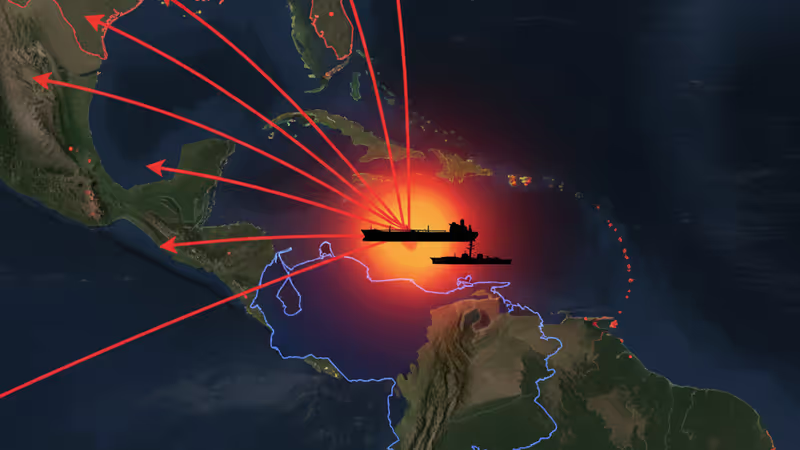
米国がベネズエラ沖で非制裁タンカーを拿捕。国際法、地政学的緊張、そして世界経済への影響を分析。未来の地政学リスクと国際貿易の展望。
2025年冬、ウクライナ紛争は戦線の激化と外交の模索が交錯。黒海とカスピ海での攻防、米国提案の三者協議の行方を地政学的に分析。エネルギー安全保障と防衛技術の未来を展望。
2025年12月の米露交渉は、ウクライナ紛争解決の新たな局面を開くか。地政学的圧力、各国の思惑、そして国際秩序への影響をPRISMが深く分析。