
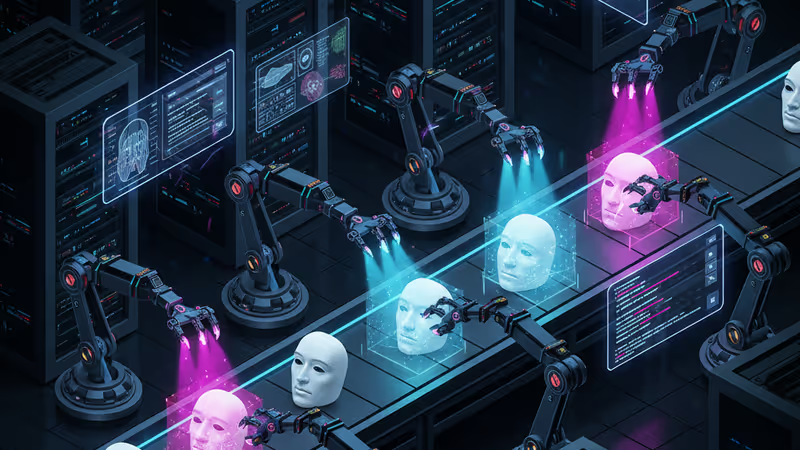
Deepfake-as-a-Service: The AI Platform Industrializing Digital Deception for Millions
An analysis of Haotian, the AI tool earning millions by professionalizing 'pig butchering' scams and creating a new market for 'Deepfake-as-a-Service'.
The Lede: Beyond the Novelty, The Enterprise of Fraud
While the world debates the creative and ethical boundaries of generative AI, a sophisticated B2B ecosystem for digital deception is already scaling. A Chinese-language AI tool, Haotian, is not merely a piece of software; it's a fully-fledged service platform earning millions by providing cybercriminals with military-grade face-swapping technology. For any executive, this signals a critical shift: the industrialization of social engineering attacks. The era of grainy, amateur deepfakes is over. We are now facing enterprise-grade 'Deception-as-a-Service' platforms with dedicated R&D, customer support, and a robust revenue model built on crime.
Why It Matters: The Collapse of Digital Trust
Haotian’s success represents a fundamental threat to the trust underpinning digital communication and commerce. By enabling scammers to conduct 'live' video calls as their fake personas, these tools dismantle a key pillar of verification. The implications are profound and extend far beyond personal romance scams:
- Corporate Security at Risk: Imagine a CFO receiving a flawless, real-time video call from their 'CEO' instructing an urgent wire transfer. The same technology used for 'pig butchering' can be weaponized for sophisticated corporate espionage and financial fraud.
- The KYC Arms Race: Financial institutions and crypto exchanges relying on video verification for Know Your Customer (KYC) checks are now in an arms race against tools that can defeat these measures in real time.
- Erosion of Evidence: The verifiability of video evidence in legal, journalistic, and business contexts is fundamentally weakened. The cost to verify will skyrocket as the cost to falsify plummets.
The $3.9 million in tracked crypto payments to Haotian is not just revenue; it's a war chest for reinvestment, creating a vicious cycle of ever-improving deception technology funded by its own illicit success.
The Analysis: From Open Source to Criminal SaaS
The evolution of deepfake technology has reached a critical inflection point. What began as a niche for open-source enthusiasts on platforms like GitHub has now bifurcated. On one path, we have legitimate, mainstream applications from big tech. On the other, a dark-web economy has professionalized the technology into a turnkey solution for crime.
Haotian is the 'Salesforce for Scammers'. It's not just an app; it's a product with features, a distribution channel (a 20,000+ subscriber Telegram channel), and technical support. Its key innovation lies in its usability and integration. By working seamlessly with common messaging apps like WhatsApp and offering granular control over facial features, it lowers the technical barrier for criminals to execute high-fidelity scams at scale. According to the UNODC, over 10 such tools are active in Southeast Asia's cybercrime hubs. This is not a lone actor but a competitive market for criminal tools, driving innovation through illicit competition.
PRISM Insight: The Rise of the 'Trust-as-a-Service' Stack
The proliferation of 'Deception-as-a-Service' creates a powerful counter-market: 'Trust-as-a-Service' (TaaS). The investment and innovation opportunities are now squarely in the realm of real-time validation and verification. We predict significant growth and M&A activity in companies specializing in:
- Real-Time Liveness Detection: AI that can analyze video streams for subtle artifacts, unnatural expressions, and digital signatures indicative of a deepfake, moving beyond simple 'blink-and-you'll-pass' tests.
- Multi-Modal Biometrics: Systems that don't just verify a face, but cross-reference voice patterns, speech mannerisms, and other unique identifiers simultaneously during a live interaction.
- Digital Watermarking & Provenance: Technologies that embed secure, verifiable metadata into original video recordings, creating a chain of custody to authenticate genuine content.
The market for cybersecurity is shifting from protecting perimeters to verifying identity and intent at every point of interaction.
PRISM's Take: We've Entered a Zero-Trust Reality
Haotian and its ilk are more than just a security threat; they are a societal one. They represent the successful commercialization of technology designed to sever the link between sight and belief. The regulatory and legislative response is dangerously lagging behind the pace of criminal innovation. Waiting for policy to catch up is a losing strategy. Businesses and individuals must now operate under a 'zero-trust' assumption for all digital communications, even video. The challenge is no longer about preventing the creation of these tools—that battle is lost. The critical mission now is to build technological and cognitive resilience in a world where seeing is no longer believing.
関連記事

韓国が150兆ウォン規模の公的成長ファンドを設立。AI、半導体、バッテリーに重点投資する国家戦略を分析し、投資家や業界への影響を読み解きます。
新型の円盤型衛星「DiskSat」が打ち上げ。20年にわたり標準だったCubeSatを超える存在となるか?宇宙産業の新たなパラダイムシフトを専門家が分析します。

AIデータセンターの需要爆発により、PC用メモリとSSDの価格が記録的に高騰。自作PCユーザーとゲーマーが直面する新たな現実と、専門家による対策を解説します。

YouTubeが200万登録のAI偽映画予告編チャンネルを閉鎖。AIコンテンツの許容範囲と「欺瞞」の境界線がどこにあるのか、プラットフォームの新たな姿勢を専門家が分析します。