
Crypto's Quantum Time Bomb: Why Zero-Knowledge Is the Only Real Defense
Quantum computers pose an existential threat to Bitcoin and Ethereum's encryption. Discover how Zero-Knowledge (ZK) technology offers a critical, flexible defense against this multi-trillion dollar risk.
The Lede: The Silent Heist Is Already Happening
Nation-states and sophisticated adversaries are not waiting for a quantum computer to break Bitcoin. They are acting now, silently siphoning and stockpiling every encrypted transaction, public key, and wallet backup they can find. This strategy, known as "harvest now, decrypt later," turns today's secure blockchain data into a ticking time bomb. The moment a sufficiently powerful quantum computer comes online—an event experts call 'Q-Day'—trillions of dollars in digital assets protected by today's encryption standards could become instantly vulnerable. This isn't a distant sci-fi threat; it's an active, ongoing cybersecurity risk that fundamentally challenges the long-term viability of the entire digital asset class.
Why It Matters: Beyond the Code
The quantum threat isn't just a technical problem for cryptographers; it's a strategic barrier to mainstream adoption. Institutional investors, pension funds, and corporations cannot responsibly allocate billions to an asset class with a known, unmitigated vulnerability that could theoretically wipe out its value overnight. The integrity of the entire $4 trillion Web3 market rests on the strength of its cryptography. The debate is no longer *if* quantum computers will break today's standards like the Elliptic Curve Digital Signature Algorithm (ECDSA), but *when*.
This creates a new, critical dividing line in the crypto space: projects with a credible quantum-resistant roadmap versus those without. The second-order effect is the emergence of a multi-billion dollar sub-industry focused on quantum security, auditing, and cryptographic migration—a race to build the digital equivalent of a nuclear bunker before the storm hits.
The Analysis: A Race Against Time
The Countdown to 'Q-Day': Separating Hype from Reality
Estimates for 'Q-Day' vary wildly. Ethereum co-founder Vitalik Buterin places the odds of a quantum break at 20% by 2030, while others remain more skeptical. However, focusing on a single date misses the point. The "harvest now, decrypt later" strategy means the window for action is closing much faster. Every transaction broadcast today using a vulnerable address—like the over 6 million BTC in early wallet formats, including Satoshi's legendary 1.1 million BTC stash—is a future target. This transforms the quantum threat from a future event into a present-day data liability.
Why a Simple 'Patch' Is Impossible
Upgrading a decentralized network like Bitcoin or Ethereum is not like pushing a software update. The core cryptographic signature scheme is woven into the fabric of the protocol. A transition to a new, quantum-resistant algorithm would require a contentious and incredibly risky hard fork, potentially splitting the network and its community. We've seen messy cryptographic transitions before, such as the multi-year deprecation of the SHA-1 hashing algorithm in the web security space. For a decentralized financial system, the stakes are orders of magnitude higher. A simple "rip and replace" approach is a non-starter.
Enter the ZK Shield: A Gradual, Flexible Defense
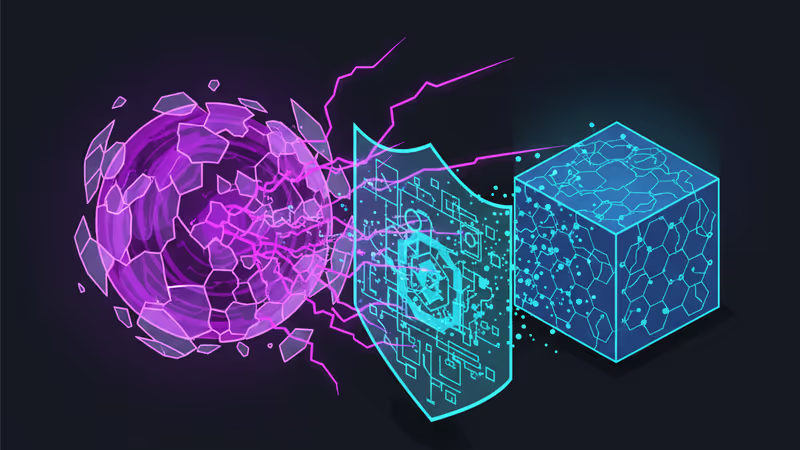
This is where Zero-Knowledge (ZK) technology shifts from a scalability feature to a critical security protocol. While commonly known for privacy and scaling solutions like ZK-rollups, the underlying mathematics can be built on quantum-resistant foundations. Specifically, cryptographic systems like zk-STARKs rely on hash-based cryptography, which is believed to be resistant to attacks from both classical and quantum computers.
The strategic genius of this approach lies in its flexibility. Blockchains don't need to execute a sudden, dangerous hard fork. Instead, they can gradually introduce support for transactions protected by quantum-safe ZK proofs. This allows for a multi-year transition where old (ECDSA) and new (ZK-STARK) systems coexist, giving the ecosystem time to migrate assets and update infrastructure without a catastrophic network event.
PRISM Insight: The Strategic & Market Implications
Investment Thesis: The Rise of Quantum-Resistant Infrastructure
The quantum threat will bifurcate the market. In the coming years, a project's valuation will increasingly depend on its "quantum readiness." We anticipate a significant premium for Layer 1 and Layer 2 protocols that have a clear, implemented strategy for quantum resistance. This creates a new investment vertical focused on companies providing ZK-based security solutions, specialized auditing services, and migration tools. Savvy investors should begin asking a new question during due diligence: "What is your quantum migration plan?" The answers will be telling.
Technology Outlook: Quantum's Double-Edged Sword
While quantum computing is a threat, it also offers a profound opportunity for Web3. One of the unsolved problems in blockchain design is generating true, unpredictable randomness for processes like validator selection or decentralized lotteries. Classical computers can only simulate randomness. Quantum systems, however, can harness the inherently unpredictable nature of quantum physics to create certified, unforgeable randomness. A public, quantum-powered randomness beacon could become a fundamental piece of next-generation blockchain infrastructure, eliminating entire categories of economic attacks and vulnerabilities.
PRISM's Take
The narrative that the quantum threat is a distant concern is dangerously complacent. The silent harvesting of blockchain data has already begun, placing a definitive expiration date on the current security models of Bitcoin and Ethereum. Zero-Knowledge technology represents the most viable and strategically sound defense, offering a gradual upgrade path rather than a catastrophic protocol overhaul. The race between quantum supremacy and cryptographic defense is on, and for the digital asset industry, it is a race for survival. Projects that fail to treat this as an urgent, strategic priority are not just ignoring a future risk; they are actively devaluing themselves in the present.
関連記事
韓国が150兆ウォン規模の公的成長ファンドを設立。AI、半導体、バッテリーに重点投資する国家戦略を分析し、投資家や業界への影響を読み解きます。
新型の円盤型衛星「DiskSat」が打ち上げ。20年にわたり標準だったCubeSatを超える存在となるか?宇宙産業の新たなパラダイムシフトを専門家が分析します。

AIデータセンターの需要爆発により、PC用メモリとSSDの価格が記録的に高騰。自作PCユーザーとゲーマーが直面する新たな現実と、専門家による対策を解説します。

YouTubeが200万登録のAI偽映画予告編チャンネルを閉鎖。AIコンテンツの許容範囲と「欺瞞」の境界線がどこにあるのか、プラットフォームの新たな姿勢を専門家が分析します。