
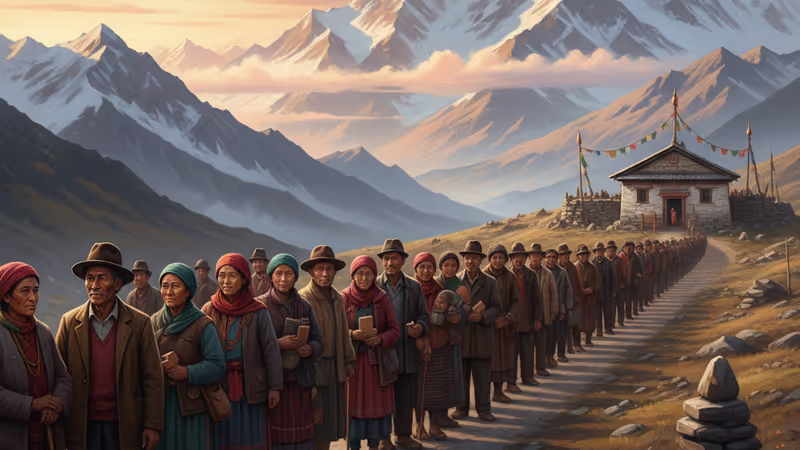
China's 'Poet Monk' Warning to India Signals New Front in Himalayan Power Play
China's fury over an Indian symposium on a poet monk reveals a high-stakes battle for control over Tibet's future and Himalayan dominance. This is a new front.
The Lede: A 17th-Century Poet Sparks a 21st-Century Geopolitical Firestorm
When a superpower issues a stark warning over a symposium about a 17th-century poet, it’s not about poetry. China's furious reaction to India hosting an event on the 6th Dalai Lama, Tsangyang Gyatso, is a critical signal for global executives and strategists. This seemingly obscure cultural dispute is a proxy battle in the escalating rivalry between the two Asian giants, with profound implications for regional stability, narrative control, and the high-stakes succession of the next Dalai Lama. It reveals that the India-China conflict is expanding beyond military standoffs into the domains of culture, religion, and history.
Why It Matters: The High-Stakes Battle for Legitimacy
This incident is far more than a diplomatic spat. It's a multi-layered strategic play with significant second-order effects:
- The Succession Battleground: The core issue is the future. The current 14th Dalai Lama is in his late 80s. China is preemptively asserting its absolute authority over the selection of his successor. By condemning India’s focus on a past Dalai Lama born in Tawang (a region China claims), Beijing is warning New Delhi not to interfere in the upcoming, and globally significant, reincarnation process.
- Weaponizing History for Territory: For Beijing, controlling the historical narrative is a tool for legitimizing territorial claims. By branding the 6th Dalai Lama as "our Tsangyang Gyatso," China attempts to absorb his legacy into the Chinese state, thereby strengthening its claim over his birthplace, Tawang, which it calls Zangnan. India's symposium is seen as a direct cultural counter-claim.
- Global Narrative Control: An international conference featuring global scholars challenges China's carefully curated and state-controlled narrative on Tibet. Beijing cannot tolerate an alternative center of gravity for Tibetan Buddhist thought and history, especially one located in a rival nation.
The Analysis: From Border Skirmishes to Cultural Warfare
The India-China rivalry has long been defined by the 3,488-kilometer Line of Actual Control (LAC), a poorly demarcated border that has seen deadly military clashes. This latest conflict demonstrates a strategic shift to a new, non-kinetic battlefield.
From Beijing's perspective, this is a provocative move by India. New Delhi is not just hosting an academic event; it's using a revered religious figure to bolster its sovereignty over Arunachal Pradesh and to position itself as a key player in the future of Tibetan Buddhism. This plays into China's deepest fears of separatism and foreign interference in what it considers a core domestic issue.
From New Delhi's perspective, this is an assertion of its sovereignty. India is exercising its right to host a cultural event on its own territory. It's part of a broader Indian strategy to develop and integrate its border regions, pushing back against China's incremental "salami-slicing" tactics. By highlighting Tawang's deep connection to a historical Dalai Lama, India reinforces its cultural and historical stewardship of the region.
This dynamic is a microcosm of the broader competition: China's top-down, authoritarian control versus India's more decentralized, democratic approach. The battle over a poet-monk's legacy is, in effect, a battle between two competing systems for influence in the Himalayas.
PRISM Insight: The Geopolitics of Information and Surveillance
This cultural clash is inextricably linked to technology. The primary battleground for China's response was not diplomatic cables, but state-affiliated social media accounts and online articles—a clear example of modern information warfare. This signals two key trends for executives:
- Escalating Digital Nationalism: Expect both nations to increasingly leverage digital platforms to push their narratives and mobilize public opinion. This creates a volatile information environment where disinformation can directly impact geopolitical tensions and market sentiment.
- Surveillance as a Tool of Sovereignty: China’s massive investment in surveillance technology across Tibet is designed precisely to prevent the emergence of alternative narratives like the one fostered by this symposium. Any challenge to state control, cultural or otherwise, will be met with intensified digital monitoring, impacting any entity operating in or near these sensitive zones. The geopolitical risk for the region has now expanded from physical borders to digital ones.
PRISM's Take: A Dress Rehearsal for the Main Event
Do not mistake this for an esoteric debate over history. This is a dress rehearsal for the globally significant event that will follow the passing of the 14th Dalai Lama. We are witnessing the opening moves in the fight over his succession, which will likely result in two competing candidates: one chosen by the Tibetan exile community and recognized by nations like India and the US, and another appointed by Beijing.
China is drawing a hard, unambiguous line: every aspect of Tibetan Buddhism, past and present, is a non-negotiable matter of Chinese sovereignty. India, by hosting this symposium, is signaling it will not be a passive bystander. The legacy of a 17th-century poet has become the front line in a 21st-century power struggle that will define Asia's future balance of power.
関連記事
世界の分断、ガザの人道危機、ウクライナ紛争、国内政治の課題を分析。地政学、人権、そしてテクノロジーが交差する現代のグローバル課題と、投資・技術トレンドをPRISMが解説します。
イスラエル軍のシリア領内進攻と1974年兵力引き離し合意の破棄は、アサド政権崩壊後のシリア情勢を不安定化させ、国際秩序に影響を与える。地政学リスクと技術・投資への波紋をPRISMが分析。

北朝鮮が国連憲章を盾に「西側の強制」に対抗を呼びかけ、グローバルサウスとの連携を強化。多極化する国際秩序における地政学的意味合いとビジネスへの影響を分析。

DRC東部紛争が米国仲介の和平を崩壊させ、国連安保理はルワンダを非難。地政学的リスクと重要鉱物サプライチェーンへの影響、今後の展望を分析。