
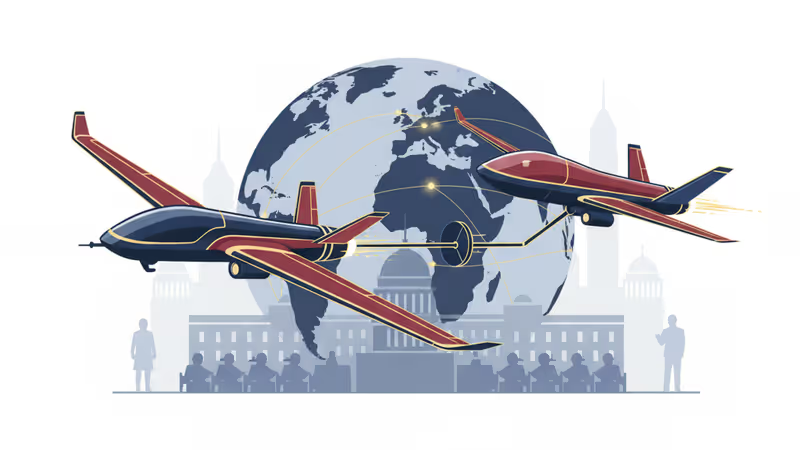
China's Autonomous Drone Refueling: Beijing Signals a New Era of Air Power
China's successful autonomous drone-to-drone refueling test is a major geopolitical signal, challenging US air dominance and redrawing the strategic map of the Indo-Pacific.
The Lede: Why This Matters to You
A recently revealed test of autonomous drone-to-drone aerial refueling in China is far more than a technical achievement. For global executives and strategists, it’s a critical signal that the architecture of military power in the Indo-Pacific is undergoing a fundamental shift. This technology directly challenges the long-held strategic advantage of distance that has defined regional security, effectively redrawing the map of operational reach and influence.
Why It Matters: The Strategic Ripple Effects
The ability for unmanned aerial vehicles (UAVs) to refuel each other in mid-air creates a cascade of second-order effects that alter the geopolitical calculus. This isn't just an incremental improvement; it's a capability multiplier.
- Extended Power Projection: Unmanned surveillance and strike drones, once limited by their fuel capacity, can now possess intercontinental range and persistence. This allows a nation to maintain a constant watch or threat presence thousands of miles from its own shores, nullifying the geographical buffer of the Pacific Ocean.
- Lowering the Risk Threshold: Aerial refueling is one of the most dangerous and complex maneuvers in aviation. By removing human pilots from both the tanker and the receiver, the risk to personnel is eliminated. This makes more aggressive and frequent refueling operations feasible, even in contested airspace.
- A New Paradigm for Naval Warfare: Carrier groups and island bases become more vulnerable. Persistent, long-range UAVs can provide continuous surveillance (ISR) on naval movements, targeting them for long-range missile systems without needing to risk manned aircraft or rely solely on satellites.
The Analysis: A New Front in the US-China Tech Race
Historical Context: The US Advantage
For over 70 years, aerial refueling has been a cornerstone of American global power. A vast fleet of tankers like the KC-135 and KC-46 allows the United States to project air power anywhere on the planet, a capability no other nation can match at scale. This logistical dominance has been a quiet but decisive factor in nearly every conflict since the Cold War.
Competitive Dynamics: The Race for Autonomy
The United States is not standing still. The US Navy's MQ-25 Stingray, developed by Boeing, is an unmanned tanker designed to refuel manned fighter jets like the F/A-18 and F-35C, extending the reach of carrier air wings. It has already successfully conducted such tests.
However, the Chinese test, as reported, involved two unmanned aircraft. This leap to a fully autonomous drone-to-drone system suggests a different strategic focus: creating self-sufficient unmanned fleets that can operate independently of manned assets. While the US is developing unmanned systems to support its existing manned force, China appears to be building a parallel, fully autonomous architecture. This isn't just about catching up; it's about pioneering a new model of air warfare.
PRISM Insight: The Tech & Investment Angle
This development highlights the convergence of several key technology sectors that are ripe for investment and innovation. The core challenge is not just flight, but robust, secure, and precise autonomous coordination.
- AI and Sensor Fusion: The ability for the receiver drone to autonomously locate, track, and dock with the tanker in “extreme conditions” points to highly advanced AI-driven sensor fusion, combining optical, radar, and other data streams for precision navigation.
- Secure Datalinks: For these systems to be combat-effective, they require jam-proof, low-latency communication networks to coordinate flight paths and maneuvers, a critical area for both defense and commercial tech development.
- Dual-Use Applications: The underlying technology for autonomous rendezvous and docking has significant commercial potential, from in-orbit satellite servicing and refueling to automated logistics and cargo transfer between aerial or marine drones.
PRISM's Take: A Statement of Strategic Intent
The decision by Chinese authorities to openly report this test is as significant as the technology itself. It is a deliberate message to the world, and specifically to Washington, that Beijing’s military ambitions are no longer confined to its near seas. This capability transforms China’s burgeoning Anti-Access/Area Denial (A2/AD) strategy from a defensive posture, designed to keep adversaries out, into a tool for offensive power projection.
The era where air superiority was measured simply by the quality and quantity of fighter jets is over. The future of air dominance will be defined by resilient, distributed, and autonomous networks. This Chinese test is a clear signal that the race to build that future is now fiercely contested.
関連記事
中国が自律UAV空中給油実験に成功した可能性。この技術が米中間の軍事バランス、特に西太平洋の地政学的地図をどう塗り替えるのかを専門家が分析。

ウクライナがクピャンスクを奪還する一方、ロシアは支配を主張。戦場の現実と情報戦が交錯する現代戦争の力学と、地政学的な影響を深く分析します。
シンガポール沖で急増する「影の船団」。西側制裁を骨抜きにし、環境・安全保障リスクを高めるこの現象の地政学的な意味合いと今後の展望を専門家が徹底分析。

ミクロネシアでの中国による滑走路再建が米国の警戒を呼んでいます。太平洋の小さな島が米中地政学の最前線となる理由と、その世界的な影響を専門的に分析します。