
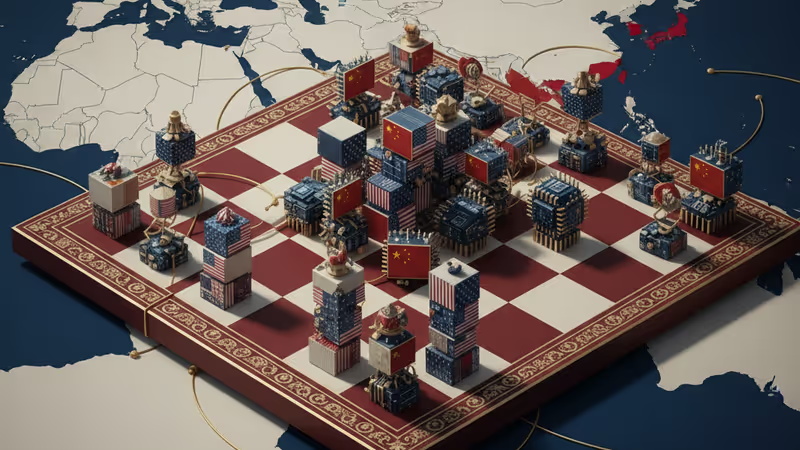
It's Not a New Cold War—It's a U.S.-China Chess Game
The latest Trump administration National Security Strategy reframes the U.S.-China relationship as an economic rivalry, not a new Cold War. Deep economic interdependence and domestic political constraints on both sides prevent a full-scale decoupling.
The `keyword:Donald Trump` administration's latest National Security Strategy document is turning heads for how it talks—and doesn't talk—about `keyword:China`. As `keyword:CNN` noted, "Gone are the sweeping declarations about `keyword:China` being `keyword:America`’s most consequential geopolitical challenge." Instead, the new strategy emphasizes the U.S.-China economic rivalry above all else. This shift fundamentally challenges the popular framing of the relationship as a second Cold War.
Fragmentation, Not Decoupling
The original Cold War was a contest between the communist `keyword:Soviet Union` and the capitalist, democratic `keyword:United States`. Their blocs were largely insulated from each other, with minimal flows of goods, finance, and technology. That's not the case today. The world's economic landscape is defined by global value chains, where production happens in multiple stages across several countries. This deep integration means a full 'decoupling' is incredibly costly.
What is observable is a degree of fragmentation. Recent research by Harvard economist Gita Gopinath shows a decline in trade between political blocs relative to flows within them. But this is far from the near-total separation of the Cold War. Unlike the U.S.-Soviet rivalry between distinct economic systems, both the `keyword:U.S.` and `keyword:Chinese` economies rely on private capital, international trade, and technology transfers, creating inter-dependencies that are hard to sever.
Mutual Dependence and Domestic Constraints
The `keyword:U.S.` acts as a provider of services, tech, and investment, while `keyword:China` remains the world's factory. This interdependence creates constraints. For `keyword:China`, facing an aging population and weakening domestic demand, export-led growth is critical for domestic political stability. Its merchandise exports to the `keyword:U.S.` stood at around `stat:$525 billion` in `stat:2024`, representing about `stat:15%` of its total.
The `keyword:U.S.`, in turn, benefits from cheaper imports that help keep consumer prices in check. With inflation a central political concern, especially heading into the `stat:2026` midterm elections, the scope for aggressive trade confrontation is limited. An estimate from the Federal Reserve Bank of St. Louis suggests that tariff hikes during the three-month period of `stat:June-August 2025` added around `stat:0.5 percentage points` to headline inflation.
The Other Players on the Board
`keyword:Russia`, while no longer a global pole like the Soviet Union, remains a military heavyweight. Its economy's reliance on energy exports means it operates largely outside the economic logic that constrains both Washington and Beijing. Meanwhile, `keyword:India`'s young, large population positions it as a major future market. Its ability to translate this demographic potential into production strength will depend on its integration with Asian value chains.
Today's U.S.-China competition is better understood as a pragmatic and transactional game of chess. Unlike the ideologically-driven conflict of the 20th century, this rivalry is shaped by domestic economic needs, leaving it more open to negotiation and adjustment. While strategic tensions will persist, the structural conditions for a full-fledged Cold War are simply absent.
本コンテンツはAIが原文記事を基に要約・分析したものです。正確性に努めていますが、誤りがある可能性があります。原文の確認をお勧めします。
関連記事
2025年、米ドル中心の経済システムが転換期を迎え、AI時代を支えるエネルギーと水資源が新たな覇権の鍵に。IMFの報告書が示す米中ブロック化と、資源安全保障の重要性を解説します。

メキシコ海軍の小型機が米国テキサス州沖で墜落し、搭乗していた8人のうち少なくとも5人が死亡した。同機は重度の火傷を負った子供を搬送する医療ミッションの最中だった。米国当局が事故原因の調査を開始している。

韓国国会は23日、与党「共に民主党」主導で、尹錫悦前大統領の戒厳令問題に関連する内乱事件を専門に扱う特別法廷の設置法案を可決した。野党は「司法の掌握」と強く反発している。

シリア北部アレッポで、政府軍とクルド人勢力SDFが停戦に合意。トルコ外相の訪問中に発生した衝突では市民2人が死亡しており、地域の緊張関係を浮き彫りにしています。