
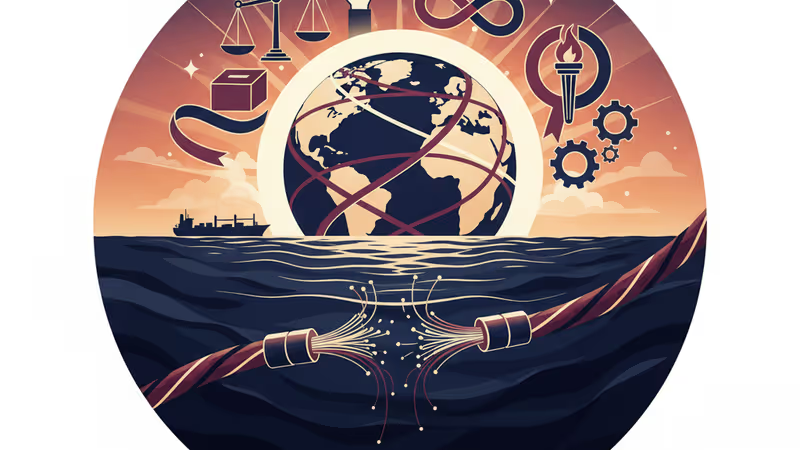
China Blames Taiwanese Smugglers for Severed Subsea Cable, Escalating Feud with Taiwan
China accuses Taiwanese nationals of smuggling in a subsea cable-cutting incident, escalating a blame game with Taiwan, which suspects Beijing of 'grey zone' warfare.
A severed cable, a jailed captain, and now a smuggling plot. China and Taiwan are locked in a new war of words over who cut the island's digital lifeline. Beijing has now accused two Taiwanese nationals of leading a smuggling operation that damaged a critical subsea communications cable in February, directly countering Taipei's claims that the incident was a deliberate act of sabotage.
Beijing's Counter-Narrative: Smuggling, Not Sabotage
The public security bureau in Weihai, a city in China’s Shandong province, announced on Wednesday that its investigation showed the vessel involved—the Togo-registered Hong Tai 58—was operated by two Taiwanese men smuggling frozen goods. According to Chinese state media, China's Taiwan Affairs Office accused Taiwan’s governing Democratic Progressive Party (DPP) of falsely framing the incident to “stir cross-Strait confrontation.” Authorities have offered a reward of up to 250,000 yuan ($35,569) for information on the suspects, identified by the surnames Chien and Chen, who have reportedly been on a wanted list since 2014.
Taiwan Fires Back: 'Political Manipulation'
Taipei swiftly rejected the accusations. Taiwan’s Mainland Affairs Council stated that the Chinese Communist Party has no jurisdiction over Taiwan and urged Beijing to provide concrete evidence. “In the absence of concrete evidence, publicly announcing names and offering rewards is not a civilized practice,” the council said, calling it “another instance of cross-border repression and political manipulation.” Previously, Taiwan had labeled the cable-cutting a “grey zone” tactic—a coercive act with plausible deniability. In June, a Taiwanese court had already sentenced the Chinese captain of the Hong Tai 58 to three years in jail for intentionally damaging the cables.
A Fragile Global Lifeline
Subsea cables form the backbone of the global internet, carrying nearly all of the world's data traffic. They're also remarkably vulnerable. According to industry data, between 100 and 200 cable breakdowns occur annually, and proving malicious intent is notoriously difficult. Since 2023, there have been at least 11 cases of subsea cable damage around Taiwan alone. The issue isn't isolated to Asia; countries in Europe's Baltic Sea have also seen a spike in similar incidents involving Russia- and China-linked ships since the invasion of Ukraine.
本コンテンツはAIが原文記事を基に要約・分析したものです。正確性に努めていますが、誤りがある可能性があります。原文の確認をお勧めします。
関連記事
長年、独裁体制が続くと見られてきたカンボジアで、エリート層の内部対立という構造的脆弱性が露呈している。国際社会の対中政策を軸としたアプローチはなぜ失敗したのか、そして今後の展望を分析する。
ナイジェリア北東部ボルノ州の州都マイドゥグリのモスクで爆発が発生。夕方の礼拝中を狙った攻撃で、少なくとも7人が死亡したと報じられている。過激派組織ボコ・ハラムの活動地域で緊張が高まっています。
米司法省は、ジェフリー・エプスタイン事件に関連する可能性のある100万件以上の追加文書を発見したと発表しました。透明化法に基づき、被害者保護のための編集作業を経て数週間以内に公開される見込みです。
2025年、パキスタンはインドとの軍事衝突を機に国際舞台へ復帰。米国との関係改善や中東での影響力を拡大したが、国内では経済的苦境と政治的対立が続いている。その光と影を分析する。
長年、独裁体制が続くと見られてきたカンボジアで、エリート層の内部対立という構造的脆弱性が露呈している。国際社会の対中政策を軸としたアプローチはなぜ失敗したのか、そして今後の展望を分析する。
ナイジェリア北東部ボルノ州の州都マイドゥグリのモスクで爆発が発生。夕方の礼拝中を狙った攻撃で、少なくとも7人が死亡したと報じられている。過激派組織ボコ・ハラムの活動地域で緊張が高まっています。
米司法省は、ジェフリー・エプスタイン事件に関連する可能性のある100万件以上の追加文書を発見したと発表しました。透明化法に基づき、被害者保護のための編集作業を経て数週間以内に公開される見込みです。
2025年、パキスタンはインドとの軍事衝突を機に国際舞台へ復帰。米国との関係改善や中東での影響力を拡大したが、国内では経済的苦境と政治的対立が続いている。その光と影を分析する。