
Beyond Webb: Why NASA's Roman Telescope Is a 'Cosmic Data Factory' Set to Remap the Universe
NASA's newly assembled Roman Space Telescope isn't another Webb. Discover why its panoramic view will create a data deluge, revolutionizing cosmology and exoplanet hunting.
The Big Picture
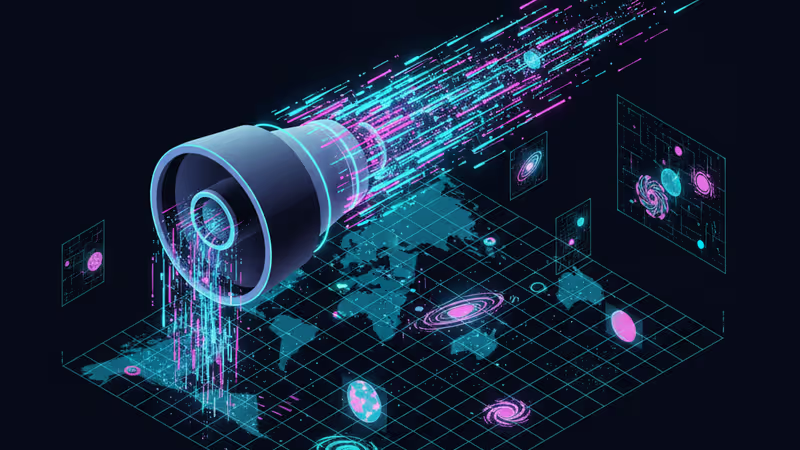
While the world remains captivated by the stunning, deep-field images from the James Webb Space Telescope (JWST), NASA has quietly completed assembly of its next great observatory. But the Nancy Grace Roman Space Telescope, on track for a 2026 launch, isn't just another Webb. It's a fundamentally different beast. Where Webb acts like a powerful microscope on tiny, ancient patches of sky, Roman will be a panoramic camera, capturing cosmic vistas 100 times larger. This milestone isn't just an engineering success; it signals a strategic shift in astrophysics—from bespoke observation to industrial-scale cosmic mapping.
Why It Matters: The Shift to Big Data Cosmology
For decades, space telescopes have focused on depth, peering at small areas to see the oldest light possible. Roman inverts this paradigm, prioritizing breadth. This has profound implications:
- Solving Cosmic Mysteries Statistically: The greatest puzzles in cosmology, like the nature of dark energy and dark matter, are unlikely to be solved by a single image. They require vast statistical samples. By imaging billions of galaxies, Roman will provide the raw data to measure the expansion of the universe and the distribution of dark matter with unprecedented precision.
- Exoplanet Census on an Epic Scale: Instead of studying individual star systems in detail, Roman will monitor hundreds of millions of stars, using a technique called microlensing to detect thousands of new exoplanets. This will create the first large-scale census of planetary systems, providing a statistical understanding of how common worlds like Earth truly are.
- A Data Deluge: Roman will generate more data than all previous NASA astrophysics missions combined. This presents a monumental challenge and opportunity for the tech sector, demanding new advances in cloud storage, AI-driven analysis, and automated pattern recognition to sift through the petabytes of information.
The Analysis: A Spy in the Sky, Reborn
Hubble's Successor, Webb's Complement
It's a mistake to see Roman as a competitor to JWST. They are complementary tools designed for different jobs. JWST is the specialist, using its infrared sensitivity to study the first galaxies and peer through cosmic dust. Roman is the generalist, the surveyor. Its primary mission is to create the largest, highest-resolution maps of the universe ever seen. In many ways, it's the true successor to Hubble's role as a wide-field imager, but on a vastly more powerful scale.
From Espionage to Exploration
A crucial piece of context often missed is Roman's origin story. The telescope's 2.4-meter primary mirror—the same size as Hubble's—was gifted to NASA by the National Reconnaissance Office (NRO), the agency that operates America's spy satellites. These NRO assets are designed to look down on Earth with an extremely wide, high-resolution field of view. By turning that technology to look up at the cosmos, NASA acquired a revolutionary capability for a fraction of the development cost. This heritage is the key to Roman's panoramic power.
PRISM Insight: The Platformization of Space Science
The completion of the Roman Space Telescope represents more than a hardware milestone; it marks the maturation of astronomy as a data-first science. For decades, telescope time was a scarce resource granted to a select few. Roman changes that dynamic. It is less a single instrument and more a data platform for the entire global scientific community.
The primary breakthroughs from Roman may not come from an astronomer looking at a single image, but from a data scientist running an algorithm across a petabyte-scale dataset. The true value will be unlocked by the software ecosystem built around its data streams. This mirrors the platform shifts we've seen in other industries—from individual software products to cloud-based platforms like AWS or Azure that enable countless other innovations. Roman is, in essence, 'Cosmology-as-a-Service', providing the foundational data layer for the next generation of cosmic discovery.
PRISM's Take
The assembly of the Roman Space Telescope is the quiet beginning of a new epoch in our understanding of the universe. We are moving from the era of artisanal astronomy, defined by exquisite but narrow views, to an age of industrial-scale cosmology. The central challenge is no longer just building bigger mirrors, but developing the computational power and AI sophistication to make sense of the coming data tsunami. Roman isn't just a new eye on the cosmos; it's a data factory that will turn the universe's greatest mysteries into solvable big data problems.
関連記事

民間宇宙飛行士ジャレッド・アイザックマン氏のNASA長官就任は単なる人事ではない。SpaceX主導の民間企業が宇宙開発の主導権を完全に掌握したことを示す地殻変動を分析。
民間宇宙飛行家J.アイザックマン氏がNASA新長官に。宇宙開発の商業化が加速する中、新時代のNASAが目指すものとその影響を専門家が徹底分析。

NASAのナンシー・グレース・ローマン宇宙望遠鏡が完成。JWSTの100倍の視野で暗黒エネルギーや系外惑星を探査。宇宙ビッグデータ時代の幕開けを専門家が分析。
NASAの次世代宇宙望遠鏡「ローマン」が完成。ハッブルの100倍の視野で、ダークマターや系外惑星の謎に挑む。宇宙探査とビッグデータの未来を解説します。