
Beyond the Rocket: Why Space Tugs Are the Next Trillion-Dollar Frontier in Logistics
Impulse Space's successful Mira mission signals a revolution in orbital logistics. Our analysis explores why 'space tugs' are the critical last-mile layer.
The Lede: The Last-Mile Problem, in Orbit
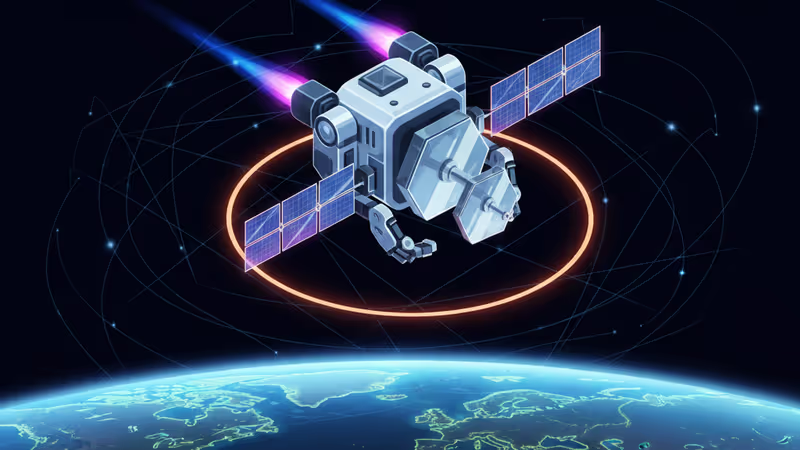
While the world watches mega-rockets launch, the real revolution is happening after the main engines cut off. Impulse Space's recent successful mission with its Mira orbital transfer vehicle (OTV) is more than a technical demonstration; it's a critical signal that the 'last-mile delivery' problem in space is being solved. For executives and investors, this isn't just about moving satellites. It’s about building the fundamental logistics layer—the orbital equivalent of FedEx or Maersk—that will underpin the entire low-Earth orbit (LEO) economy.
Why It Matters: Unlocking Orbital Real Estate
For years, small satellite operators had to hitchhike. A launch on a Falcon 9 rocket would get them to the right orbital altitude, but not necessarily the right 'address.' They were dropped off on a pre-set highway with no off-ramps. This severely limited the utility and business models for countless ventures. OTVs, or 'space tugs,' change the entire equation.
- Democratization of Orbits: Satellite constellations can now be deployed to precise, custom orbits, maximizing their operational efficiency and value. This is crucial for Earth observation, communications, and IoT services.
- Enabling New Markets: This technology is the foundational step for future in-space services like satellite refueling, life extension, repair, and active debris removal. It transforms satellites from disposable assets into serviceable platforms.
- Increased Launch ROI: Every rideshare mission becomes exponentially more valuable. A single rocket can now service dozens of unique orbital destinations, creating a far more efficient and robust launch market.
The Analysis: The Race for In-Space Mobility
The concept of an orbital transfer stage is not new, but its commercialization for the smallsat era is a game-changer. What was once the domain of nation-state programs is now a fiercely competitive commercial sector, driven by the plummeting cost of launch access from providers like SpaceX. Impulse Space, founded by SpaceX co-founder Tom Mueller, enters this arena with a formidable pedigree.
The key differentiator in Impulse's Mira vehicle is its use of high-thrust chemical propulsion. This is a strategic choice. While competitors are focused on high-efficiency, low-thrust electric propulsion (which can take months to change orbits), Impulse is betting on speed. Rapid maneuvering is a capability that will be mission-critical for time-sensitive deployments, national security applications, and rapid response scenarios.
The competitive landscape is heating up:
- Rocket Lab: With its Photon satellite bus, the company offers a vertically integrated solution, launching on its own rocket and then using Photon for final placement.
- Momentus: A public company utilizing water-plasma propulsion, though it has faced technical and regulatory hurdles.
- D-Orbit: A European leader with its ION Satellite Carrier, which has a strong flight heritage in deploying CubeSats.
Impulse's SpaceX DNA and focus on rapid, high-thrust performance positions it as a leader in the 'express delivery' segment of this emerging market.
PRISM Insight: The 'Picks and Shovels' of the LEO Economy
For investors, the rise of space tugs represents a classic 'picks and shovels' play. Instead of betting on a single satellite constellation, you are investing in the essential infrastructure that all constellations will need to succeed. The Total Addressable Market (TAM) isn't just the cost of the tugs themselves; it's a percentage of the unlocked value of the tens of thousands of satellites they will deploy and service in the coming decade. We are witnessing the shift from an economy based on *getting to space* to one based on *operating in space*.
PRISM's Take: From Dumb Upper Stage to Orbital Shepherd
The era of treating a rocket's upper stage as a simple, disposable 'bus' is over. Impulse Space's mission validates the market's trajectory towards intelligent, maneuverable platforms that act as orbital shepherds, precisely placing assets where they generate the most value. While launch providers build the highways to orbit, companies like Impulse are building the all-important network of local roads and delivery vans. This is not just an incremental improvement; it is the missing infrastructure layer required to build a true, functioning, and highly profitable space economy.
関連記事
Impulse Spaceの軌道上輸送機(OTV)が宇宙のラストワンマイル配送に革命を。衛星ビジネスと宇宙経済の未来をどう変えるのか、専門家が徹底分析します。
AWSがロシア国家による5年間のサイバー攻撃を公表。攻撃はクラウド本体ではなく、顧客側の設定ミスを標的としていた。地政学的リスクとクラウドセキュリティの新たな課題を解説。

最新LLMによる古典的ゲーム再現テストから、AIコーディングの現在地と未来を分析。開発者の役割はどう変わるのか?PRISMが深掘りします。

アップルの折りたたみiPhoneは2026年登場も供給不足が濃厚。これは単なる遅延ではなく、新たな超高級市場を創出する戦略だ。価格と供給の裏を分析。