
Beyond AI: How This 'Two-Phone Trick' Redefines Viral Content Creation
In an era of AI-generated images, one artist's viral 'two-phone trick' reveals a powerful counter-trend in creative photography and content creation.
The Lede: The Analog Rebellion in a Digital World
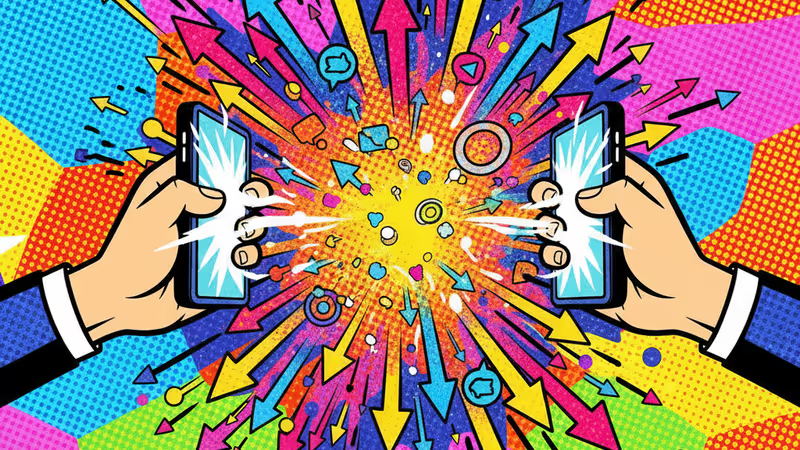
In an era where generative AI can conjure entire worlds from a text prompt, you might assume the future of visual content belongs to the algorithm. You would be wrong. An artist named Yahav Draizin is achieving viral reach not with complex prompts and processing power, but with a deceptively simple setup: two smartphones and zero post-production. While executives chase the synthetic media revolution, this phenomenon signals a powerful counter-current: the rising value of constrained, high-concept human creativity. This isn't just about fun pictures; it's a critical lesson in capturing attention in a saturated market.
Why It Matters: The Authenticity Premium
Draizin's work is a masterclass in what we call 'Engineered Serendipity.' By physically juxtaposing a digital image on one phone with a real-world scene, he creates a moment that feels both magical and achievable. This matters for several reasons:
- Rebellion Against Perfection: For years, social media aesthetics were dominated by hyper-polished, flawless imagery. This 'in-camera' approach is raw, clever, and transparent. It taps into a growing consumer demand for authenticity over artificiality, a trend seen in the rise of platforms like BeReal and the unvarnished style of TikTok.
- The New UGC Blueprint: Brands spend millions trying to generate authentic user-generated content (UGC). This technique provides a new, accessible format for creativity. It lowers the barrier to entry—no expensive software or skills needed—while raising the bar for ingenuity. This is the future of interactive brand campaigns.
- IP Generation at Zero Cost: Draizin is creating valuable, shareable intellectual property using only the devices we all carry. It’s a powerful demonstration of creative arbitrage—using low-cost tools to produce high-impact results.
The Analysis: From Darkroom Tricks to 'Digital-Analog' Hybrids
Forced perspective and composite imaging are not new. Photographers in the 19th century used darkroom alchemy to achieve similar effects. The 20th century gave us Photoshop, which made digital manipulation mainstream but also created a culture of suspicion—we learned to question if what we saw was 'real.'
Draizin's method represents a new phase. It's a 'digital-analog' hybrid that reclaims the magic of in-camera effects. The cleverness isn't hidden in layers of software; it's performed live, in the physical world. He's not just showing you a final image; he's showing you the 'how' as part of the art itself. This transparency builds immediate trust and delight with the audience. It’s a direct response to the 'black box' nature of AI image generators, where the process is obscured. This human-in-the-loop approach is more relatable and, therefore, more shareable.
PRISM Insight: The Enduring Power of Platforms Over Features
The current tech narrative is obsessed with generative AI models as the 'next big thing.' However, Draizin’s success is a potent reminder that the most enduring value lies not in a single feature (like image generation) but in the ubiquitous platforms that enable its distribution (the smartphone and the social network). His work is a form of 'human-powered augmented reality,' performed without a headset or special app.
For investors and strategists, the lesson is clear: don't just chase the algorithm. Invest in the creators and platforms that foster novel uses of existing technology. The ultimate creative tool isn't the AI model; it's the human mind's ability to see and connect disparate ideas. The biggest opportunities will be in empowering this human ingenuity at scale, not just trying to replace it.
PRISM's Take: Authenticity is the Killer App
The future of content is not a simple binary of human versus machine. It's a spectrum of collaboration. While AI will undoubtedly automate and augment content production on a massive scale, the highest value will be assigned to ideas that are undeniably, cleverly, and emotionally human. Yahav Draizin’s work is a leading indicator of this trend. He proves that in a world drowning in synthetic content, the most powerful differentiator is an authentic idea, brilliantly executed with the tools at hand. The most advanced technology for generating viral content remains the human brain.
関連記事

独裁者たちの意外なほど質素な食事。その裏には、シェフを支配する異常なルールと権力者の妄想があった。歴史から現代のリーダーシップ論を読み解く。
エプスタイン邸から発見されたトランプ氏のコンドーム。単なるゴシップで終わらない、現代の政治とメディア、そしてミーム化現象を読み解く深層分析。
映画『The Sheep Detectives』のニュースを深掘り。奇抜な設定の裏にある、コンテンツ飽和時代を生き抜くためのグローバルなIP戦略と映像業界のトレンドを解説します。
フランスの2800万人規模の研究で、コロナワクチンが全死亡率を25%低下させる可能性が判明。その理由と、予防医療やmRNA技術の未来への影響を分析します。