
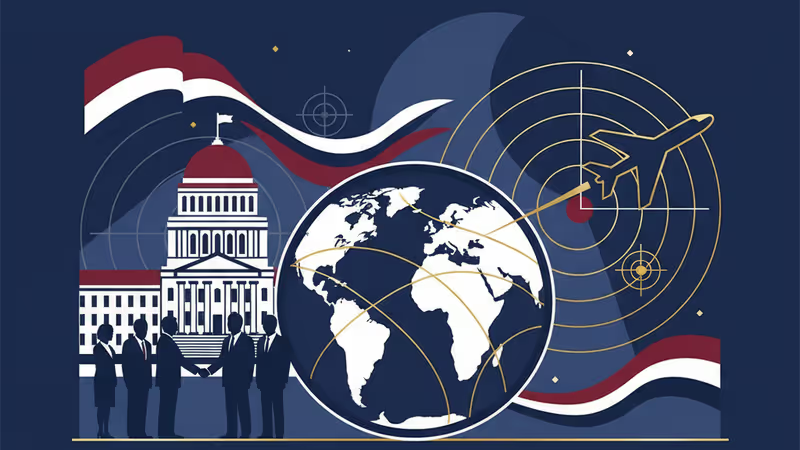
America's 'Vengeance' Strike in Syria: A Geopolitical Reset or Tactical Mirage?
Analysis of the U.S. 'vengeance' strike in Syria. Beyond a summary, we dissect the geopolitical implications, the shift in U.S. foreign policy, and what it means.
The Lede: Beyond the Bombs
A massive U.S. airstrike in Syria is more than a line item in a defense budget; it's a clear signal of a shift in American foreign policy doctrine. For global executives, Operation Hawkeye Strike is not just a regional flare-up. It's a real-time demonstration of the Trump administration's 'retribution' playbook: swift, overwhelming, and publicly declared as vengeance. This approach fundamentally alters global risk calculations, impacting everything from regional supply chain stability to the predictability of U.S. actions on the world stage. Understanding this shift is critical to navigating the new, more volatile rules of geopolitical engagement.
Why It Matters: The Second-Order Effects
While the immediate goal was to eliminate Islamic State (IS) targets, the strategic ripples will be felt far beyond the Syrian desert. This is not simply a counter-terrorism mop-up; it's an event with significant second-order consequences:
- Recalibrating Regional Power: A decisive U.S. action of this scale sends a powerful message to other actors in the Syrian theater, namely Russia and Iran. It reasserts American military dominance and its willingness to use it unilaterally, forcing a reassessment of strategic boundaries.
- Energy Market Volatility: While Syria is not a major oil producer, escalating military action in the heart of the Middle East introduces a premium for instability. The operation's proximity to Iraq, a key OPEC member, means any miscalculation could have immediate effects on global energy prices.
- The Future of Alliances: Jordan's participation solidifies its role as a key U.S. security partner. More profoundly, President Trump's claim of Syrian government support—if true—signals a bizarre and pragmatic deconfliction that could scramble existing alliances and enmities.
The Analysis: A Doctrine of Retribution
This strike represents a tactical and philosophical departure from the long-term, coalition-based 'degrade and destroy' campaigns of the past. The rhetoric from Defense Secretary Pete Hegseth, framing the operation as a "declaration of vengeance," marks a transition from counter-insurgency strategy to a doctrine of pure retribution.
A Message to Moscow and Tehran
The United States, Russia, and Iran operate in dangerously close proximity within Syria. A 'massive strike' is a projection of force intended not only to cripple IS remnants but also to remind great-power competitors of U.S. lethal capabilities. The claim of Syrian government support is the most complex variable. It could be a simple deconfliction notice spun for political gain, or it could signal a tacit, temporary alignment of interests against a common nuisance—a stunning development given Damascus's backing by Moscow and Tehran.
The Evolving Threat of IS
The Palmyra ambush that triggered this response underscores a critical reality: IS has successfully transitioned from a territorial 'caliphate' to a classic insurgency. It no longer needs to hold cities to pose a threat. The question, therefore, is whether large-scale conventional strikes are the appropriate tool. Such operations can eliminate command centers and weapons depots, but they often fail to dismantle the decentralized, ideologically-driven networks that characterize modern insurgencies, sometimes even fueling recruitment.
Conflicting Narratives
The discrepancy between the official U.S. account (IS gunman) and the Syrian Observatory for Human Rights' claim (Syrian security forces member) cannot be dismissed. If the latter is true, it paints a far darker picture of a proxy attack or a catastrophic failure of security protocols within the Assad regime's forces, adding another layer of complexity and mistrust to an already chaotic environment.
PRISM Insight: The Tech of Retribution
Beneath the geopolitical surface, this operation is a showcase for the modern military-tech stack. The ability to 'hunt, find, and kill' with the speed suggested by Secretary Hegseth relies on a fully integrated suite of technologies. This includes real-time satellite and drone surveillance (ISR), signals intelligence for locating targets, and precision-guided munitions to execute the strike. For investors, this serves as a powerful validation for the defense tech sector, particularly in unmanned systems, advanced sensors, and data-processing capabilities that shorten the 'sensor-to-shooter' timeline.
PRISM's Take: Performance of Power
Operation Hawkeye Strike should be seen as a performance of power, deliberately crafted for multiple audiences. For IS, it’s a demonstration of lethal reach. For American allies, it's a reassurance of U.S. resolve. For rivals like Russia and Iran, it's a stark warning. And for the domestic U.S. audience, it's the fulfillment of a promise of decisive action. The ultimate metric of success, however, will not be the number of targets destroyed. It will be whether this act of retribution successfully deters future attacks or merely serves as a costly, cathartic reaction that perpetuates a cycle of violence. The assertion of Syrian government support, a previously unthinkable alignment, is the true indicator of a shifting geopolitical landscape where yesterday's enemies become today's temporary, silent partners against a common threat.
関連記事

中国の奇襲リスク増大を受け、台湾軍が分散型指揮訓練を強化。この次世代防衛戦略が持つ地政学的な意味と、インド太平洋の安全保障への影響を専門家が分析します。

トランプ米大統領がシリアでのISILへの報復攻撃を発表。アサド政権崩壊後のシリア新政権との異例の協調は、中東の地政学をどう変えるのか。その深層を分析します。

トランプ政権が銃撃事件を受け多様性ビザ抽選を停止。この決定が米国の移民政策、国際関係、そしてグローバルな人材獲得競争に与える深層的な影響を分析します。
2025年末、ウクライナ戦争は膠着。プーチン大統領の発言とEUの巨額支援から、停戦交渉の裏にある地政学的ジレンマと今後の欧州安全保障を分析します。