
America's Healthcare Redline: New Data Reveals a Deep Economic Divide
New data reveals healthcare affordability is a hyperlocal crisis. It's not the cost, but the wage gap, creating a deep economic divide across US cities.
The Lede: Your Employee's Zip Code is Their Financial Destiny
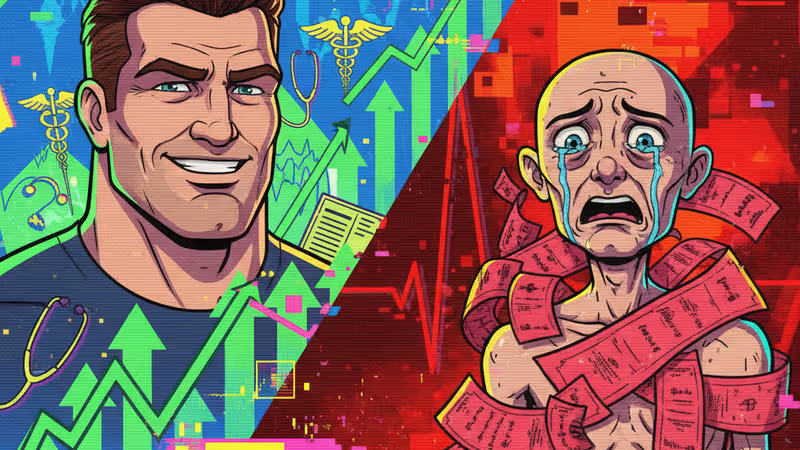
Forget national averages. New city-level data reveals a startling truth: healthcare affordability isn't a national issue, it's a hyperlocal crisis. A routine doctor's visit that's a minor expense for your engineer in San Jose is a potential financial catastrophe for your team member in Detroit, consuming nearly four times the share of their income. This isn't just a cost-of-living variance; it's a map of economic distress that directly impacts workforce stability, productivity, and your benefits strategy. The key takeaway isn't that healthcare is expensive, but that for millions, wages have completely decoupled from the cost of staying alive.
Why It Matters: The Second-Order Effects
This data highlights a dangerous economic schism with significant second-order effects for business and society:
- Talent & Retention: Cities where basic healthcare consumes over 10% of monthly income become talent deserts. Companies in these areas face a constant uphill battle attracting and retaining skilled workers, who will inevitably migrate to locations where their compensation provides greater financial security.
- Productivity Drain: Financial stress is a leading cause of distraction and absenteeism. When a significant portion of your workforce is worried about affording a prescription or a dentist visit, their focus and overall productivity plummet. This hidden cost directly impacts your bottom line.
- The Vicious Cycle: High healthcare burdens lead to delayed care, which results in more severe (and expensive) health problems later. For a city, this creates a less healthy, less productive population, further depressing economic potential and creating a vicious cycle of decline.
The Analysis: A Tale of Two Economies
The WalletHub ranking isn't a list of the most expensive cities for medicine; it's a stark illustration of America's post-industrial economic divergence. The cities where healthcare is most burdensome—Detroit, Cleveland, Newark—are legacy industrial hubs still grappling with the loss of high-wage manufacturing jobs. Their economic base eroded, but the fundamental costs of services did not, leaving residents caught in an affordability trap.
Conversely, the cities at the bottom of the list—Gilbert, Fremont, Irvine—are largely affluent suburbs of thriving tech and commercial centers. They are populated by knowledge workers whose wage growth has, to a degree, kept pace with rising costs. The report effectively maps the winners and losers of the last 40 years of economic transformation. It proves that the most painful variable in the healthcare equation isn't the price of an MRI, but the size of the paycheck used to pay for it.
PRISM Insight: The Hyperlocal HealthTech Opportunity
This geographic disparity is the next major battleground for disruptive innovation. The 'move fast and break things' ethos of Silicon Valley often produces solutions for the affluent. However, this data provides a precise roadmap for a new wave of HealthTech and FinTech companies focused on the underserved.
The opportunity lies in creating models that are geographically and economically aware. Imagine telehealth platforms with dynamic pricing based on a user's zip code and local median income. Consider the potential for Direct Primary Care (DPC) models that can scale in post-industrial cities by offering affordable, flat-fee services that bypass broken insurance systems. For investors, the alpha isn't in another wellness app for the Bay Area; it's in scalable solutions that solve the brutal affordability equation for the 100 million Americans living in these high-burden zones.
PRISM's Take: The National Solution is Local
We must stop talking about 'the' American healthcare problem and start addressing the multitude of hyperlocal healthcare crises. A one-size-fits-all federal policy is doomed to fail because it ignores the root cause exposed by this data: wage stagnation. The most potent solutions won't come from Washington D.C., but from technology and business models that attack the specific cost-to-income ratio devastating cities like Detroit and Cleveland. The future of American well-being depends on innovators who understand that you can't solve a wage problem with a healthcare solution alone; you need to build a bridge between the two.
関連記事

エリザベス・オルセンとクリスティン・ミリオティ主演の新作『Seven Sisters』が始動。ストリーミング戦争の最前線でHulu/FXが放つ一手とその意味を徹底分析。

『エミリー、パリへ行く』シーズン6の可能性を徹底分析。Netflixの長期IP戦略、データが導く「ポスト・パリ」時代の展望、そしてエンタメ業界への影響を解説します。

アマゾンの新セール「スーパーサタデー」を徹底分析。単なる割引ではなく、年末商戦を支配するデータと物流を駆使したリテール新戦略の正体とは。

PEOPLE誌が選ぶ2025年ベスト映画リストを深掘り。ハリウッドが「脱フランチャイズ」へと舵を切り、スターと監督主導のオリジナル作品が主流になる新潮流を分析します。