
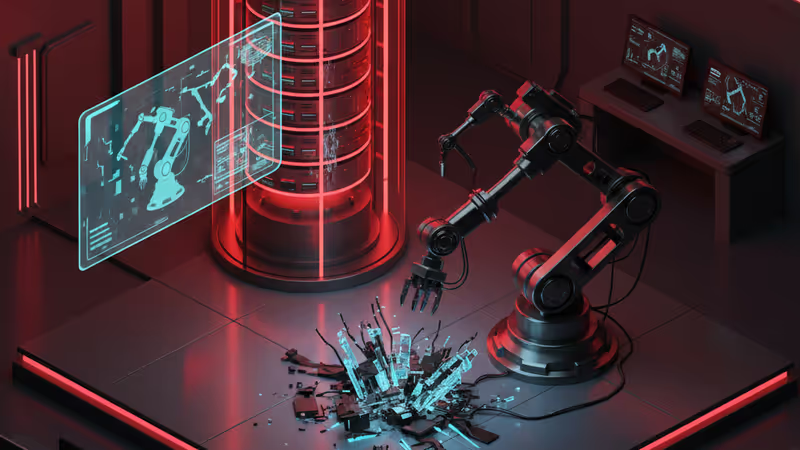
AI's Brutal Reality Check: OpenAI's 'Code Red' Signals a New Era of Physical-World Friction
OpenAI's 'code red' isn't just about competing with Google. It signals a new era where AI's biggest challenges are physical: data centers, power, and geopolitics.
The C-Suite Briefing
OpenAI’s recent “code red” to outpace Google isn’t just another chapter in the AI arms race. It’s a critical signal that the AI revolution is exiting its blue-sky R&D phase and colliding with the brutal realities of the physical world. For leaders and investors, this marks a pivotal shift: the primary battleground for AI dominance is moving from pure algorithms to the gritty, unforgiving domains of energy grids, local politics, and geopolitical warfare.
Why It Matters: The Stack is Physical
The abstract race for artificial general intelligence (AGI) is now constrained by three physical-world choke points, creating a new and volatile risk landscape:
- Infrastructure as a Weapon: The insatiable demand for compute power requires a massive build-out of data centers. These have become the new front lines, where local community opposition—whether organic or amplified by foreign disinformation campaigns—can cripple a tech giant’s roadmap. A stalled data center in Virginia or Arizona is a direct strategic victory for geopolitical rivals.
- The Margin Squeeze: The frantic pace set by competitors like Google, which has an integrated ecosystem and vast resources, forces pure-play AI labs like OpenAI into a state of permanent operational crisis. This pressure cooker environment inevitably leads to strategic pivots and painful restructuring—like the historic layoffs at Google that followed its own “code red” in 2023.
- The Talent-to-Productivity Gap: Hiring the world's best AI talent is no longer enough. The challenge is translating that talent into products that can be shipped, scaled, and monetized at a global level, a far more complex operational task than simply topping a research benchmark.
The Analysis: From Digital Sprint to Geopolitical Marathon
The parallels between Google's 2022 panic over ChatGPT and OpenAI's 2024 scramble are telling. Both moments represent an existential shock that forces a foundational shift from a research-first culture to a wartime, product-obsessed footing. For Google, it was about defending its search monopoly. For OpenAI, it's about surviving as an independent entity against integrated behemoths.
However, the external environment has fundamentally changed. Three years ago, the main constraint was algorithmic progress. Today, it’s about securing a physical supply chain: land for data centers, power from the grid, and public approval. State actors like China and Russia understand this better than anyone. They don’t need to build a better LLM to slow U.S. progress; they just need to exploit social media to fuel a single, successful anti-data-center campaign. The asymmetry is staggering: a few thousand dollars in AI-generated propaganda could stall a multi-billion dollar infrastructure project.
This new reality exposes the AI industry's Achilles' heel—a dependency on a fragile physical world that it has, until now, largely been able to ignore.
PRISM Insight: Invest in the Friction
The smartest capital will flow not just to the model-builders, but to the companies solving the physical-world bottlenecks. The primary investment thesis for the next 36 months is "The New AI Stack," which extends far below the software layer:
- Energy & Cooling: Companies specializing in liquid cooling, small modular reactors (SMRs), and energy-efficient data center designs.
- Cyber-Physical Security: Firms that can detect and neutralize AI-driven disinformation campaigns targeting critical infrastructure projects.
- Embodied AI: The coming wave of AI-powered robotics is the ultimate answer to physical constraints. Instead of running ever-larger models in the cloud, value will shift to intelligent agents that can perform tasks efficiently in the real world. The upcoming blitz of robot demos at conferences like CES is not a gimmick; it’s the early signal of the next trillion-dollar platform shift.
PRISM's Take
OpenAI’s “code red” is not a sign of weakness but a necessary, painful awakening. The era of insulated innovation is over. The future of AI will be forged not in pristine labs but in contentious town hall meetings, geopolitical strategy rooms, and the complex engineering of the global energy grid. The winners will not simply be those with the best code, but those who master the brutal interplay between silicon, power, and politics.
関連記事
OpenAIのコードレッドは単なる企業間競争ではない。データセンターを巡る地政学的リスク、LLM搭載ロボットの台頭など、AIの未来を左右する深層トレンドを分析。

OpenAIが青少年保護ガイドラインを強化。高まる規制圧力への対応だが、その実効性には課題も。AIの安全性と未来の規制を専門家が分析。

OpenAIが最大8300億ドルの評価額で資金調達を協議中。AI業界の軍拡競争と、テクノロジーが国家インフラ化する未来を専門家が分析します。

ChatGPTのApp Directoryは単なる機能追加ではない。AIをOS化し、次世代プラットフォームの覇権を狙うOpenAIの壮大なエコシステム戦略を詳細に分析する。