
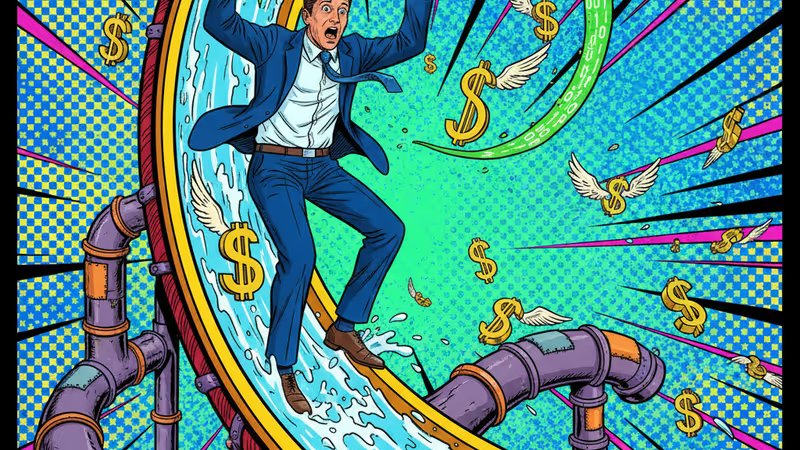
Action Park's Legacy: What Silicon Valley Can Learn From the World's Most Dangerous Theme Park
Action Park wasn't just a dangerous theme park; it's a critical case study in risk, UX, and liability. Here's what its legacy teaches today's innovators.
The Lede: Beyond Nostalgia, A Masterclass in Risk
A New Jersey theme park so notoriously dangerous it had to purchase its own fleet of ambulances is now a cult legend. But for today's leaders, Action Park is more than a punchline—it’s a critical case study in the extreme pendulum swing of user experience (UX), liability, and corporate risk appetite. Before we curated every digital and physical journey to within an inch of its life, there was a place that handed the controls, and the consequences, directly to the customer. Understanding its rise and fall provides a powerful lens through which to view our current obsession with frictionless, sanitized experiences.
Why It Matters: The Birth of the Safety Industrial Complex
Action Park wasn't just an outlier; it was a catalyst. Its spectacular, high-profile failures and the ensuing litigation directly fueled the hyper-regulation of the modern amusement industry. The park's closure in 1996 marked the end of an era and the beginning of another.
- Second-Order Effects: The legacy of Action Park is visible in every warning sign, every height-and-weight requirement, and every redundant safety harness at parks today. It forced the industry, insurance carriers, and regulators to create the stringent ASTM standards that now govern amusement rides globally.
- The User Shift: It fundamentally changed the definition of a "guest." The user was transformed from an active, (overly) empowered participant into a passive passenger. The goal shifted from delivering raw thrill to delivering a perfectly predictable, repeatable, and legally defensible simulation of thrill.
The Analysis: An Analog Anomaly in a Digital-First World
Operating from 1978 to 1996, Action Park was a product of a pre-digital, pre-litigation-obsessed culture. Its design philosophy—what we might now call an "open-world sandbox"—was to build the apparatus and let guests figure it out. This was the physical-world equivalent of early internet forums or beta software releases: chaotic, user-driven, and filled with unforeseen (and painful) bugs.
Its primary competitor, Disney, was already perfecting the art of the curated narrative—the "on-rails" experience where every sight, sound, and movement is meticulously controlled. Action Park was the chaotic, indie startup to Disney's polished enterprise corporation. It prioritized user agency above all else, including safety, and in doing so, wrote the playbook on what not to do from a risk management perspective. The nostalgia it evokes, particularly among Gen X and Millennials, isn't for the injuries, but for the remembered sense of autonomy and genuine, unscripted adventure.
PRISM Insight: The Market for Perceived Risk
The ghost of Action Park haunts the modern experience economy. While no public company could stomach its liability profile today, the consumer appetite for the *feeling* it provided has never been higher. This creates a significant market opportunity for what we call "Engineered Danger."
Investors and innovators should be looking at ventures that can thread this needle. The future isn't about real danger, but high-fidelity, psychologically impactful perceived risk. This is the thesis behind:
- Hyper-Realistic VR/AR: Simulating the Tarzan Swing or the Cannonball Loop without the physical consequences.
- Gamified Obstacle Courses: The success of brands like Tough Mudder and Spartan Race is built on providing controlled, supervised hardship and risk.
- Advanced Haptics and Simulators: Tech that can replicate the visceral, physical feedback of an out-of-control experience in a perfectly safe environment.
The investment play is in technologies that can decouple genuine thrill from unacceptable liability.
PRISM's Take: Nostalgia as a Market Signal
Action Park is a cultural artifact, but its endurance in popular memory is a powerful market signal. It reveals a deep-seated human desire to escape the over-curated, frictionless bubble we've built. The story isn't that a park was reckless; it's that for nearly two decades, people flocked to it. They craved the intensity. The ultimate lesson from Action Park is that in a world increasingly devoid of genuine stakes, the most valuable commodity is an authentic experience. The next billion-dollar brands in entertainment won't be those that eliminate risk, but those that master the art of safely simulating it.
関連記事
トランプ氏の歴史的有罪評決が米大統領選、社会、テクノロジーに与える衝撃を深掘り分析。投資家や有権者が知るべき本当の意味とは。

政治的緊張にもかかわらず、上海のスシローに行列が。この現象が示す中国の新たな消費者行動と、グローバルブランドへの教訓をPRISMが徹底分析。
C.ロナウドのSNS投稿は単なる肉体美の披露ではない。彼が築くビジネス帝国と、アスリートの価値を再定義する新時代のブランド戦略を徹底分析。
テイラー・スウィフトのドキュメンタリーが暴く驚異の舞台裏。39秒の早着替え、衣装のサプライチェーン問題から、1兆円ビジネスの成功戦略を読み解く。