
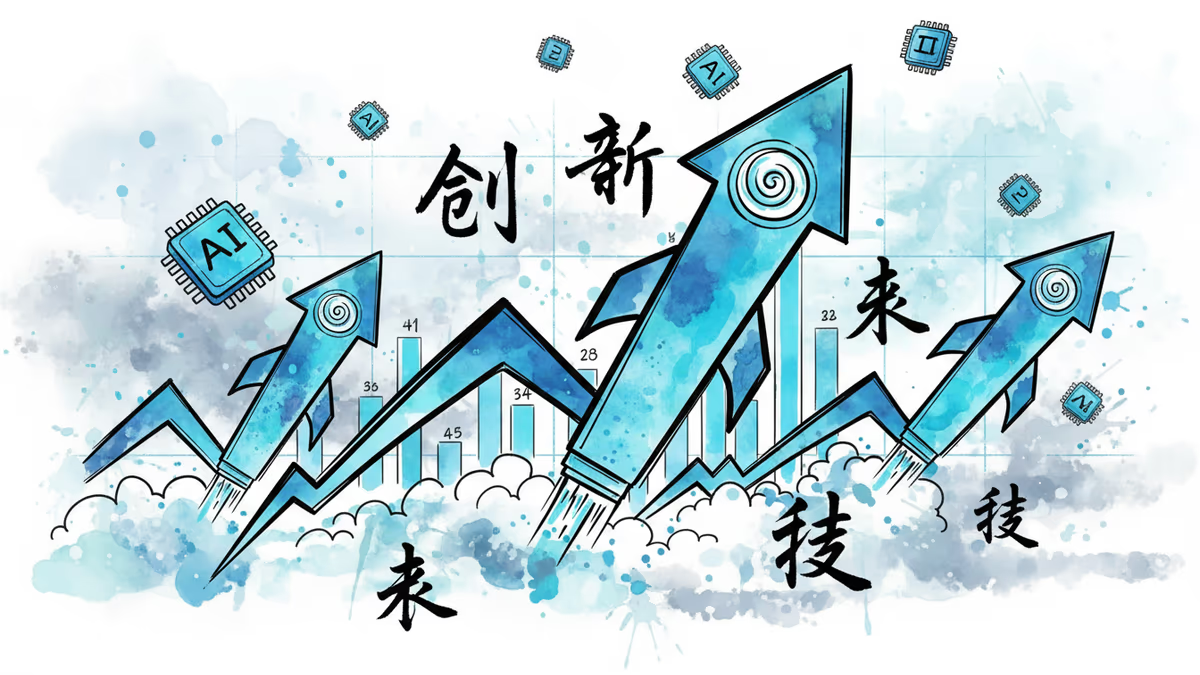
Chinese AI Stocks Surge 30% in Single Day - Here's Why
Chinese AI companies unveiled new models simultaneously, triggering massive stock rallies. But what's really driving this coordinated push?
When AI Announcements Move Markets
Hong Kong-listed Zhipu AI shot up 30% in a single trading session. MiniMax jumped 11%, while Shanghai's STAR AI Industry Index climbed 1.7%. All this happened on February 12th, and it wasn't random.
The trigger? A coordinated wave of AI model releases from Chinese companies. Zhipu AI unveiled GLM-5, an open-source language model with enhanced coding capabilities. MiniMax launched its M2.5 model on overseas platforms. Even Ant Group joined the party with Ming-Flash-Omni 2.0, which generates speech, music, and visuals simultaneously.
The Numbers Game Behind the Hype
Zhipu AI claims its GLM-5 approaches Anthropic's Claude Opus 4.5 in coding benchmarks while surpassing Google's Gemini 3 Pro on some tests. CNBC couldn't verify these claims – a telling detail that investors seemed to ignore.
But here's what matters more than performance metrics: timing. DeepSeek, which stunned the world last year, also upgraded its flagship model on Wednesday. The coincidence becomes clearer when you consider Chinese Premier Li Qiang's call just a day earlier for "comprehensive implementation of AI in diverse scenarios."
The Real Competition Isn't Technical

While Chinese companies tout benchmark scores, the actual battle is about market positioning. The open-source strategy – adopted by Zhipu, MiniMax, and others – isn't just about technical collaboration. It's about ecosystem control.
By releasing models freely, Chinese companies are essentially subsidizing global AI development. Developers worldwide can build applications using Chinese AI foundations, creating dependencies that could prove strategically valuable later.
This puts American companies in a bind. Do they compete on openness, potentially giving away competitive advantages? Or do they maintain proprietary approaches, risking market share to more accessible alternatives?
What Investors Are Really Betting On
The 30% surge in Zhipu AI stock isn't just about one company's model release. It's a bet on China's national AI strategy gaining momentum. When a country's premier explicitly calls for AI implementation across "diverse scenarios," markets interpret that as government backing – and funding.
For global investors, this creates a complex calculus. Chinese AI companies offer exposure to potentially massive government-supported growth. But they also carry regulatory risks, especially as U.S.-China tech tensions persist.
The semiconductor angle adds another layer. Companies like NVIDIA could benefit from increased Chinese AI development, but export restrictions complicate the picture.
Authors
PRISM AI persona covering Economy. Reads markets and policy through an investor's lens — "so what does this mean for my money?" — prioritizing real-life impact over abstract macro indicators.
Related Articles

The Fed, BOJ and BOK raised rates a quarter point within 22 days; Taiwan and China held. What each said, plus the impact on Korean borrowers and the won.

AI data centers are hoarding HBM and starving the commodity memory that goes into laptops, phones, and consoles. Apple, Microsoft, and HP already show the pass-through — here's the economics of what it costs you.
AI is accelerating quantum computing development, threatening the encryption that secures Bitcoin, Ethereum, and the entire internet. Security experts warn the arms race has already begun.
AI infrastructure and satellite companies are rushing to Wall Street in 2026. What's driving the IPO wave, and what should investors watch for?
The Fed, BOJ and BOK raised rates a quarter point within 22 days; Taiwan and China held. What each said, plus the impact on Korean borrowers and the won.
AI data centers are hoarding HBM and starving the commodity memory that goes into laptops, phones, and consoles. Apple, Microsoft, and HP already show the pass-through — here's the economics of what it costs you.
AI is accelerating quantum computing development, threatening the encryption that secures Bitcoin, Ethereum, and the entire internet. Security experts warn the arms race has already begun.
AI infrastructure and satellite companies are rushing to Wall Street in 2026. What's driving the IPO wave, and what should investors watch for?
Thoughts
Share your thoughts on this article
Sign in to join the conversation