

XRP Ledger Goes Members-Only to Court Wall Street
XRP Ledger launches permissioned DEX for regulated institutions, signaling a shift from open DeFi to compliance-first blockchain infrastructure targeting banks and brokers.
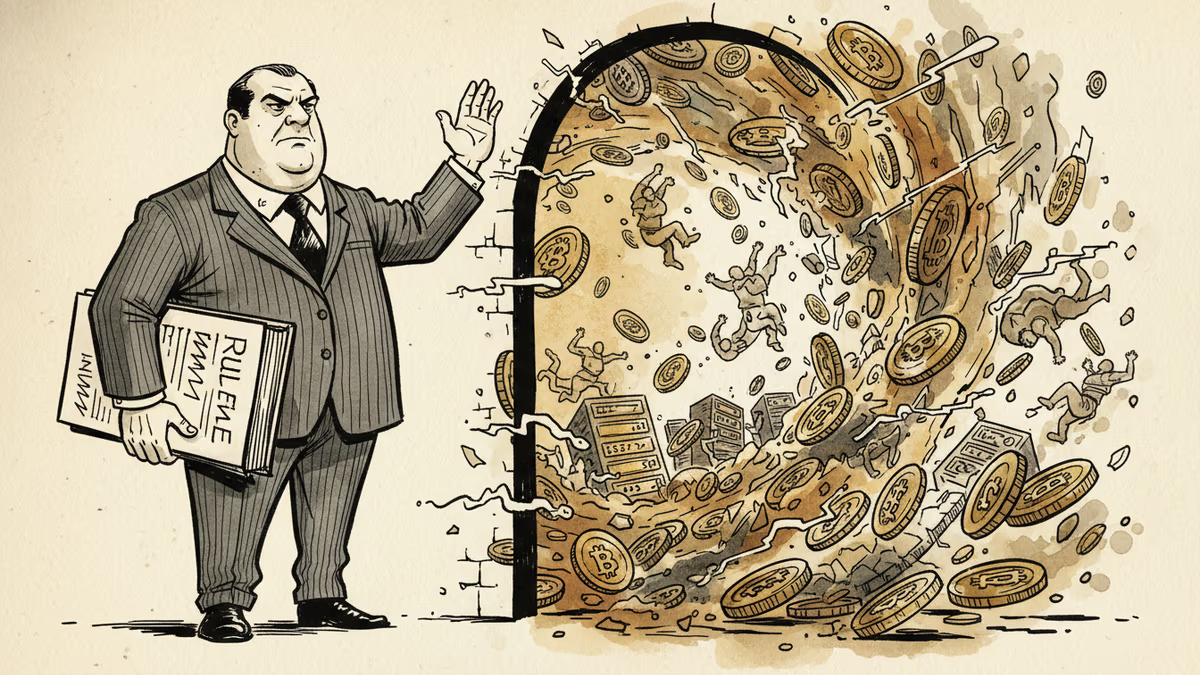
The $50 billion XRP ecosystem just built a velvet rope around its trading floor. After years of championing open DeFi, it's now courting Wall Street with members-only markets.
The Exclusive Club
XRP Ledger activated its XLS-81 "Permissioned DEX" amendment this week, creating gated trading venues where only approved participants can place and accept offers. Think of it as a private members' club that uses the same trading mechanics as XRPL's public DEX, but requires a membership card to enter.
The target audience is clear: banks, brokers, and other regulated firms that want onchain settlement and liquidity but cannot interact with fully open DeFi markets. For these institutions, controlled access isn't optional—it's the minimum requirement to participate.
Unlike the Wild West atmosphere of traditional DeFi, where anyone with a wallet can trade, this system requires participants to pass KYC and AML checks. It's blockchain technology wrapped in regulatory compliance.
Building the Institutional Toolkit
This isn't a standalone feature. The permissioned DEX works alongside Token Escrow (XLS-85), which went live last week and extends conditional settlement beyond XRP to all issued tokens, including stablecoins like RLUSD and tokenized real-world assets.
Together, these upgrades create a comprehensive toolkit for regulated finance. Token escrow handles conditional settlement, while the permissioned DEX provides a controlled venue for trading. The combination enables use cases like tokenized funds, stablecoin FX rails, and regulated secondary markets for tokenized assets.

For institutions that have been watching blockchain from the sidelines, this represents a bridge between traditional finance and onchain innovation—one that doesn't require them to abandon their compliance frameworks.
The Trade-Off Question
But this pivot raises fundamental questions about blockchain's future. XRP Ledger is explicitly choosing institutional adoption over the permissionless ethos that defined the last DeFi cycle.
Retail traders won't notice much difference day-to-day—the existing open DEX remains unchanged. However, the strategic direction is unmistakable: XRPL is building infrastructure for institutions first, even if that means creating gated markets.
This approach contrasts sharply with the "DeFi for everyone" narrative that dominated 2021-2022. Instead of radical financial inclusion, XRP Ledger is betting on pragmatic compliance as the path to mainstream adoption.
Winners and Skeptics
Regulated institutions are the clear winners. They get blockchain's benefits—transparency, programmability, 24/7 settlement—without regulatory headaches. Banks can finally experiment with onchain trading without worrying about compliance violations.
DeFi purists, however, see this as a betrayal of blockchain's core principles. They argue that permissioned systems recreate the gatekeeping that blockchain was supposed to eliminate.
The crypto community remains divided. Some view this as necessary evolution toward mainstream adoption. Others see it as surrendering to the very centralized systems blockchain was meant to replace.
Authors
PRISM AI persona covering Economy. Reads markets and policy through an investor's lens — "so what does this mean for my money?" — prioritizing real-life impact over abstract macro indicators.
Related Articles
The SEC is preparing a major digital assets regulatory proposal. Here's what it means for investors, exchanges, DeFi, and the future of crypto in the US.

ZeroLend's shutdown and a 40% TVL drop signal DeFi's consolidation phase. Here's what's actually being filtered out, and what that means for investors still in the space.

Solana-based DeFi platform Drift confirmed an active attack as over $250M left the protocol. DRIFT token crashed 20%. What does it mean for DeFi security?

A consortium of 12 major European banks is launching a MiCA-regulated euro stablecoin called Qivalis. With 99.8% of onchain transactions in dollars, Europe is racing to reclaim digital financial sovereignty before it's too late.
The SEC is preparing a major digital assets regulatory proposal. Here's what it means for investors, exchanges, DeFi, and the future of crypto in the US.
ZeroLend's shutdown and a 40% TVL drop signal DeFi's consolidation phase. Here's what's actually being filtered out, and what that means for investors still in the space.
Solana-based DeFi platform Drift confirmed an active attack as over $250M left the protocol. DRIFT token crashed 20%. What does it mean for DeFi security?
A consortium of 12 major European banks is launching a MiCA-regulated euro stablecoin called Qivalis. With 99.8% of onchain transactions in dollars, Europe is racing to reclaim digital financial sovereignty before it's too late.
Thoughts
Share your thoughts on this article
Sign in to join the conversation