
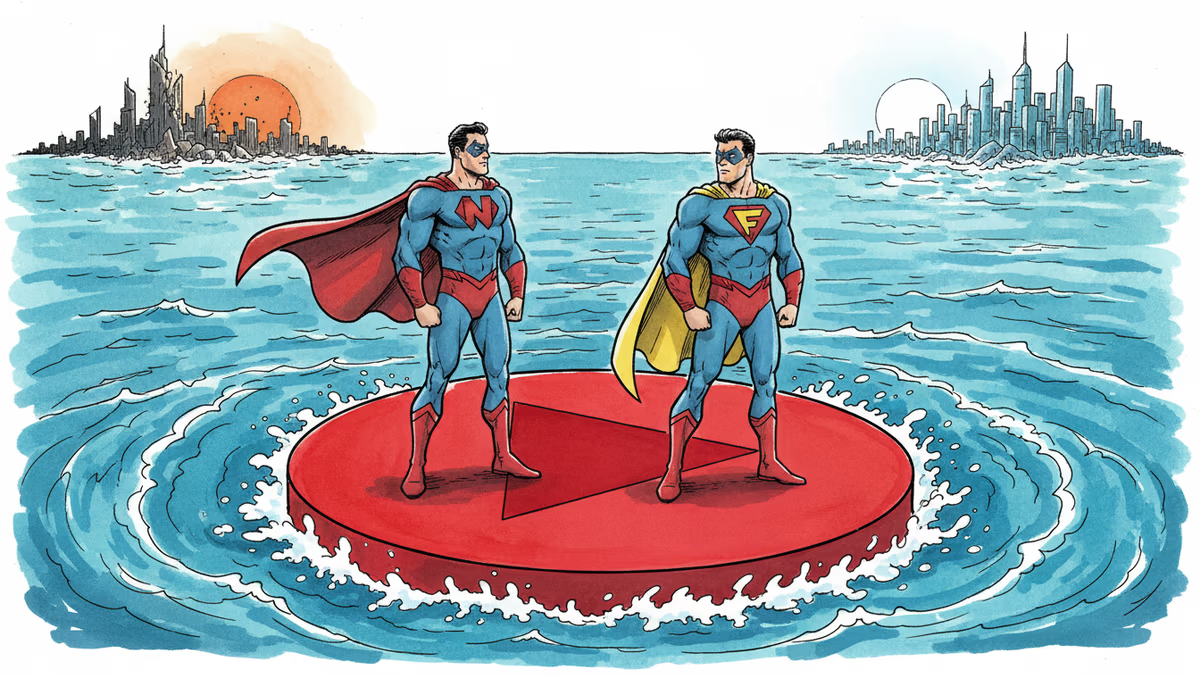
The WONDERfools: What Netflix's Fantasy Gamble Reveals About K-Drama's Next Phase
Netflix's The WONDERfools (Episodes 1-8) starring Park Eun-bin and Cha Eun-woo isn't just a fantasy series—it's a stress test of K-drama's global formula in 2026.
Park Eun-bin's last Netflix series drew over 100 million viewing hours in its first month. Her next move matters—and she chose a fantasy action show.
The WONDERfools is now streaming on Netflix, with Episodes 1 through 8 available. The series stars Park Eun-bin, Cha Eun-woo, Choi Dae-hoon, and Im Sung-jae in a world built around individuals with supernatural abilities. It sits squarely in the fantasy-action genre—a corner of the K-drama market that has been growing fast but hasn't yet produced a franchise-level hit on the scale of Squid Game or Kingdom.
That gap is exactly what makes The WONDERfools worth watching closely. Not just as a show, but as an industry signal.
Two Stars, Two Very Different Bets
The casting of Park Eun-bin alongside Cha Eun-woo looks like a straightforward pairing of acting credibility and star power. But the underlying logic runs deeper than that.
Park Eun-bin is a career actress with over two decades of experience, whose global profile exploded with Extraordinary Attorney Woo (2022). Choosing a fantasy-action series as her follow-up is a deliberate genre stretch—trading the emotional intimacy of a grounded drama for physical spectacle and world-building. It's a risk. Audiences who came for Woo Young-woo's quiet intensity will need to recalibrate.
Cha Eun-woo, a member of K-pop group ASTRO, represents a different industrial logic entirely. Idol-to-actor transitions have been a reliable Netflix casting strategy since at least 2019: the built-in fandom drives first-week viewing spikes, social media amplification comes pre-loaded, and the algorithm rewards that early momentum. The trade-off is that idol-led dramas tend to perform well at launch but rarely generate the sustained critical conversation that leads to season renewals or IP expansion.
Putting both together in the same series is Netflix hedging across two audience segments simultaneously—the prestige-drama crowd following Park Eun-bin, and the fandom ecosystem orbiting Cha Eun-woo. It's a smart hedge. Whether it produces a coherent show is a separate question.

Where This Fits in the K-Fantasy Landscape
The K-drama genre map in 2026 has three dominant clusters on Netflix. There's the social-critique survival genre (Squid Game lineage), the historical genre hybrid (Kingdom, My Dearest), and the supernatural action world-building category (Sweet Home, Moving, Hellbound). The WONDERfools belongs to the third.
That third category has a specific problem: it keeps producing visually ambitious shows that don't cross over into the cultural conversation the way the first two clusters do. Sweet Home Season 3 landed quietly. Hellbound Season 2 struggled to recapture the discourse of its debut. The genre generates loyal niche audiences but rarely breaks into the broader mainstream moment that Netflix's global metrics require to justify franchise investment.
The question The WONDERfools has to answer isn't whether it's a good fantasy show. It's whether it can do what Moving (2023, Disney+) managed to do—use the superhero framework as a delivery mechanism for something emotionally specific enough to travel across cultures. Moving worked because the superpower was almost incidental to the story of parents protecting children. The ability was a metaphor, not the point.
If The WONDERfools finds an equivalent emotional core beneath its action sequences, it has a path to genuine global traction. If the powers are the point, it'll face the same headwinds as every other mid-tier superhero property competing against Marvel and DC on the same platform.
The Structural Tension Netflix Can't Fully Solve
There's a tension baked into how Netflix commissions K-drama that The WONDERfools makes visible. Netflix needs shows that work globally—which pushes toward genre universality, spectacle, and faster pacing. Korean audiences, and the domestic critical establishment, tend to reward character density, emotional specificity, and the kind of social subtext that doesn't translate easily.
The most successful Netflix K-dramas have threaded this needle by accident as much as design. Squid Game was a Korean allegory about debt and class that happened to be legible as a global thriller. Extraordinary Attorney Woo was a very Korean story about neurodiversity and workplace culture that resonated globally precisely because of its specificity, not despite it.
The WONDERfools, as a fantasy-action series, is structurally more dependent on genre execution than on social specificity. That makes it easier to market globally but harder to make irreplaceable. There are a lot of fantasy shows. There's only one Squid Game.
With 8 episodes now available and the back half still to come, the series is at the point where it either deepens its world or coasts on its opening setup. Viewer reactions in the drama hangout communities are already splitting along predictable lines—international fans more engaged with the action and chemistry, domestic audiences more focused on whether the characters earn their emotional beats.
This content is AI-generated based on source articles. While we strive for accuracy, errors may occur. We recommend verifying with the original source.
Related Articles

Lim Ji-yeon-led My Royal Nemesis reportedly hit No. 1 on Netflix's global non-English chart in its opening week. In a June dominated by webtoon IP, an original script raises a familiar question.
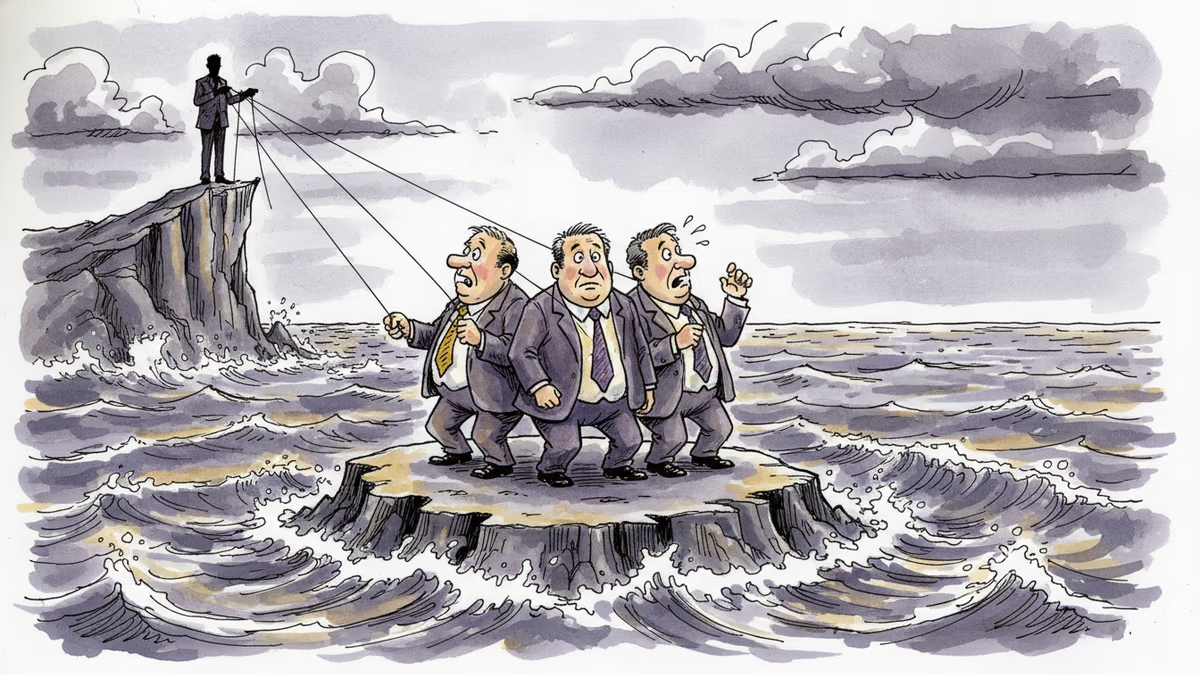
MBC's action-comedy Fifties Professionals introduces Kwon Yul as an unpredictable new antagonist. Here's why this drama's premise matters beyond the casting news.

Netflix drops character stills for Husbands in Action, an action-comedy starring Jin Sun Kyu, Gong Myoung, Kim Ji Suk, and Yoon Kyung Ho. Here's what the casting and premise signal about K-film's global strategy.
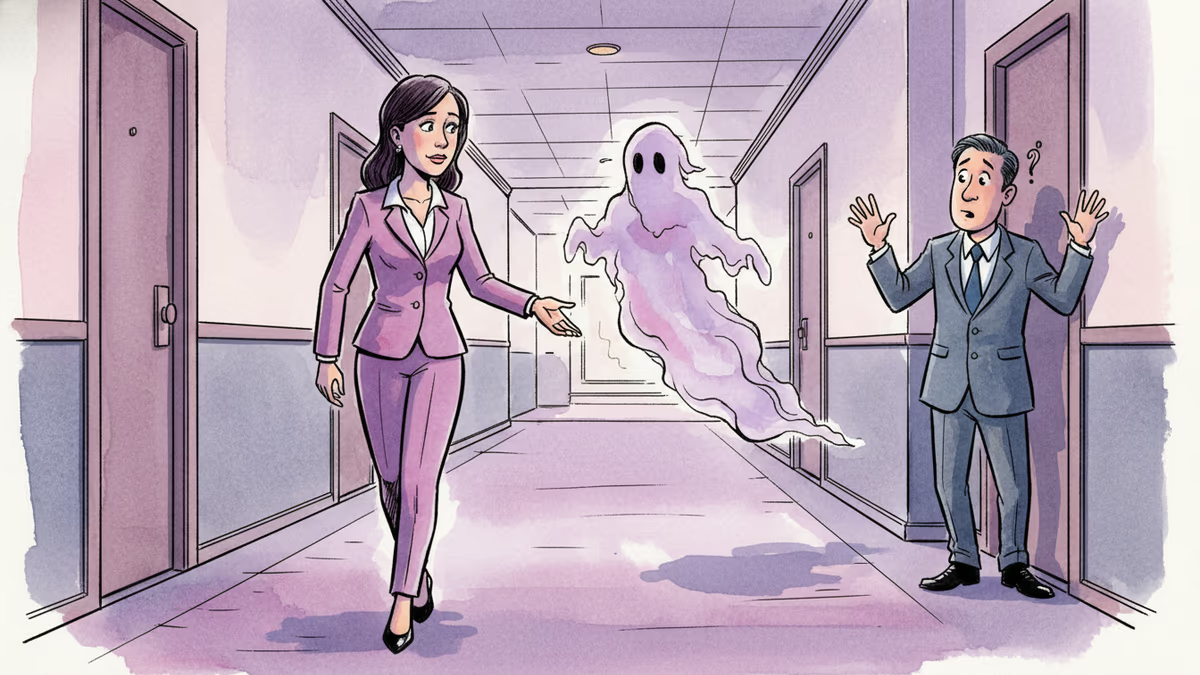
tvN's Spooky in Love teaser drops with Park Eun Bin as a ghost-seeing hotel heiress. Behind the occult romance lies a calculated industry strategy worth unpacking.
Lim Ji-yeon-led My Royal Nemesis reportedly hit No. 1 on Netflix's global non-English chart in its opening week. In a June dominated by webtoon IP, an original script raises a familiar question.
MBC's action-comedy Fifties Professionals introduces Kwon Yul as an unpredictable new antagonist. Here's why this drama's premise matters beyond the casting news.
Netflix drops character stills for Husbands in Action, an action-comedy starring Jin Sun Kyu, Gong Myoung, Kim Ji Suk, and Yoon Kyung Ho. Here's what the casting and premise signal about K-film's global strategy.
tvN's Spooky in Love teaser drops with Park Eun Bin as a ghost-seeing hotel heiress. Behind the occult romance lies a calculated industry strategy worth unpacking.
Thoughts
Share your thoughts on this article
Sign in to join the conversation