
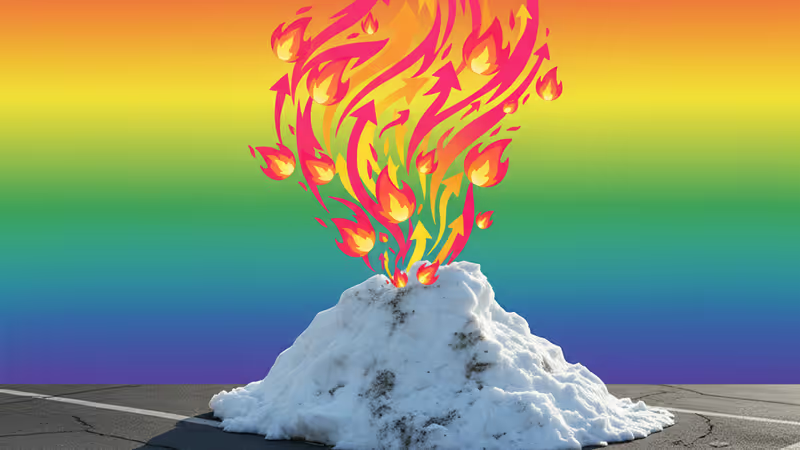
The Science of 'Zombie Snow': Why That Giant, Dirty Snow Pile Won't Melt
Ever wonder why giant, dirty snow piles linger for months after winter? Discover the science behind 'zombie snow,' from latent heat of fusion to the insulation effect.
It’s a familiar sight as winter fades: a lone, filthy snow pile stubbornly holding on in a sunny parking lot. It sits like a monument to a season that's long gone, but why does it take so much time to disappear?
The answer lies in a combination of factors, starting with physics. According to science writers, a key reason is the 'latent heat of fusion'. This is the energy required to change a solid (ice) into a liquid (water). Simply having temperatures above freezing isn't enough; a massive pile of snow needs a huge amount of sustained energy—and time—to make the transition, much like an ice cube won't melt instantly in your hand.
The second reason is the structure itself. These giant mounds are human-made, created when snowplows clear streets and parking lots. The process compacts the snow, making it incredibly dense. The outer layer of this compacted snow then acts as an excellent insulator, shielding the core from the sun and warmer air. It's like a natural igloo protecting itself.
These snow piles can be surprisingly persistent. After a particularly snowy winter in 2015, one notorious snow mound made in Boston lingered until July. The problem can get so significant that cities sometimes use dump trucks to haul the mounds away to melt in less trafficked areas.
If you're hoping for an unsightly pile to vanish, the best natural catalyst is rain. Rainwater can pierce the snowbank, destroying its insulating properties and accelerating the melting process. Of course, there is one small upside to such persistent snow: your snowman is likely to remain standing a little longer.
This content is AI-generated based on source articles. While we strive for accuracy, errors may occur. We recommend verifying with the original source.
Related Articles

Feeling 'awvish'? Suffering from a 'kiffle'? Dive into 10 forgotten English words for winter sickness, from a 'meldrop' on your nose to the 'alysm' of being stuck in bed.

A deep dive into why aespa Winter's 'rude' behind-the-scenes clips went viral, exposing a massive cultural divide between Korean and international K-pop fans.

Aespa's Winter is facing a massive backlash over two viral clips showing her 'attitude' towards staff. We break down why it went viral and what it says about K-pop culture.

BTS's Jungkook and aespa's Winter mentioned the same obscure song, and the internet exploded. Here's why this is more than just a dating rumor.