
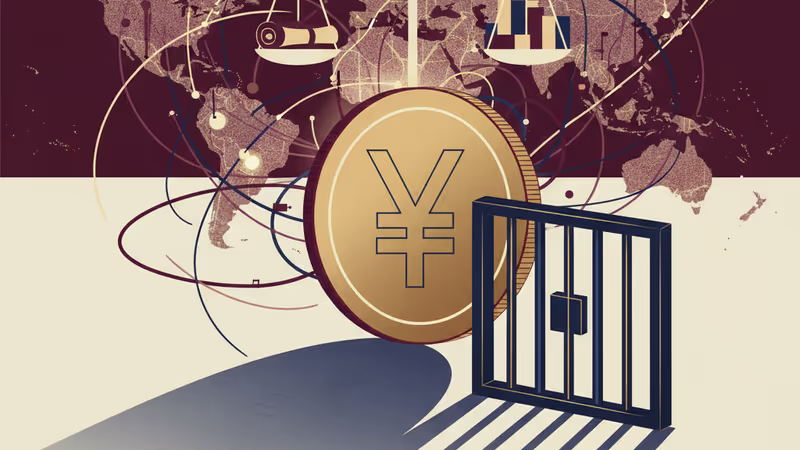
The Yuan's Two-Track Ascent: A Trade Juggernaut, A Reserve Laggard
Analysis shows China's yuan is gaining significant ground as a trade settlement currency amid geopolitical shifts, but its role in global finance, investment, and reserves remains minimal.
Beijing's push to internationalize the yuan is achieving notable success in global trade, but the currency's broader ambitions to challenge the US dollar as a premier investment and reserve asset are hitting a wall. An analysis from Oxford Economics reveals a story of two distinct paths: one of rapid ascent in commerce, and another of stagnation in global finance.
A Geopolitical Boost for Trade Settlement
The yuan's role as a settlement currency in international trade has surged, a shift attributed to the "dramatic change in the global geopolitical landscape over the past few years," according to Betty Wang, head of North Asia research at Oxford Economics. In the first three quarters of , cross-border yuan settlements hit , up . This now accounts for of the country's goods trade—a four-fold increase from the level in .
The High Wall of Global Finance
Despite its success in trade, the yuan's broader global footprint remains limited. Cross-Border Interbank Payment System (CIPS) handles about in daily transactions. While sizeable, it's dwarfed by the nearly routed each day through the US dollar-based Clearing House Interbank Payments System (CHIPS).
On the investment and reserve fronts, the picture is even starker. Yuan-denominated debt issuance accounts for just of the global market. Furthermore, IMF data shows the yuan's share of global reserves actually slipped from . Over the same period, the US dollar’s share also fell, from , but it remains the world's undisputed primary reserve currency.
Beijing is pursuing a carefully managed internationalization. It’s leveraging geopolitical shifts to boost the yuan's role in trade, but its reluctance to fully open its capital account acts as a deliberate brake, prioritizing domestic financial stability over the yuan's potential as a truly global reserve currency.
This content is AI-generated based on source articles. While we strive for accuracy, errors may occur. We recommend verifying with the original source.
Related Articles

A major Chinese comic convention in Hangzhou has banned all Japanese-themed works just a week before its opening, a stark reflection of the escalating geopolitical tensions between Beijing and Tokyo.

North Korean leader Kim Jong Un and his daughter Kim Ju Ae attended a hotel opening in Samjiyon, signaling a push to show economic progress before a key party congress in early 2026.

Beijing appears to be recalibrating its Taiwan policy, scaling back military intimidation in favor of a softer approach that emphasizes 'peaceful reunification' and a vision for post-unity governance.

Germany's trade deficit with China is set to hit a record €87 billion in 2025, fueled by weak German exports, strong EV competition, and a corporate 'in China, for China' strategy, raising fears of a protectionist turn.