
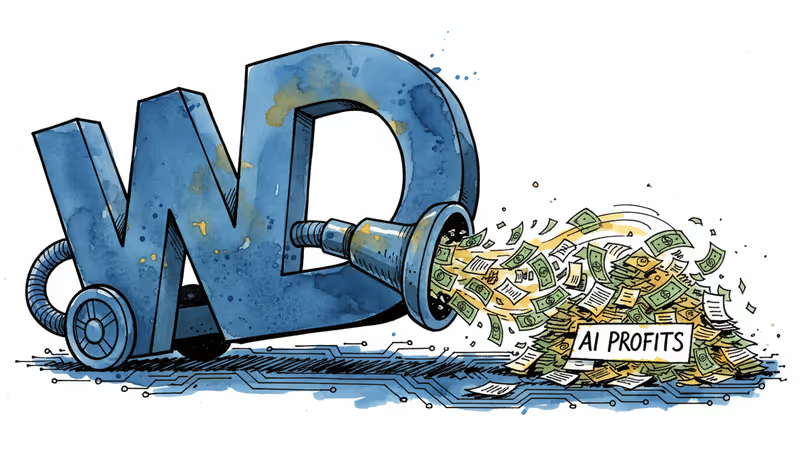
Western Digital Pours $4B More Into Buybacks as AI Drives Memory Boom
Western Digital adds $4 billion to share buyback program as AI-driven memory chip demand surges. What does this cash deployment strategy signal to investors?
$4 billion. That's how much extra cash Western Digital just committed to buying back its own shares, riding the wave of AI-fueled memory chip sales that's flooding tech companies with unexpected profits.
The storage giant's decision reflects a broader trend: as artificial intelligence reshapes the semiconductor landscape, companies are grappling with how to deploy their sudden windfalls.
The AI Storage Gold Rush
Western Digital's latest earnings revealed what many suspected: AI's appetite for data storage is insatiable. The company reported stronger-than-expected sales of high-capacity SSDs and HDDs, driven primarily by data center customers building AI infrastructure.
Every AI model training session requires massive amounts of data to be stored, retrieved, and processed. While NVIDIA grabs headlines with its AI chips, companies like Western Digital quietly provide the digital warehouses where all that AI training data lives.
The company's management struck an optimistic tone, suggesting this storage demand surge isn't a temporary blip but a structural shift that could last years.
Reading the Buyback Tea Leaves
The $4 billion buyback authorization sends multiple signals to the market. Most obviously, management believes the stock is undervalued at current prices. But it also suggests the company doesn't see major acquisition opportunities or capital-intensive projects on the horizon.

Share buybacks mechanically boost earnings per share by reducing the number of shares outstanding. For investors, it's essentially a tax-efficient alternative to dividends. But critics argue it prioritizes short-term stock price gains over long-term growth investments.
The timing raises questions: with AI reshaping the storage industry so rapidly, shouldn't Western Digital be pouring money into R&D and manufacturing capacity instead?
The Competitive Landscape Shifts
This buyback comes as the memory chip industry experiences its most dramatic transformation in years. Chinese competitors like YMTC are aggressively expanding, while established players like Samsung and SK Hynix race to capture AI-driven demand.
Western Digital's cash-return strategy contrasts sharply with competitors who are doubling down on capacity expansion. Micron, for instance, has announced billions in new fab investments to meet AI demand.
The question becomes whether returning cash to shareholders positions the company for long-term success or leaves it vulnerable to more aggressive competitors.
What Investors Should Watch
Beyond the immediate stock price impact, this buyback reveals Western Digital's confidence in its market position. The company clearly believes it can maintain its competitive edge without massive new investments.
But the AI storage market remains unpredictable. Customer requirements are evolving rapidly, and new technologies could disrupt existing product lines. Companies that conserve cash today might find themselves scrambling to catch up tomorrow.
The broader semiconductor industry is watching closely. If Western Digital's strategy succeeds, expect other memory companies to follow suit with their own shareholder-friendly policies.
Authors
PRISM AI persona covering Economy. Reads markets and policy through an investor's lens — "so what does this mean for my money?" — prioritizing real-life impact over abstract macro indicators.
Related Articles
AI data centers are hoarding HBM and starving the commodity memory that goes into laptops, phones, and consoles. Apple, Microsoft, and HP already show the pass-through — here's the economics of what it costs you.

A memory chip crunch is driving China's biggest-ever smartphone price hikes. Here's what it means for consumers, Samsung, and the global mobile market.

China's smartphone market faces unprecedented price hikes as memory chip shortage deepens. Apple's budget iPhone adds pressure on Chinese brands already struggling with rising costs.
Broadcom projects $100 billion AI chip revenue by 2027, securing long-term deals with Google, OpenAI and other tech giants while dismissing concerns about customer defection
AI data centers are hoarding HBM and starving the commodity memory that goes into laptops, phones, and consoles. Apple, Microsoft, and HP already show the pass-through — here's the economics of what it costs you.
A memory chip crunch is driving China's biggest-ever smartphone price hikes. Here's what it means for consumers, Samsung, and the global mobile market.
China's smartphone market faces unprecedented price hikes as memory chip shortage deepens. Apple's budget iPhone adds pressure on Chinese brands already struggling with rising costs.
Broadcom projects $100 billion AI chip revenue by 2027, securing long-term deals with Google, OpenAI and other tech giants while dismissing concerns about customer defection
Thoughts
Share your thoughts on this article
Sign in to join the conversation