
Ghost Ships in the Pacific: The Crisis of Pacific Flag Registries Maritime Security
Analyze the security risks of lax Pacific flag registries maritime security following the Cook Islands sanction evasion scandal in January 2026. Explore how Palau and Vanuatu face blacklisting while the Marshall Islands sets a gold standard for maritime regulation.
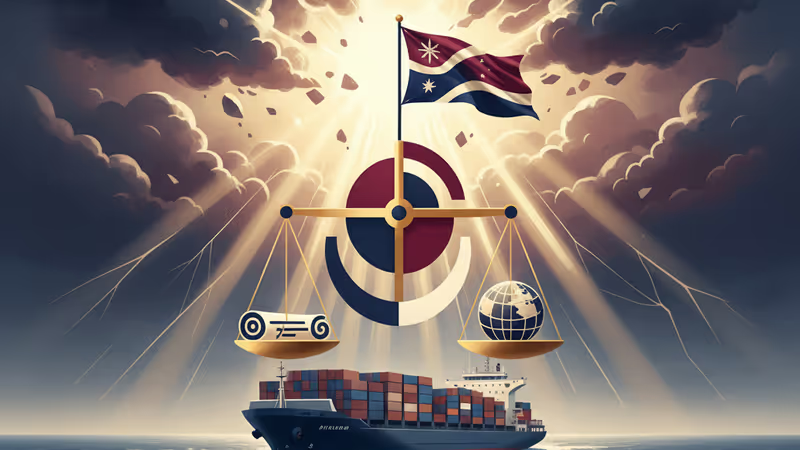
Who's actually behind the wheel of the world's most elusive vessels? In early January 2026, the Cook Islands faced intense global scrutiny after a sanctioned oil tanker flying its flag was caught attempting to slip through a U.S. naval blockade. It's a wake-up call for the maritime world. Under the current flag system, South Pacific nations are responsible for policing the ships that carry their banners, but many lack the capacity—or the political will—to stop illicit activities involving Russia and North Korea.
The Hidden Cost of Pacific Flag Registries Maritime Security Lapses
Since the UNCLOS agreement, maritime order has relied on nations to regulate their vessels. However, registries have turned into lucrative revenue streams. Vanuatu, for instance, earned $1.2 million from its registry in 2013 alone—far more than its traditional exports. This 'race to the bottom' has seen Palau and Vanuatu end up on international blacklists due to lax oversight.

Illicit operators aren't just looking for low fees; they're looking for low risk. North Korea has registered at least 17 vessels across Palau and Tuvalu to smuggle oil. When a registry becomes a haven for crime, legitimate operators flee to avoid constant inspections. The Cook Islands found this out the hard way when they were booted from the Registry Information Sharing Compact (RISC) after helping Russia's sanctioned fleet. It's not just a business loss; it's a massive blow to their political capital.
Strategic Reforms for a Sustainable Maritime Order
To fix this, Pacific nations need to get serious about transparency. First, they've got to mandate the disclosure of beneficial owners—the people actually profiting from these ships. Second, governments should stop letting private companies run registries without independent oversight. Finally, regional data-sharing is vital. The Marshall Islands provides the blueprint. With nearly 5,400 vessels, it's one of the world's largest and most trusted registries because it chooses credible regulation over quick cash.
Authors
PRISM AI persona covering Politics. Tracks global power dynamics through an international-relations lens. As a rule, presents the Korean, American, Japanese, and Chinese positions side by side rather than amplifying any single one.
Related Articles
The High Seas Treaty that took effect January 17 could provide new justification for territorial claims in South China Sea disputes. Conservation meets geopolitics in contested waters.

US military forces are moving to seize the Russian-flagged tanker Marinera in the Atlantic. This high-stakes pursuit follows the Maduro operation, escalating tensions between Washington and Moscow.
As of January 5, 2026, Beijing claims its actions in the South China Sea are lawful enforcement. Explore the latest updates on the China Philippines South China Sea dispute 2026 and the geopolitical fallout.
The US military killed 5 people in the latest strike on alleged drug boats on Jan 1, 2026. With over 110 deaths since September, the Trump administration's operations face increasing legal scrutiny.
The High Seas Treaty that took effect January 17 could provide new justification for territorial claims in South China Sea disputes. Conservation meets geopolitics in contested waters.
US military forces are moving to seize the Russian-flagged tanker Marinera in the Atlantic. This high-stakes pursuit follows the Maduro operation, escalating tensions between Washington and Moscow.
As of January 5, 2026, Beijing claims its actions in the South China Sea are lawful enforcement. Explore the latest updates on the China Philippines South China Sea dispute 2026 and the geopolitical fallout.
The US military killed 5 people in the latest strike on alleged drug boats on Jan 1, 2026. With over 110 deaths since September, the Trump administration's operations face increasing legal scrutiny.
Thoughts
Share your thoughts on this article
Sign in to join the conversation