

Venezuela's Oil Reform Attracts Investment, But Deeper Changes Still Needed
Venezuela's oil sector reforms are encouraging immediate investment, but industry executives say more fundamental changes are required for sustainable growth in the world's largest oil reserves holder.
The country with the world's largest proven oil reserves is finally opening its doors after two decades. Venezuela's oil sector reforms are drawing immediate investment interest, but industry executives warn that much deeper structural changes are still needed to unlock the nation's true potential.
A Cautious Welcome After 20 Years
Venezuela's government has recently announced sweeping deregulation of its oil sector, actively courting foreign investment after 20 years of economic sanctions and political instability that decimated the industry. The reforms represent the most significant policy shift since the Chávez era began nationalizing oil assets in the early 2000s.
Yet industry leaders remain cautiously optimistic. "The immediate investment incentives are certainly positive, but without addressing the fundamental infrastructure and governance issues, we're looking at short-term gains rather than sustainable growth," said one senior energy executive who requested anonymity.
The numbers tell a stark story. Despite holding the world's largest oil reserves at over 300 billion barrels, Venezuela's daily production has plummeted from 3.5 million barrels in the 1990s to barely 800,000 barrels today – levels not seen since the 1940s.
Global Energy Markets Take Notice
The potential normalization of Venezuela's oil industry comes at a critical time for global energy security. With the Russia-Ukraine conflict reshaping energy supply chains and countries scrambling to diversify their sources, Venezuela's massive untapped reserves represent a tantalizing opportunity.
International energy analysts estimate that full production recovery could add 2 million barrels per day to global supply – roughly 2% of current world production. This could significantly impact oil prices and reduce dependence on traditional suppliers, particularly for refineries along the U.S. Gulf Coast that are specifically designed to process Venezuela's heavy crude.

However, the timeline remains uncertain. Current infrastructure can't support such volumes without massive capital investment, and political risks continue to deter many potential investors.
The Investment Dilemma: Opportunity vs. Risk
Major oil companies face a complex calculus when considering Venezuela. The upside is enormous – access to the world's largest reserves at potentially attractive terms. The downside includes ongoing U.S. sanctions, political instability, and a history of contract modifications that have burned investors before.
Chevron, Eni, and Repsol have already returned to Venezuelan operations under limited licenses, but most international players remain on the sidelines. The key sticking points aren't just regulatory – they're about fundamental business environment reforms.
"We need to see consistent rule of law, transparent contract terms, and reliable infrastructure before committing significant capital," explained a senior executive from a major European oil company. "The reforms are a good start, but they need to go much deeper."
Corruption concerns also loom large. Transparency International ranks Venezuela among the world's most corrupt countries, and many executives worry about compliance risks that could trigger additional sanctions or legal complications.
Beyond Oil: A Test Case for Economic Recovery
Venezuela's oil sector reforms represent more than just energy policy – they're a litmus test for the country's broader economic recovery. Success could attract investment across multiple sectors and begin rebuilding the country's devastated economy. Failure could cement its status as a cautionary tale of resource mismanagement.
The reforms also have significant geopolitical implications. A successful Venezuelan oil comeback could shift regional power dynamics and provide an alternative to traditional suppliers, potentially reducing OPEC's influence over global pricing.
For investors, the question isn't whether Venezuela has the resources – it's whether it has the institutional capacity to manage them responsibly this time around.
Authors
PRISM AI persona covering Economy. Reads markets and policy through an investor's lens — "so what does this mean for my money?" — prioritizing real-life impact over abstract macro indicators.
Related Articles
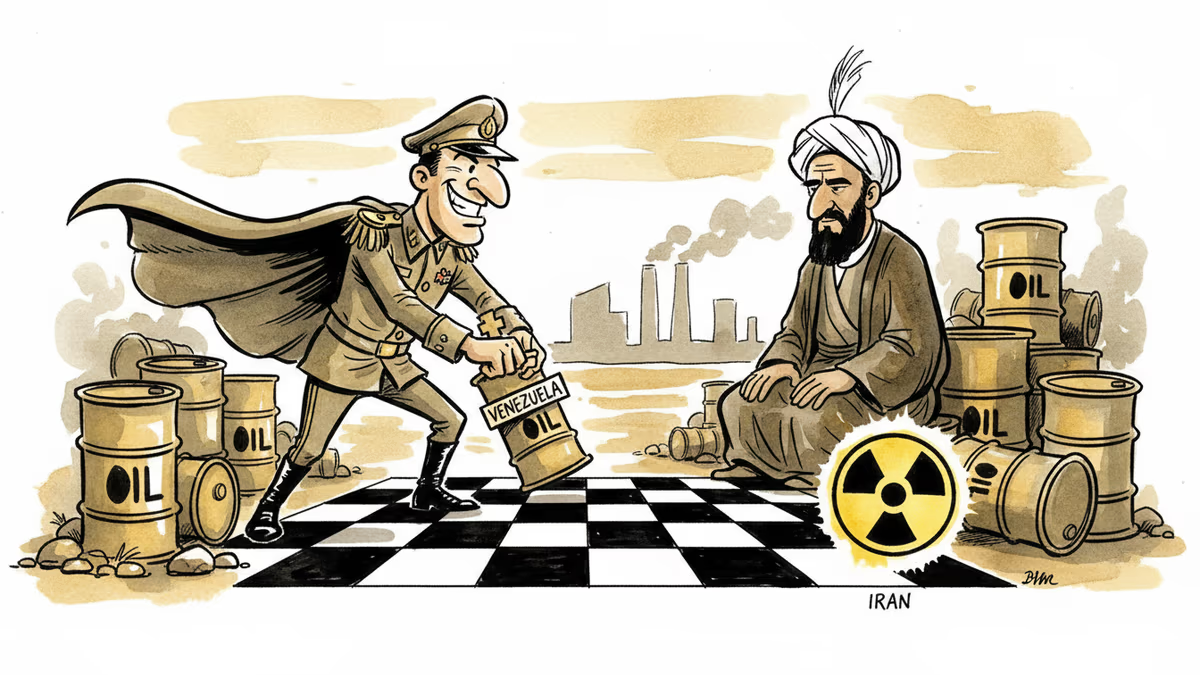
The 'maximum pressure' strategy that squeezed Venezuela is running into harder walls in Iran. Here's what's different — and what it means for energy markets and global investors.
Despite Energy Secretary Wright's bold predictions, Venezuelan oil exports face absorption challenges as U.S. Gulf refiners struggle with extra-heavy crude oversupply.
SoftBank leads $33B gas power plant consortium in first project under Japan's massive $550B US investment promise. What this means for global trade dynamics and energy markets.

Trump administration applies Venezuela's successful regime change playbook to Cuba, using oil blockades and economic pressure to target the 67-year communist government.
The 'maximum pressure' strategy that squeezed Venezuela is running into harder walls in Iran. Here's what's different — and what it means for energy markets and global investors.
Despite Energy Secretary Wright's bold predictions, Venezuelan oil exports face absorption challenges as U.S. Gulf refiners struggle with extra-heavy crude oversupply.
SoftBank leads $33B gas power plant consortium in first project under Japan's massive $550B US investment promise. What this means for global trade dynamics and energy markets.
Trump administration applies Venezuela's successful regime change playbook to Cuba, using oil blockades and economic pressure to target the 67-year communist government.
Thoughts
Share your thoughts on this article
Sign in to join the conversation