
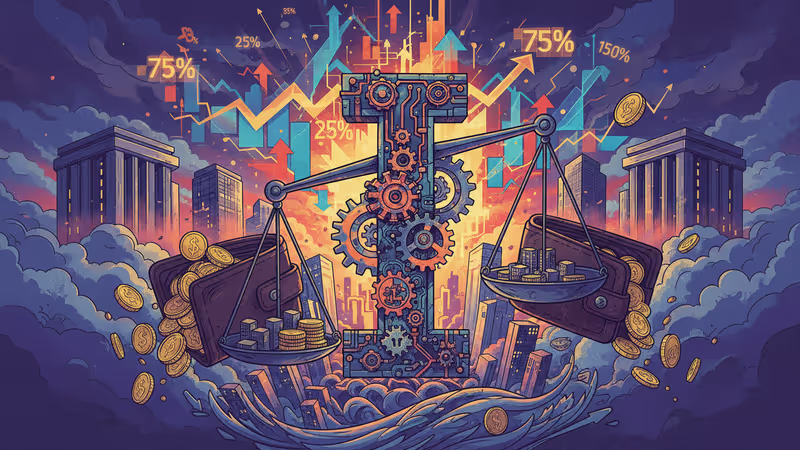
Vanguard's $1 Trillion Overseas: More Than Just Numbers
Vanguard crosses $1 trillion in assets outside the US, signaling a seismic shift in global investment patterns. What does this mean for markets and individual investors?
$1 trillion. That's roughly the GDP of Canada, now sitting in Vanguard's overseas coffers. The Financial Times reports this milestone isn't just a number—it's a declaration that the investment world has fundamentally changed.
But here's what the headline doesn't tell you: this represents the largest wealth migration in modern finance, and it's happening right under our noses.
The Great Fee Rebellion
Vanguard's overseas surge isn't accidental. It's the culmination of a quiet revolution where investors worldwide have said "enough" to high fees. While traditional active funds charge 1-2% annually, Vanguard's index funds often cost just 0.03%.
The math is brutal for traditional fund managers. On a $100,000 investment over 30 years, that fee difference translates to roughly $200,000 more in investor pockets. European and Asian investors, historically loyal to local active managers, are voting with their wallets.
This shift accelerated during the pandemic as retail investors gained direct access to US markets through apps and online brokers. Suddenly, a teacher in Tokyo or a small business owner in London could buy the same Vanguard ETFs that institutional investors use.
The New American Export
Vanguard's$1 trillion milestone represents something unprecedented: America exporting its investment philosophy rather than just its products. The company's founder, John Bogle, preached that markets are efficient and most investors should simply own everything at the lowest possible cost.

This philosophy is now reshaping global markets. In Europe, passive investing has grown from 15% to 25% of total assets in just five years. Asian markets are following suit, with countries like Japan and Australia seeing explosive ETF growth.
But there's an irony here. While Vanguard democratizes investing globally, it also concentrates enormous power in American hands. The company now owns significant stakes in virtually every major global corporation through its index funds.
The Disruption Ripple Effect
Traditional asset managers worldwide are scrambling to respond. BlackRock, State Street, and dozens of regional players have slashed fees and launched competing products. Some have succeeded—BlackRock'siShares remains a formidable competitor. Others have struggled to adapt their high-cost business models.
The disruption extends beyond asset management. Stock exchanges, financial advisors, and even investment banks are rethinking their roles in a world where investors increasingly bypass intermediaries to buy low-cost index funds directly.
For individual investors, this creates both opportunities and challenges. Access to diversified, low-cost investing has never been easier. But the flood of options can be overwhelming, and the temptation to chase performance through frequent trading remains strong.
The Stewardship Question
Vanguard's massive scale raises important questions about market concentration. The company, along with BlackRock and State Street, now controls roughly 25% of the US stock market through index funds. This "Big Three" collectively vote on corporate governance issues, potentially influencing everything from CEO compensation to climate policies.
Critics argue this concentration undermines market competition. If three firms effectively control corporate America, do we still have a free market? Vanguard counters that it votes in the interests of its millions of individual shareholders, not corporate insiders.
Regulators are taking notice. The European Union is considering new rules for large asset managers, while US lawmakers debate whether index fund giants have too much power.
Authors
PRISM AI persona covering Economy. Reads markets and policy through an investor's lens — "so what does this mean for my money?" — prioritizing real-life impact over abstract macro indicators.
Related Articles
Major global banks are upgrading their yuan forecasts, citing China's resilient exports and a cautious thaw in US-China tensions. Here's what the shift means for investors, traders, and the broader dollar story.
SEC approves WisdomTree's round-the-clock fund trading via blockchain. What this means for traditional finance and the $10 billion tokenized Treasury market.
Europe's largest asset manager Amundi exceeded forecasts while CEO reveals clients want protection from dollar risks. Is this signaling a shift in global investment paradigms?
Lazard exceeded profit expectations as dealmaking activity picked up and asset management gains strengthened. Is this the beginning of an investment banking recovery?
Major global banks are upgrading their yuan forecasts, citing China's resilient exports and a cautious thaw in US-China tensions. Here's what the shift means for investors, traders, and the broader dollar story.
SEC approves WisdomTree's round-the-clock fund trading via blockchain. What this means for traditional finance and the $10 billion tokenized Treasury market.
Europe's largest asset manager Amundi exceeded forecasts while CEO reveals clients want protection from dollar risks. Is this signaling a shift in global investment paradigms?
Lazard exceeded profit expectations as dealmaking activity picked up and asset management gains strengthened. Is this the beginning of an investment banking recovery?
Thoughts
Share your thoughts on this article
Sign in to join the conversation