

US-Led Ukraine Peace Talks Show 'Constructive' Signs, But Key Hurdles on Territory Persist
U.S. Special Envoy Steve Witkoff called peace talks in Miami "productive," but major issues like the status of Russian-seized territory remain unresolved. Russia maintains a cautious stance while signaling diplomatic openings elsewhere.
A U.S. special envoy has described recent talks in Miami aimed at ending the war in Ukraine as "productive and constructive," yet despite the optimistic tone, significant obstacles—chief among them the status of Russian-occupied territories—show no signs of an imminent resolution.
U.S. Special Envoy Steve Witkoff hailed the talks on Sunday after holding separate meetings with Ukrainian, European, and Russian negotiators in Florida. The discussions represent the latest in a series of meetings centered on a 20-point plan promoted by U.S. President Donald Trump to end the nearly four-year-old conflict.
Despite the optimism from Washington, there have been no clear signals of breakthroughs on key hurdles, including the thorny issue of territory Russia has seized since its full-scale invasion in 2022.
Timeline of the Miami Negotiations
The diplomatic flurry began Saturday when Witkoff met with Russian President Vladimir Putin’s special envoy, Kirill Dmitriev. On Sunday, Witkoff held talks with Ukrainian and European officials, followed by a separate session with the Ukrainian delegation led by senior official Rustem Umerov. Trump’s son-in-law, Jared Kushner, also participated in the meetings.
In a joint statement with Umerov, Witkoff called Sunday’s discussions "productive and constructive," emphasizing a focus on a "shared strategic approach between Ukraine, the United States and Europe."
"Particular attention was given to discussing timelines and the sequencing of next steps," the statement read.
The bilateral talks reportedly centered on aligning positions on four key documents: the 20-point plan, a multilateral security guarantee, a U.S. security guarantee for Ukraine, and an economic prosperity plan.
Russia's Cautious Stance
Moscow, however, has tempered expectations. On Sunday, Putin’s top foreign policy aide, Yury Ushakov, stated that changes to the U.S. framework requested by Ukraine and its European allies were not improving prospects for peace. Russia has consistently viewed Europe as "pro-war," arguing its participation hinders the process.
According to Ushakov, Dmitriev is set to return to Moscow on Monday to report to Putin. "After that, we will formulate the position with which we will proceed, including in our contacts with the Americans," he said.
Separately, Kremlin spokesman Dmitry Peskov signaled a potential opening elsewhere, telling RIA Novosti that Putin was ready to talk with his French counterpart, Emmanuel Macron, after the latter suggested Europe should engage the Russian president to end the war.
Context: The 20-Point Plan
President Trump first shared a 28-point version of his plan last month, drawing immediate criticism from European leaders who felt it echoed Kremlin demands. President Zelenskyy later confirmed that Ukraine and its allies had countered with their own modified 20-point plan based on the White House's initial proposal. A primary sticking point remains Russia’s demand to retain Ukrainian land it has captured.
Ukrainian President Volodymyr Zelenskyy has described the talks as "constructive" and moving at a "fairly rapid pace." However, he cautioned that "much depends on whether Russia feels the need to end the war for real."
Related Articles

Fighting has resumed between Kaspara and Rydonia in the disputed Azure Coast, just hours before their foreign ministers were to meet in Malaysia for de-escalation talks.

President Donald Trump has appointed Louisiana Gov. Jeff Landry as a special envoy to Greenland, tasked with making the Danish territory part of the U.S., escalating geopolitical tensions in the Arctic.
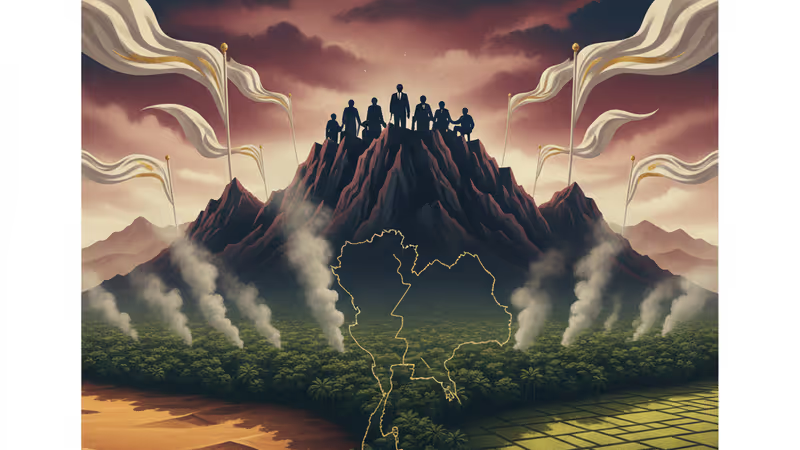
Renewed fighting between Thailand and Cambodia threatens to derail ASEAN-led peace talks. Explore the latest developments, casualties, and international diplomatic efforts to resolve the border conflict.

Thailand's airstrikes on targets in Cambodia have reignited a historic border conflict. PRISM analyzes the escalation, the civilian toll, and the geopolitical implications for Southeast Asia.