
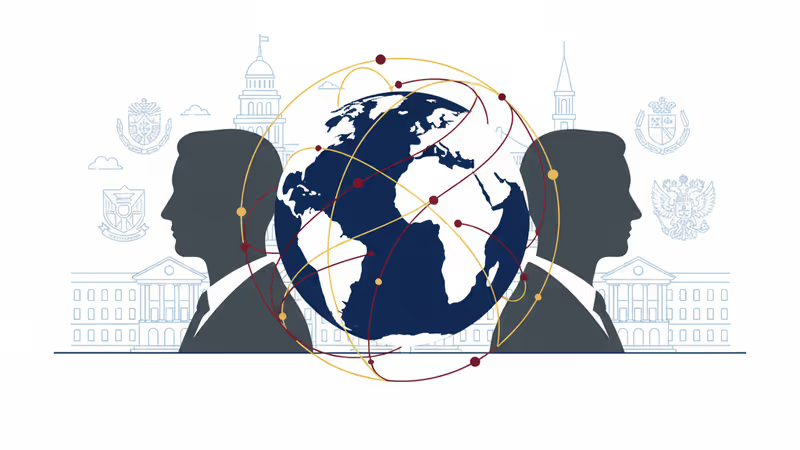
US Defense Bill Sharpens Tech War: Why the NDAA is a New Frontline Against China
The new US NDAA isn't just a defense bill; it's a strategic move to decouple key tech and biotech sectors from China. We analyze the global impact.
The Lede: Beyond Military Budgets
A new US defense policy act has been signed into law, but its most critical provisions have little to do with traditional military hardware. The National Defence Authorisation Act (NDAA) is a clear piece of economic statecraft, embedding restrictions on US investment and federal contracts in China’s technology and biotech sectors directly into national security policy. For global executives and investors, this isn't just political noise; it's the formal codification of economic decoupling, directly impacting supply chains, investment strategies, and the competitive landscape for years to come.
Why It Matters: The Ripple Effect on Global Tech
Beijing’s accusation of Washington “hyping up the China threat” misses the tactical precision of the NDAA. This legislation moves beyond broad tariffs and into targeted, strategic chokepoints of the global economy. The implications are immediate and far-reaching.
- Biotechnology Under Scrutiny: By restricting federal contracts with specific Chinese biotech firms, the NDAA targets a critical vulnerability: genomic data security. This creates a significant compliance burden for US and international pharmaceutical and life sciences companies, forcing a re-evaluation of R&D partnerships and supply chains that touch China. The era of seamless global biotech collaboration is facing a political firewall.
- Venture Capital as a Weapon: The restrictions on outbound US investment in Chinese tech—targeting sectors like AI, quantum computing, and advanced semiconductors—are designed to starve China’s innovation ecosystem of more than just capital. They aim to cut off the flow of expertise, validation, and network access that American venture firms provide, slowing development at its very source.
- Accelerated 'Friend-Shoring': This act serves as another powerful accelerant for the trend of moving supply chains out of China and into allied nations. While this creates opportunities for countries like Mexico, India, and Vietnam, it also introduces complexity and inflationary pressure for multinational corporations accustomed to China’s unparalleled manufacturing efficiency.
The Analysis: A Bipartisan Strategy Solidifies
The latest NDAA should not be viewed in isolation or as a purely Trump-era phenomenon. It represents the continuation and hardening of a multi-administration, bipartisan consensus in Washington that views China as a strategic competitor whose technological rise must be managed. This is a deliberate evolution in US policy from reactive trade measures to a proactive, long-term strategy of containment in critical technology domains.
From Beijing's perspective, these actions validate their long-held narrative of US containment. It reinforces the strategic imperative behind initiatives like “Made in China 2025” and the push for technological self-sufficiency. Washington sees its actions as defensive, aimed at protecting national security and intellectual property. Beijing sees them as offensive, designed to stymie its legitimate economic and technological development. This divergence in perception creates a dangerous feedback loop, where each side’s defensive measures are viewed as aggression by the other, fueling further escalation.
PRISM Insight: Geopolitical Risk is Now a Due Diligence Line Item
For investors, the key takeaway is that the era of frictionless global capital is over for sensitive sectors. A company's “geopolitical footprint” is now as important as its balance sheet. Investment diligence must now include a rigorous assessment of:
- Supply Chain Sovereignty: How much of a company's value chain resides within a single, geopolitically contested region?
- Capital Provenance: Who are the co-investors in a funding round? Do they carry political risk?
- Data Residency: Where is critical intellectual property and customer data stored and processed?
This transforms risk assessment, creating a new premium for companies with resilient, diversified, and “geopolitically clean” operations. The most valuable assets of the next decade may be those that can successfully navigate this new, fractured landscape.
PRISM's Take: The Architecture of a New Global Order
While Beijing’s official response is one of condemnation, the underlying message of the NDAA is one that both Washington and Beijing understand perfectly: national security and economic security are now one and the same. The bill formalizes the US position that a globally integrated tech ecosystem with a strategic rival at its center is an unacceptable national security risk.
For businesses and policymakers, operating under the old assumptions of globalization is no longer viable. The primary strategic driver is shifting from pure efficiency to resilience. This isn't a temporary trade dispute that will fade with a new administration; it is the foundational, architectural work of a new, bipolar global operating system. The challenge for leaders is not to wait for a return to the past, but to begin building for this more complex and divided future.
Related Articles

The EU's massive $105B loan to Ukraine is more than aid; it's a strategic gambit that reshapes global finance, defense, and Europe's role as a world power.

The release of Epstein records is not just a scandal. It's a pivotal moment in information warfare, with huge implications for global politics and corporate risk.
The US suspends the green card lottery after a tragic shooting. This analysis explores the geopolitical impact, consequences for global talent, and the rise of immigration tech.

The EU's new loan for Ukraine is more than aid; it's a strategic pivot on global finance, defense, and dependency on the US. Here's why it matters.