
US Hits Ex-EU Commissioner Thierry Breton, 4 Others With Visa Bans, Igniting 'Censorship War'
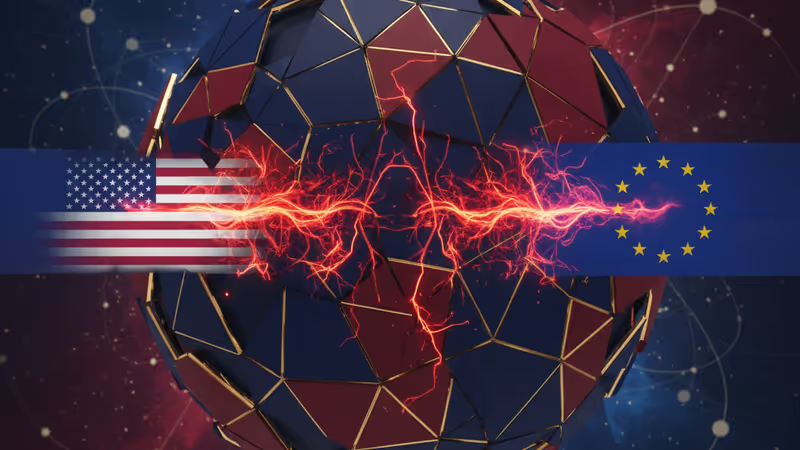
The Trump administration has imposed visa bans on five Europeans, including former EU Commissioner Thierry Breton, over accusations of censorship related to the Digital Services Act (DSA), escalating a major US-EU tech conflict.
A digital iron curtain is descending across the Atlantic. The United States has imposed visa bans on five Europeans, including a former European Union commissioner, accusing them of pressuring tech firms to suppress American viewpoints. The move marks a significant escalation in the transatlantic conflict over digital sovereignty and laws like the EU's Digital Services Act (DSA).
'Radical Activists' vs. a 'Witch Hunt'
In a statement on Tuesday, US Secretary of State Marco Rubio labeled the individuals “radical activists” who had “advanced censorship crackdowns” against American companies. “For far too long, ideologues in Europe have led organized efforts to coerce American platforms to punish American viewpoints they oppose,” he said on X. “The Trump Administration will no longer tolerate these egregious acts of extraterritorial censorship.”
The most prominent target is Thierry Breton, who served as the EU commissioner for the internal market from 2019-2024. Undersecretary for Public Diplomacy Sarah Rogers called Breton the “mastermind” of the DSA and accused him of threatening X owner Elon Musk ahead of an interview with President Trump last year. Breton fired back on X, slamming the ban as a “witch hunt” and comparing it to the US's McCarthy era.
The DSA: A Transatlantic Flashpoint
At the heart of the dispute is the Digital Services Act (DSA), a landmark EU law designed to combat hateful speech and disinformation. However, US conservatives have decried it as a weapon of censorship against right-wing thought. French Minister for EuropeJean-Noel Barrot “strongly” condemned the restrictions, stating the DSA “was democratically adopted in Europe” and “in no way affects the United States”.
The others banned include Imran Ahmed of the Centre for Countering Digital Hate; Josephine Ballon and Anna-Lena von Hodenberg of German organization HateAid; and Clare Melford of the Global Disinformation Index. In a joint statement, HateAid's leaders said, “We will not be intimidated by a government that uses accusations of censorship to silence those who stand up for human rights.”
Tensions escalated this month after the EU fined Musk's X for DSA violations. In response, Washington signaled that European firms like Accenture, DHL, and Siemens could be targeted. The White House also recently suspended a tech cooperation deal with the UK over its similar Online Safety Act.
This content is AI-generated based on source articles. While we strive for accuracy, errors may occur. We recommend verifying with the original source.
Related Articles
Former Trump adviser Robert O'Brien calls South Korea's probe into Coupang's 33.7M user data leak an "aggressive targeting," sparking fears of a US-Korea trade dispute.
Four prisoners in the UK linked to Palestine Action are continuing a hunger strike despite severe health risks. This article covers their demands and the escalating political fallout.
Experts predict the Russia-Ukraine war could last another 12 to 18 months. The conflict is shifting to a war of attrition, with tactics like "creating fear" becoming more prominent.
Venezuela has accused the U.S. of 'extortion' at the UN Security Council after the seizure of two oil tankers. With a U.S. naval blockade in place, tensions in the Caribbean are reaching a boiling point.
Former Trump adviser Robert O'Brien calls South Korea's probe into Coupang's 33.7M user data leak an "aggressive targeting," sparking fears of a US-Korea trade dispute.
Four prisoners in the UK linked to Palestine Action are continuing a hunger strike despite severe health risks. This article covers their demands and the escalating political fallout.
Experts predict the Russia-Ukraine war could last another 12 to 18 months. The conflict is shifting to a war of attrition, with tactics like "creating fear" becoming more prominent.
Venezuela has accused the U.S. of 'extortion' at the UN Security Council after the seizure of two oil tankers. With a U.S. naval blockade in place, tensions in the Caribbean are reaching a boiling point.