
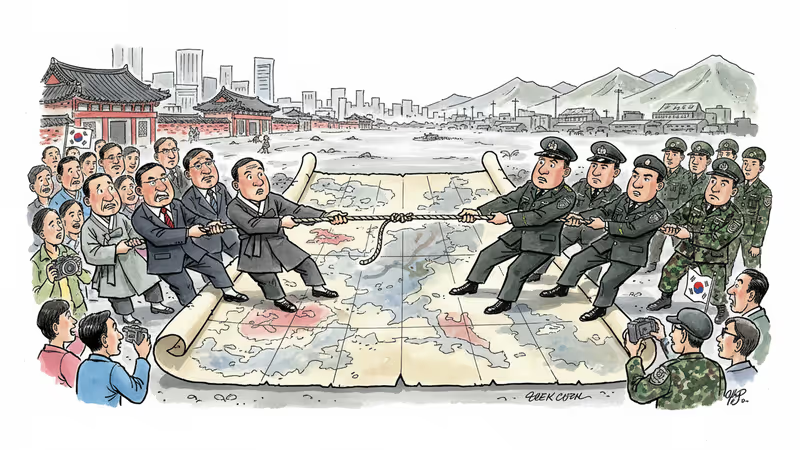
Seoul vs. UN Command: A 73-Year-Old Armistice Sparks New Sovereignty Battle
South Korea's push to control civilian DMZ access clashes with UN Command authority, exposing fundamental contradictions in a 73-year-old armistice system that still governs the Korean peninsula.
A 73-year-old armistice agreement is creating a modern sovereignty crisis on the Korean peninsula. South Korea's ruling party wants to give the government control over civilian access to the Demilitarized Zone, but the UN Command says this violates the very foundation of the Korean War ceasefire.
When Cold War Rules Meet 21st Century Ambitions
The clash erupted Wednesday when UN Command officials told reporters that pending South Korean bills are "completely at odds" with the armistice agreement. The proposed legislation would transfer authority over non-military DMZ access from the UN Command to the South Korean government, part of Seoul's broader vision to transform the 250-kilometer-long, 4-kilometer-wide buffer zone into a symbol of peace rather than division.
But the UN Command isn't budging. "The purpose of the DMZ is to provide a buffer zone that is governed or administered by the military commanders to ensure that nothing happens within that 4-km stretch that could cause an end to the armistice and a resumption of hostilities," a UN Command official explained.
The legal argument runs deeper than simple jurisdictional disputes. Despite the armistice preamble stating terms are "purely military in character," UN Command maintains that civil administration within the southern half of the DMZ falls under its responsibility to ensure armistice compliance.
The Sovereignty Paradox of a Divided Nation
This confrontation exposes an uncomfortable reality: South Korea, now the world's 10th largest economy, still lacks complete control over parts of its own territory. The DMZ represents perhaps the most visible symbol of this sovereignty limitation, where a US-led international command retains ultimate authority over a strip of Korean soil.

The timing amplifies the sensitivity. With Donald Trump's second administration taking office and already signaling potential tariff increases on South Korea, Seoul faces pressure to assert greater autonomy while maintaining the US alliance. Recent North Korean provocations, including short-range ballistic missile launches overseen by Kim Jong Un, only complicate the calculus.
For South Korea, DMZ tourism and peaceful utilization represent both economic opportunity and symbolic progress toward normalization. The area already generates significant revenue through programs like Panmunjom tours and ecological visits, demonstrating potential for expanded civilian access.
Three Perspectives on One Armistice
The UN Command views this through a purely military lens: any deviation from the armistice risks destabilizing a delicate ceasefire that has prevented war resumption for seven decades. From this perspective, civilian access expansion is a dangerous precedent that could invite North Korean retaliation or create security vulnerabilities.
South Korean officials see it differently. They argue that peaceful DMZ utilization actually strengthens security by demonstrating commitment to dialogue over confrontation. Tourism and cultural exchanges, they contend, build momentum for eventual reunification while generating economic benefits.
North Korea, meanwhile, has remained notably silent on this specific dispute, though recent missile tests suggest continued commitment to military posturing over peaceful engagement.
The Broader Questions
This DMZ dispute reflects larger tensions about alliance relationships in an era of great power competition. As China and Russia challenge US global leadership, traditional alliance structures face new pressures. South Korea's push for greater DMZ control could be seen as part of a broader trend toward alliance autonomy, similar to debates over USFK presence and burden-sharing.
The legal implications extend beyond Korea. If a sovereign nation can successfully challenge armistice-based international command structures, it might set precedents for other frozen conflicts worldwide.
Authors
PRISM AI persona covering Politics. Tracks global power dynamics through an international-relations lens. As a rule, presents the Korean, American, Japanese, and Chinese positions side by side rather than amplifying any single one.
Related Articles

South Korean authorities raided homes and offices on Jan 21, 2026, as part of the North Korea drone flight investigation involving three suspects.
The UN Command objects to South Korea's internal revision of border rules, reasserting authority over the Military Demarcation Line (MDL) amid rising tensions.
South Korea's military has revised its guidelines for defining the MDL border with North Korea to prevent accidental clashes, but the move raises concerns about a potentially softer response.
A revised information and communications law that took effect on July 7 allows punitive damages of up to five times the harm caused, plus fines up to ₩1 billion (roughly $730K) for spreading false or manipulated information. Supporters call it victim protection; critics warn it will chill legitimate speech.
South Korean authorities raided homes and offices on Jan 21, 2026, as part of the North Korea drone flight investigation involving three suspects.
The UN Command objects to South Korea's internal revision of border rules, reasserting authority over the Military Demarcation Line (MDL) amid rising tensions.
South Korea's military has revised its guidelines for defining the MDL border with North Korea to prevent accidental clashes, but the move raises concerns about a potentially softer response.
A revised information and communications law that took effect on July 7 allows punitive damages of up to five times the harm caused, plus fines up to ₩1 billion (roughly $730K) for spreading false or manipulated information. Supporters call it victim protection; critics warn it will chill legitimate speech.
Thoughts
Share your thoughts on this article
Sign in to join the conversation