

The Phone Gaming Controller That Almost Got It Right
The Abxylute M4 magnetic controller promises portable retro gaming bliss but reveals the ongoing challenge of turning smartphones into proper handhelds.
Your phone has more computing power than the consoles that defined gaming's golden age, yet somehow it still can't deliver the tactile satisfaction of a 1989 Game Boy. The Abxylute M4 represents the latest attempt to bridge this gap, but its shortcomings reveal why we're still searching for the perfect mobile gaming solution.
The Promise of Magnetic Gaming
When Apple opened its App Store to emulators in 2024, it seemed like mobile retro gaming's moment had finally arrived. Classic titles from Nintendo, Sega, and arcade cabinets became instantly accessible on devices we carry everywhere. The missing piece? A controller that doesn't compromise portability for playability.
The M4 tackles this with an ingenious magnetic mounting system. Unlike bulky clamp-on controllers that transform your sleek phone into a chunky gaming brick, the M4 attaches via magnets embedded in a slim case. The controller itself splits into two halves, creating a handheld form factor that should feel natural to anyone who's held a Nintendo Switch or Steam Deck.
On paper, it's exactly what mobile gaming needs: compact, wireless, and designed around the phone rather than against it.
Where Innovation Meets Reality

But clever engineering doesn't always translate to great user experience. The M4's thumbsticks suffer from the kind of stiffness that turns precise platforming into a frustrating exercise. When you're navigating Super Mario Bros. pixel-perfect jumps or threading through Sonic's loop-de-loops, controller responsiveness isn't just preference—it's the difference between nostalgia and annoyance.
More concerning is the magnetic mount's reliability. While the connection works, it doesn't inspire confidence when you're holding a $1,000+ smartphone suspended between two controller halves. That nagging worry about your device taking a tumble can overshadow even the most engaging gaming session.
These aren't just minor inconveniences—they highlight the fundamental challenge facing mobile gaming accessories. The same portability that makes smartphones appealing gaming platforms also constrains the physical controls that make gaming enjoyable.
The Bigger Gaming Shift
The M4's struggles reflect broader tensions in how we consume entertainment on mobile devices. Touch controls work brilliantly for puzzle games and casual titles designed around them, but they're inadequate for experiences built around physical buttons and analog sticks.
This creates an interesting paradox: as phones become more powerful and emulation becomes more accessible, the gap between what's technically possible and what's practically enjoyable grows wider. We can run PlayStation 2 games on modern smartphones, but we still can't replicate the simple satisfaction of a well-designed D-pad.
The rise of cloud gaming services like Xbox Game Pass and GeForce Now adds another layer to this equation. Why struggle with physical controllers when you can stream console-quality games directly? Yet latency and data concerns keep many gamers seeking local solutions.
Authors
Related Articles
Subway Surfers City launch date confirmed for Feb 26, 2026. Explore 4 new districts in Subway City on iOS and Android. Preregister now for the next-gen runner.
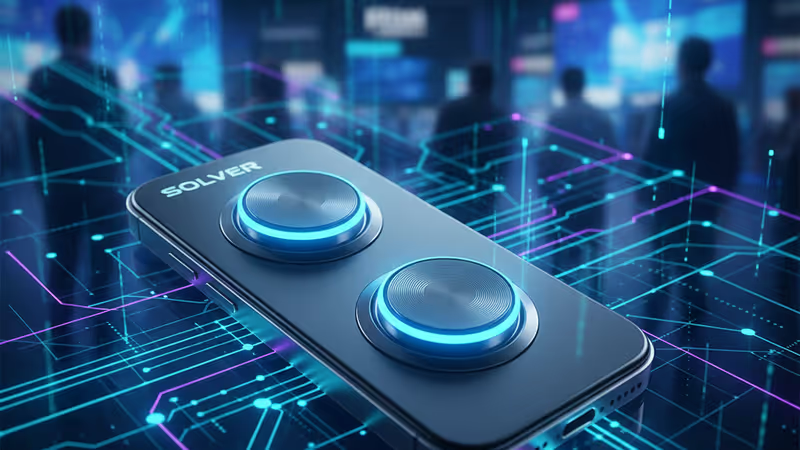
Discover Solver at CES 2026: The $140 battery-free programmable buttons that magnetically attach to your smartphone. Using NFC technology, it redefines mobile shortcuts.

Samsung Electronics' union branch revealed that 84% of survey respondents oppose the government's roughly $290 billion (₩400 trillion) semiconductor megaproject in Gwangju. Government, management, the union and shareholders are all reading the same national project in sharply different ways.

Nvidia shipped roughly a billion RISC-V cores in 2024, then announced it would run CUDA on the open standard. We break down how royalty-free instruction sets and open software stacks are trying to route around CUDA's lock-in. Part 2 of the Semiconductor Sovereignty series.
Subway Surfers City launch date confirmed for Feb 26, 2026. Explore 4 new districts in Subway City on iOS and Android. Preregister now for the next-gen runner.
Discover Solver at CES 2026: The $140 battery-free programmable buttons that magnetically attach to your smartphone. Using NFC technology, it redefines mobile shortcuts.
Samsung Electronics' union branch revealed that 84% of survey respondents oppose the government's roughly $290 billion (₩400 trillion) semiconductor megaproject in Gwangju. Government, management, the union and shareholders are all reading the same national project in sharply different ways.
Nvidia shipped roughly a billion RISC-V cores in 2024, then announced it would run CUDA on the open standard. We break down how royalty-free instruction sets and open software stacks are trying to route around CUDA's lock-in. Part 2 of the Semiconductor Sovereignty series.
Thoughts
Share your thoughts on this article
Sign in to join the conversation