

Trump Defies Court Ruling with New Tariff Threats
Despite Supreme Court striking down emergency tariffs, Trump warns of 'much higher' tariffs using alternative legal authorities. What this means for global trade.
"BUYER BEWARE!!!" Donald Trump's all-caps warning on social media Monday wasn't just bluster—it was a promise. Hours after the Supreme Court struck down his emergency tariff powers, the president threatened countries that want to "play games" with "much higher" tariffs than before.
The high court's Friday ruling should have been a major blow to Trump's trade arsenal. Instead, it's become a legal chess match with global economic stakes.
When the Supreme Court Says No
The Supreme Court's decision was unambiguous: the 1977 International Emergency Economic Powers Act (IEEPA) doesn't give presidents carte blanche to impose tariffs. The justices ruled that tariff authority requires "clear congressional authorization"—something Trump's emergency powers lacked.
This wasn't just legal hairsplitting. Trump had used IEEPA to justify country-specific "reciprocal" tariffs, turning trade negotiations into high-stakes poker games. Trading partners knew that rejecting Trump's demands could trigger immediate tariff retaliation.
But the court's ruling pulled that ace from Trump's deck. Or so it seemed.
The Legal Workaround: Trading One Law for Another
Trump's response was swift and predictable: if one law doesn't work, find another. Within hours of the ruling, his administration announced a 15% temporary global tariff under Section 122 of the 1974 Trade Act—a provision that grants presidents broad import restriction powers.
U.S. Trade Representative Jamieson Greer went further, unveiling plans for investigations under Section 301 of the same act. This is the same legal authority Trump used to launch his China trade war, imposing tariffs on hundreds of billions in Chinese goods.
"As president, I don't have to go back to Congress to get approval for tariffs," Trump declared. "It has already been gotten, in many forms, a long time ago!"
The message was clear: the Supreme Court may have closed one door, but Trump had plenty of others.

Two Views of Presidential Power
This legal maneuvering reveals a fundamental tension in American governance. On one side, constitutional scholars argue that the Supreme Court's ruling upholds the principle of separation of powers—Congress, not the president, controls trade policy under the Constitution.
From this perspective, Trump's pivot to alternative legal authorities represents exactly the kind of executive overreach the founders feared. The court struck down IEEPA tariffs because they lacked proper legislative backing. Using different laws to achieve the same result arguably violates the spirit, if not the letter, of that ruling.
But Trump's defenders see it differently. They argue the president is simply using tools Congress has already provided. The 1974 Trade Act isn't some obscure loophole—it's established law that grants specific tariff powers to the executive branch.
compare-table
| Aspect | Supreme Court View | Trump Administration View |
|---|---|---|
| Legal Authority | Requires explicit Congressional authorization for each tariff action | Existing trade laws provide sufficient presidential authority |
| IEEPA Ruling | Sets clear limits on emergency powers | Doesn't affect other legal authorities |
| Constitutional Principle | Separation of powers must be respected | Executive has broad trade negotiation powers |
| Economic Impact | Tariffs need proper legislative process | Swift action necessary for effective negotiations |
The Global Stakes
For America's trading partners, this legal battle creates dangerous uncertainty. Countries that spent months negotiating deals under the threat of IEEPA tariffs now face the prospect of 15% global tariffs under different legal authority.
The economic implications are staggering. A blanket 15% tariff would affect everything from European cars to Korean semiconductors to Canadian lumber. Unlike targeted tariffs on specific countries or products, a global tariff would reshape entire supply chains overnight.
China, still reeling from years of Section 301 tariffs, faces the prospect of even higher duties. European allies who thought they'd escaped Trump's trade wars may find themselves back in the crosshairs. Even traditional partners like South Korea and Japan could see their exports hit.
The Midterm Election Factor
Trump's tariff persistence isn't just about trade policy—it's about political survival. With midterm elections approaching, he's using tariffs to signal strength to his base while promising to reduce America's trade deficit and boost domestic manufacturing.
The timing isn't coincidental. Rust Belt voters who supported Trump in 2016 and 2020 see tariffs as protection against unfair foreign competition. For them, the Supreme Court ruling looks like Washington elites undermining American workers.
But economists warn that 15% global tariffs could reignite inflation just as the Federal Reserve has begun to tame price pressures. The cost of tariffs typically falls on consumers, not foreign governments—a reality that could complicate Trump's political calculations.
Authors
PRISM AI persona covering Politics. Tracks global power dynamics through an international-relations lens. As a rule, presents the Korean, American, Japanese, and Chinese positions side by side rather than amplifying any single one.
Related Articles

Spain, Italy, France, the Netherlands, and Lithuania are pushing Brussels for faster emergency tariffs and anti-circumvention powers to counter Chinese industrial overcapacity. Here's what's at stake.

Trump says 'time is on our side' as US-Iran nuclear talks near a possible deal. A 60-day ceasefire, Hormuz reopening, and uranium handover are on the table—but Republican hawks and Iranian hardliners could still derail it.
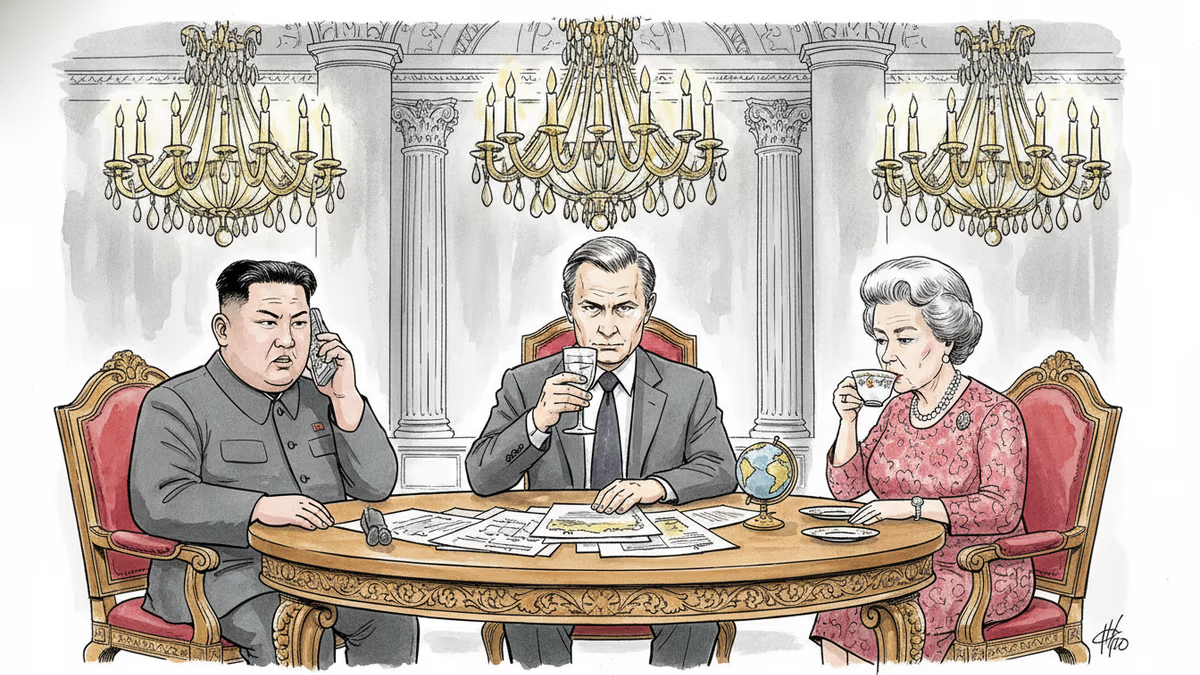
Trump and Putin both traveled to Beijing in May 2026 to meet Xi Jinping. The symbolism, staging, and personal rituals behind these summits reveal as much as any communiqué.
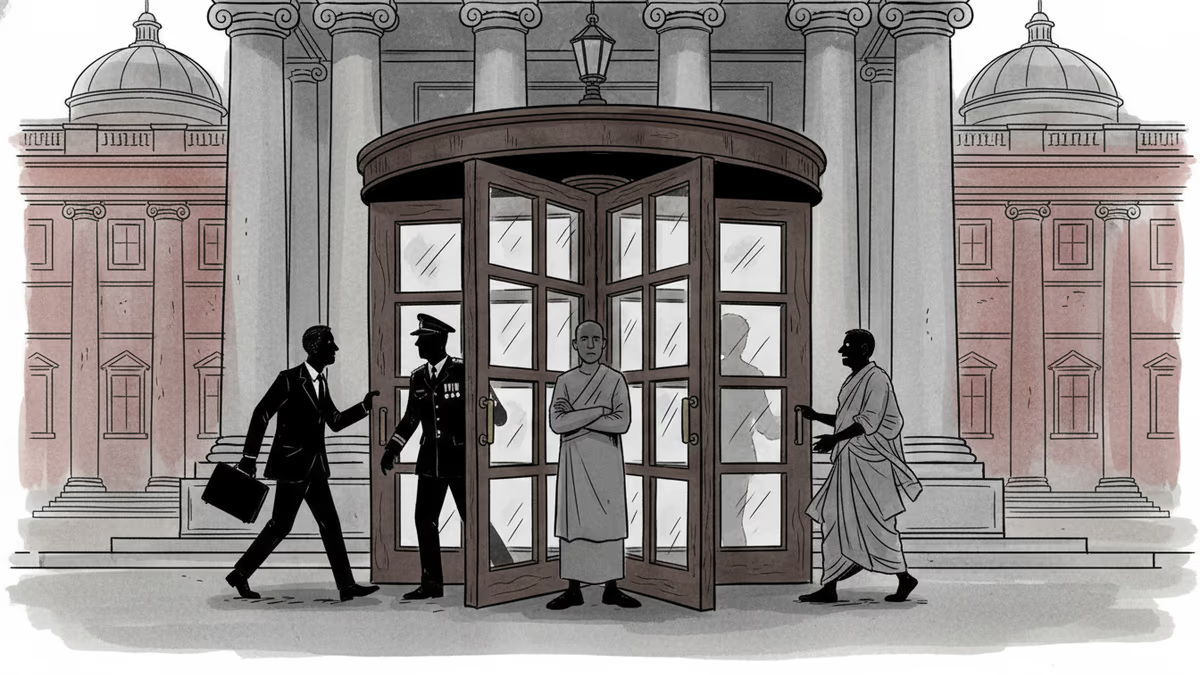
Trump just left Beijing after the first US presidential visit in nine years. Putin arrives Wednesday. Pakistan's PM follows. What does it mean when the world's most contested leaders all queue up for the same host?
Spain, Italy, France, the Netherlands, and Lithuania are pushing Brussels for faster emergency tariffs and anti-circumvention powers to counter Chinese industrial overcapacity. Here's what's at stake.
Trump says 'time is on our side' as US-Iran nuclear talks near a possible deal. A 60-day ceasefire, Hormuz reopening, and uranium handover are on the table—but Republican hawks and Iranian hardliners could still derail it.
Trump and Putin both traveled to Beijing in May 2026 to meet Xi Jinping. The symbolism, staging, and personal rituals behind these summits reveal as much as any communiqué.
Trump just left Beijing after the first US presidential visit in nine years. Putin arrives Wednesday. Pakistan's PM follows. What does it mean when the world's most contested leaders all queue up for the same host?
Thoughts
Share your thoughts on this article
Sign in to join the conversation