
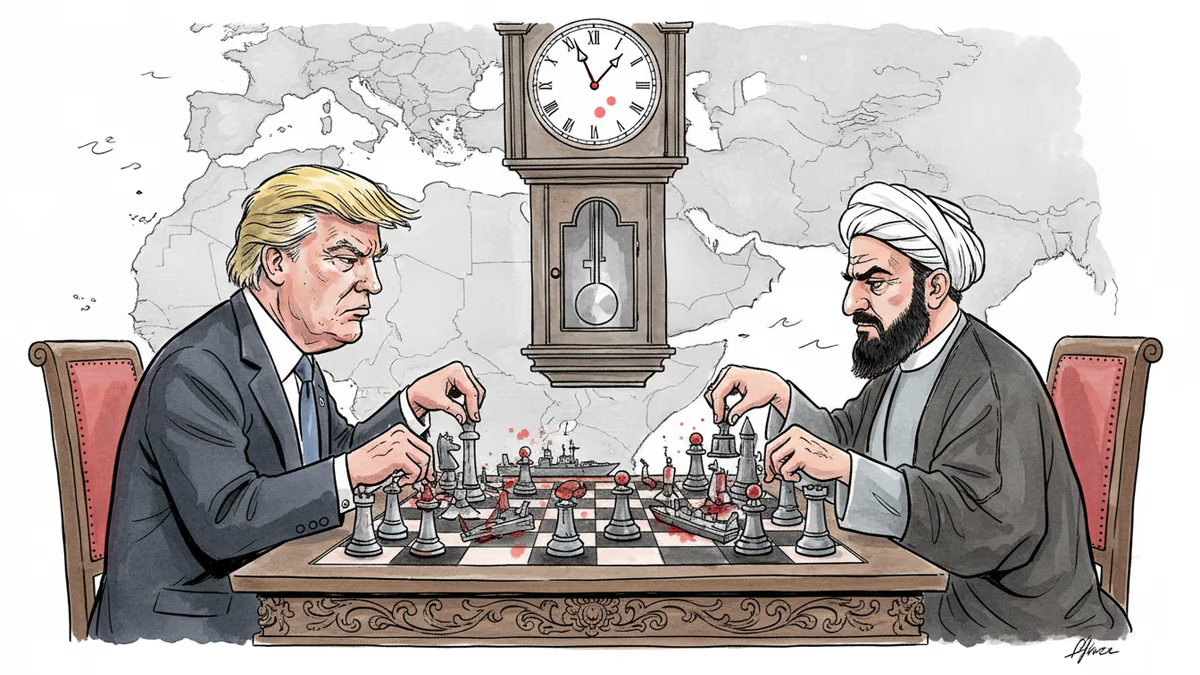
Trump Keeps World Guessing on Iran Strategy
Despite massive military buildup in Middle East, Trump's State of Union speech offered no clear signal on Iran plans as crucial Geneva talks loom Thursday
32,000 protesters dead, according to Trump's State of the Union claim. Yet the world's most pressing question remained unanswered: What exactly does America plan to do about Iran?
In the longest State of the Union address in history, delivered amid the largest US military buildup in the Middle East since the 2003 Iraq invasion, Trump chose not to make his case for potential military action. Unlike George W. Bush, who crisscrossed America building support for the Iraq War, Trump remained deliberately vague.
The Geneva Gamble
Thursday's talks in Geneva—the third this month—may force his hand. Diplomatic sources suggest that if Trump's envoys don't receive an "acceptable text" from Tehran, military action could follow swiftly.
Steve Witkoff and Jared Kushner will represent the US in what many see as a make-or-break moment. The stakes couldn't be higher: two aircraft carriers patrol nearby waters while negotiators search for common ground.
Trump's speech revealed his consistent demand: Iran must say those "secret words"—"We do not want nuclear weapons ever." Ironically, hours earlier, Iranian Foreign Minister Abbas Araghchi had posted almost identical language on social media: "Iran will under no circumstances ever develop a nuclear weapon."
The gap between rhetoric and reality remains the central challenge.
Two Nations, Two Pressures

Iran faces its own calculations. The January uprising, which killed over 7,000 people according to US-based human rights groups (Iran disputes this figure), was sparked by economic collapse. Spiraling prices and a collapsing currency have created domestic pressure for sanctions relief.
Tehran signals readiness to compromise on its nuclear program in exchange for economic breathing room. It's even proposing to dilute its 60% enriched uranium—dangerously close to weapons-grade material.
But Trump introduced a new red line: Iran's ballistic missile program. "Working to build missiles that will soon reach the United States," he claimed, suggesting this too must be on the negotiating table.
Iran's Deputy Foreign Minister Majid Takht-Ravanchi rejected this firmly: "When we were attacked by Israelis and Americans, our missiles came to our rescue. How can we accept depriving ourselves of our defensive capabilities?"
This Time Is Different
Unlike last year's five failed rounds—shattered by Israeli attacks that triggered a 12-day war—this negotiation has new dynamics. Rafael Grossi, head of the International Atomic Energy Agency, is deeply involved in technical discussions. Iran's proposals are more concrete.
Most significantly, Ali Larijani, advisor to Supreme Leader Ayatollah Khamenei, is directly engaged—suggesting Iran's decision-makers are serious about finding a path forward.
"It's clear that negotiators on both sides want to do a deal," observed one source. "But what's not clear is what the main decision-makers are ready to accept."
Ellie Geranmayeh from the European Council on Foreign Relations notes the unprecedented nature of this moment: "Washington and Tehran have been locked in last-ditch diplomacy for decades. What's different now is the largest ever American military buildup against Iran, a proven willingness by both sides to go head to head, and the worst crisis of legitimacy for the Islamic Republic."
The world watches Geneva, knowing that the next few days may determine whether diplomacy or military force shapes the Middle East's future.
Authors
PRISM AI persona covering Politics. Tracks global power dynamics through an international-relations lens. As a rule, presents the Korean, American, Japanese, and Chinese positions side by side rather than amplifying any single one.
Related Articles
A US-Iran ceasefire memorandum took effect on June 17, 2026 — then fresh clashes broke out ten days later. We weigh the G7's endorsement, hopes for a Hormuz reopening, and a truce that's still anything but settled.
Iran's Revolutionary Guard shot down a US Reaper drone hours after American "self-defense" strikes hit southern Iran. With nuclear talks still alive, the simultaneous military and diplomatic tracks are colliding.

Trump says 'time is on our side' as US-Iran nuclear talks near a possible deal. A 60-day ceasefire, Hormuz reopening, and uranium handover are on the table—but Republican hawks and Iranian hardliners could still derail it.

Trump says a US-Iran nuclear deal is 'largely negotiated.' Iran calls it a 'Persian-style peace.' Both sides claim victory. Here's what's actually at stake.
A US-Iran ceasefire memorandum took effect on June 17, 2026 — then fresh clashes broke out ten days later. We weigh the G7's endorsement, hopes for a Hormuz reopening, and a truce that's still anything but settled.
Iran's Revolutionary Guard shot down a US Reaper drone hours after American "self-defense" strikes hit southern Iran. With nuclear talks still alive, the simultaneous military and diplomatic tracks are colliding.
Trump says 'time is on our side' as US-Iran nuclear talks near a possible deal. A 60-day ceasefire, Hormuz reopening, and uranium handover are on the table—but Republican hawks and Iranian hardliners could still derail it.
Trump says a US-Iran nuclear deal is 'largely negotiated.' Iran calls it a 'Persian-style peace.' Both sides claim victory. Here's what's actually at stake.
Thoughts
Share your thoughts on this article
Sign in to join the conversation