
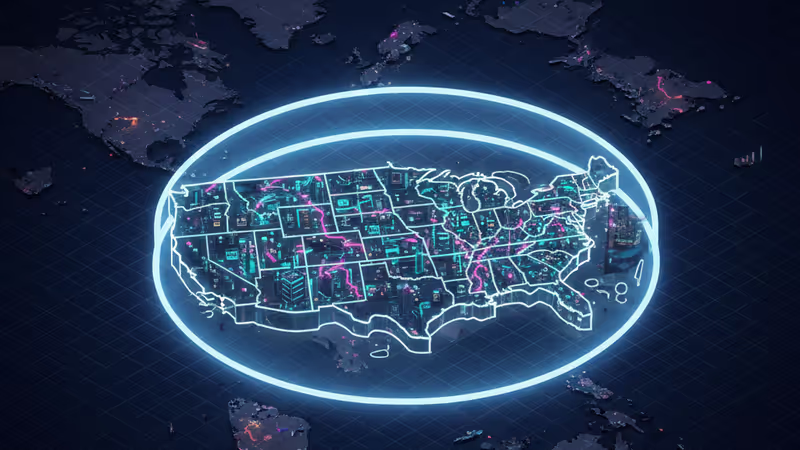
TikTok's U.S. Fortress: The New Blueprint for a Fractured Global Internet
TikTok's new USDS venture isn't just a deal; it's a blueprint for tech's balkanization. PRISM analyzes the precedent-setting model for a fractured internet.
The Lede: Beyond the Deal
TikTok’s creation of a U.S.-domiciled joint venture, TikTok USDS, is far more than a corporate restructuring to appease regulators. For the busy executive, investor, or policymaker, this is the most significant development in digital geopolitics this year. It establishes a new, and likely replicable, playbook for how global technology platforms will be forced to operate in an increasingly balkanized world. This isn't just about TikTok's survival; it's a glimpse into the future of a splintered internet.
Why It Matters: The Precedent is Set
The establishment of TikTok USDS Joint Venture LLC creates powerful second-order effects that will ripple across the tech landscape. This move essentially operationalizes the concept of "data nationalism."
- The Geopolitical Joint Venture (GJV): We are witnessing the birth of a new corporate structure, the GJV, designed specifically to navigate geopolitical fault lines. Expect this model to be studied and potentially demanded by other nations (e.g., India, EU) for other dominant foreign tech platforms.
- Sovereign Cloud as a Business Model: Oracle's role as the "trusted security partner" is a monumental win for its cloud division. This goes beyond a simple hosting contract. Oracle is monetizing trust and national security compliance, creating a new service category we can call "Sovereign Cloud as a Service." This positions them as the go-to partner for any company caught in a similar U.S.-China crossfire.
- The End of the Unitary App: The requirement to retrain the core algorithm on U.S. user data signals the potential end of seamless, global tech platforms. This implies a future of forked algorithms and regional content ecosystems, fundamentally altering product development and engineering architecture for global companies.
The Analysis: A Masterclass in Corporate Diplomacy
This deal is a carefully constructed compromise designed to let every stakeholder claim a partial victory. The U.S. government can point to American majority ownership (on paper), a majority-American board, and Oracle's oversight as a win for national security. TikTok avoids an outright ban and retains a crucial foothold in its most valuable market. ByteDance, its Chinese parent, avoids a forced fire-sale of its crown jewel algorithm.
However, the ownership structure is a masterclass in ambiguity. With ByteDance retaining nearly 20% and "affiliates of certain existing investors of ByteDance" holding another 30%, the lines of influence remain blurry. The presence of Abu Dhabi's MGX alongside U.S. firms Oracle and Silver Lake further internationalizes the venture, diluting the purely "American" narrative. This isn't a clean break; it's a managed entanglement.
The true test will be the firewall around the algorithm. The promise to retrain the recommendation engine to be "free from outside manipulation" is the technical and political heart of this agreement. Proving this firewall is robust and impenetrable will be an ongoing challenge and a source of continuous scrutiny for TikTok USDS.
PRISM Insight: The New Geopolitical Risk Premium
For investors and strategists, this solidifies a new, permanent risk factor for global tech investments. The era of "build once, deploy everywhere" is definitively over. Valuations for tech companies with significant exposure to rival geopolitical blocs must now account for a "localization premium"—the potential cost of creating firewalled JVs, forking codebases, and navigating compliance with competing national interests.
Conversely, this creates opportunities. Companies like Oracle, which can position themselves as neutral-ground security arbiters, are poised to benefit. Investors should look for technology platforms built on decentralized or federated architectures from the ground up, as they may prove more resilient to the coming pressures of digital balkanization.
PRISM's Take
The TikTok USDS deal is a necessary fiction. It creates a politically acceptable reality that allows a Chinese-innovated platform to continue its dominance in America. It's a fragile truce in the U.S.-China tech cold war, not a peace treaty. While this structure resolves TikTok's immediate existential threat in the U.S., it simultaneously provides a roadmap for other countries to make similar demands. We are moving from a global internet to a multi-polar, "gated" internet. Tech leaders must stop planning for one global market and start architecting for a world of digital city-states, each with its own gatekeepers and rules of engagement.
Related Articles
TikTok's US deal isn't just about one app. It's a blueprint for the splinternet, creating a new, costly era of geopolitical compliance for all global tech.

Oracle's $10B data center funding issue signals a new risk for the AI boom. Our analysis reveals the financial fragility threatening the AI hardware sector's growth.

India's strategy to focus on mature semiconductor nodes is a shrewd geopolitical move to de-risk global supply chains, not just a bid to compete on tech.
US sanctions, intended to curb China's tech rise, are fueling a boom in domestic AI chipmakers. This isn't just hype; it's the birth of a parallel hardware ecosystem.