

This AI Weaves Cashmere From Trash—And It's Cheaper Than the Real Thing
A startup's AI is turning waste into high-performance textiles like cashmere. Discover how this could upend the fashion industry and make sustainability cheaper.
The $50 Cashmere Sweater is a Lie. AI is Exposing It.
That impossibly soft, impossibly cheap cashmere sweater has a dark secret: it's the product of an unsustainable system pushing goat herds and grasslands to their breaking point. For years, the fashion industry has operated on a flawed premise—that sustainability must come at a premium. A startup named Everbloom is calling the bluff, and its weapon is a material science AI that could fundamentally re-architect the $1.7 trillion textile industry.
Armed with over $8 million in funding, Everbloom isn't just making a cashmere substitute. It's building a platform that turns low-value waste—from wool scraps to poultry feathers—into high-performance, biodegradable textiles that are, critically, cheaper than the originals. This isn't another eco-friendly capsule collection; it's a direct assault on the economic model of fast fashion.
Why It Matters: The End of the 'Sustainable Premium'
For decades, consumers have been trained to accept a trade-off: pay more for ethical and sustainable goods or accept the environmental cost of affordability. Everbloom's approach, as articulated by CEO Sim Gulati, aims to shatter this paradigm. The company’s core thesis is that for a new material to succeed at scale, it must offer both a product benefit and an economic benefit. This is a game-changer.
Most people aren't considering the second-order effects:
- Supply Chain Revolution: This could de-risk fashion's volatile supply chains, which are susceptible to climate change and geopolitical instability. A consistent, localized source of raw material (waste) is far more stable than relying on Mongolian goat herds.
- New Value from Waste: Industries from agriculture to apparel could suddenly find their waste streams transformed into revenue streams. What is currently a disposal cost could become a valuable input for a new generation of materials.
- The Blurring of 'Natural' and 'Synthetic': If an AI-designed, upcycled fiber is biodegradable, performs like cashmere, and has a fraction of the environmental impact, what does "natural" even mean? This forces a re-evaluation of material value away from origin stories and towards performance and impact.
The Analysis: More Than Just a New Thread
Braid.AI: A Digital Weaver for the Physical World
Everbloom's core innovation is Braid.AI, a model that fine-tunes formulations to create specific fibers. This is a crucial distinction. They aren't just creating one new material; they are creating a platform for designing materials on demand. By manipulating keratin—the protein found in everything from wool to feathers—the AI can dial in parameters to replicate polyester, wool, or cashmere.
This represents a significant leap from first-generation synthetics like nylon and polyester, which solved a performance problem but created a new environmental one (petroleum dependency, microplastics). Everbloom claims its fibers are fully biodegradable, a hypothesis they are currently testing. If proven, it combines the performance of synthetics with the end-of-life benefits of natural fibers—the holy grail of textile science.
Sidestepping the Manufacturing 'Valley of Death'
Where most material science startups fail is in scaling production. Building new factories and convincing an entrenched industry to adopt new machinery is a capital-intensive nightmare. Everbloom’s most strategic decision is to create a "drop-in replacement."
Their process—chopping waste, adding proprietary compounds, and extruding pellets—is designed to feed directly into the spinning machines already used for 80% of the textile market (specifically, polyester production). This brilliant move bypasses the need for massive infrastructure investment, making adoption for mills nearly frictionless. It's a lesson learned from the struggles of other novel material companies that required bespoke manufacturing processes, limiting their scale and adoption.
PRISM Insight: The Real IP is Process, Not Just Product
For Investors: The takeaway here is to look beyond the end product. The investment thesis for Everbloom isn't just "fake cashmere." It's an AI-driven platform that makes the circular economy economically superior to the linear one. The company's defensible moat isn't a single fiber recipe but the Braid.AI platform and proprietary compounds that allow it to be a flexible, low-cost raw material provider for the entire textile industry. The "drop-in" manufacturing compatibility dramatically de-risks the investment by lowering the capital expenditure required to scale.
For Business Leaders: The rise of technologies like Everbloom signals a critical inflection point. Relying on traditional, resource-intensive supply chains is becoming a competitive liability. Forward-thinking brands in apparel, home goods, and even automotive interiors should be actively piloting these next-generation materials. The risk is no longer in experimentation; the risk is in being the last one to realize that your competitor can deliver a comparable product for less money, with a sustainability story that actually holds up to scrutiny.
PRISM's Take
Everbloom isn't just another sustainable fashion startup; it's a material science company using AI to fix broken economics. The goal isn't to sell a few thousand expensive sweaters to the eco-conscious elite. The goal is to become the new feedstock for the mass market by making the sustainable choice the cheapest and most efficient one. By creating a drop-in solution that leverages existing infrastructure, they have a credible path to scale. If Braid.AI can deliver on its promise of performance, price, and biodegradability, it won't just change how our clothes are made—it will change the fundamental calculus of manufacturing for the better.
Related Articles

Original analysis on why the AI data center boom is causing a memory chip shortage, leading to higher smartphone prices and a market shake-up in 2026.
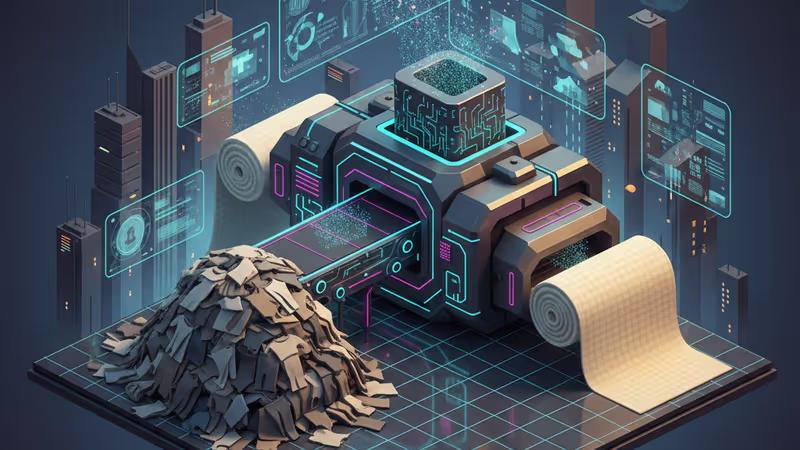
Everbloom's AI turns waste into biodegradable cashmere that's cheaper than virgin materials. Is this the end of fast fashion's unsustainable model?

Caught between its privacy mission and its financial reliance on Google, Mozilla is pivoting to AI. Our analysis explores if this can save it from irrelevance.
Caught between its privacy mission and its financial reliance on Google, Mozilla is pivoting to AI. Our analysis explores if this can save it from irrelevance.