
After the Fire: Hong Kong's Housing Crisis Is the Deeper Tragedy
A fire in Hong Kong's Tai Po district killed 159, but the real tragedy it exposes is the city's chronic housing crisis, a systemic failure impacting its economy, politics, and social stability.
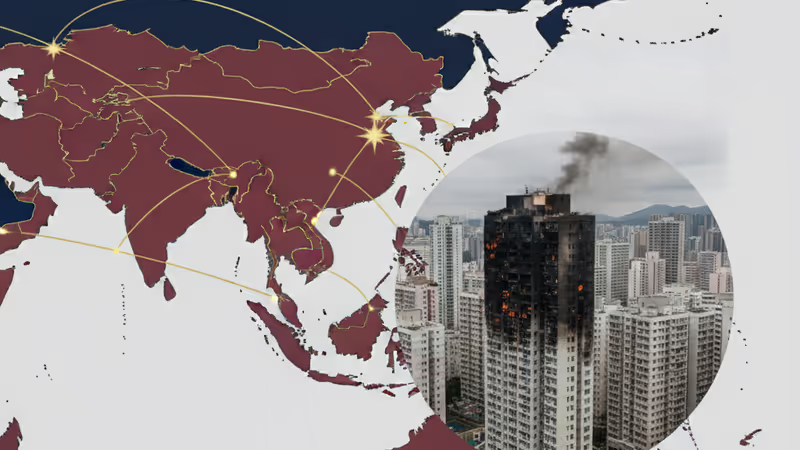
A devastating fire in Hong Kong's Tai Po district has claimed at least 159 lives and left a community shattered, but its true impact extends far beyond the immediate tragedy. The blaze at the Wang Fuk Court public housing complex has cast a harsh light on the city's chronic housing crisis, a deep-seated issue that shapes its politics, economy, and social fabric. This isn't just a story about a disaster; it's a case study on the systemic vulnerabilities of one of the world's most vital cities.
For survivors, the loss is devastatingly personal, compounded by the fact that the fire tore through a public housing complex where most had bought their homes with government subsidies. While the Hong Kong government and NGOs have pledged support, the path forward is fraught with uncertainty. The most obvious solution—relocating them to other public housing—collides with a stark reality: as of September 2025, the average waiting time for a subsidized rental unit was already around five years. Survivors don't just need a place to go; they need a place to live.
Hong Kong's public housing program has its origins in another disaster. A 1953 Christmas Day fire in a squatter settlement left over 50,000 people homeless, prompting the government to build resettlement blocks and create what would become the Housing Authority. Today, the program is a cornerstone of the city's social safety net, sheltering over 2 million people—about 30 percent of Hong Kong's population. For many, it's the only buffer against a relentlessly unaffordable private market.
Yet the system is under immense strain. The government has long battled issues like tenants who exceed income limits, while thousands remain without permanent homes. The Social Welfare Department reported 1,564 registered “street sleepers” as of 2022, a figure that NGOs believe is a significant undercount.
This housing insecurity is a source of systemic instability. According to China’s state-run Xinhua news agency, discontent over “problems relating to housing and land supply” was a key grievance fueling the 2019 street protests. Economically, the Chinese General Chamber of Commerce has stated that inadequate land supply “has become the biggest bottleneck to Hong Kong’s continued economic growth.” For an entire generation of young people, home ownership seems like an impossible dream.
While the Tai Po fire loomed large over Hong Kong's 2025 Legislative Council election, it's a mistake to frame the tragedy as a primary driver of the political outcome. The low voter turnout—under 32 percent—reflects a broader, pre-existing dissatisfaction with governance, in which the housing crisis has long been a central part. The fire didn't create new discontent; it painfully amplified what was already there.
This content is AI-generated based on source articles. While we strive for accuracy, errors may occur. We recommend verifying with the original source.
Related Articles

The conviction of media mogul Jimmy Lai is not just a legal ruling. It's a strategic move in China's global information warfare, redefining political risk.

Over a dozen staffers have left the Heritage Foundation amid turmoil over its ties to extremist influencers. The exodus highlights a growing civil war within the American conservative movement.

South Korea's rival political parties have reached a surprise agreement to appoint a special counsel to investigate a major scandal involving the Unification Church. The probe follows public pressure and could implicate high-profile figures from both parties.

Gaza's ancient Great Omari Mosque, a site with a 2,000-year history, has been destroyed in the conflict. This article analyzes the significance of its loss and the broader implications for cultural heritage in war.