

The Uganda Gambit: How a Chinese Dissident's Case Puts U.S. Credibility on Trial
A Chinese dissident who exposed Xinjiang camps faces U.S. deportation to Uganda, revealing a critical clash between U.S. foreign policy and domestic enforcement.
The Lede: A Strategic Contradiction
A Chinese dissident who exposed conditions in Xinjiang's detention camps now faces deportation from the U.S. — not to China, but to Uganda. This isn't merely an immigration case; it's a glaring stress test of U.S. foreign policy. For global executives and strategists, this story matters because it reveals a critical disconnect between America's stated geopolitical goals and its on-the-ground administrative actions. When a nation's bureaucracy undermines its own foreign policy, it signals a level of internal incoherence that creates risk and opportunity for global players.
Why It Matters: The Second-Order Effects
The deportation of Guan Heng, the filmmaker who documented the camps, would have cascading geopolitical consequences far beyond one man's fate. This case is a live demonstration of how domestic policy can create unforced errors in international strategy.
- Eroding U.S. Soft Power: The U.S. government has sanctioned Chinese officials over the human rights abuses in Xinjiang. Seeking to deport a key witness to those abuses hands a significant propaganda victory to Beijing, allowing it to frame U.S. human rights advocacy as hypocritical.
- A Chilling Effect on Intelligence: Future whistleblowers and defectors from authoritarian states like China and Russia will question the wisdom of seeking refuge in the U.S. This potentially stems the flow of valuable human intelligence essential for national security.
- Signaling to Allies: U.S. allies, particularly in Europe and Asia, watch these cases closely. Such actions raise doubts about American resolve and its reliability as the anchor of a values-based international order.
The Analysis: When Policy and Enforcement Collide
The core of this issue lies in the collision between two distinct arms of the U.S. government. On one hand, the State Department and Congress have built a policy framework to condemn and punish China for its actions in Xinjiang. On the other, Immigration and Customs Enforcement (ICE) and Department of Justice lawyers are operating within a domestic legal framework focused on immigration enforcement, where entering without a visa is a primary violation.
The Trump administration's argument for a "third-country deportation" to Uganda is a legal maneuver, but its geopolitical deafness is profound. Uganda has deepening economic and security ties with China, making it a questionable safe haven for a prominent critic of the Chinese Communist Party. The action suggests that the bureaucratic imperative to enforce immigration law is currently overriding the strategic imperative to counter Chinese authoritarianism.
This is not a new phenomenon, but the starkness of this case — involving a high-profile dissident who provided evidence for a cornerstone of U.S. foreign policy — makes it a uniquely damaging example. It exposes a vulnerability where an adversary doesn't even need to act; it can simply watch as a rival's internal processes contradict its global posture.
PRISM Insight: The Geopolitics of Human Capital
Beyond the immediate political fallout, this case touches upon the global competition for talent. The world's brightest minds, including engineers, scientists, and entrepreneurs living under authoritarian regimes, often look to the U.S. as a sanctuary. Incidents like this sow doubt and may reroute that flow of human capital to other Western nations like Canada, the UK, or Germany.
For the tech sector, this is critical. Dissidents often leverage U.S.-based platforms like YouTube to disseminate information, as Guan did. If the U.S. is no longer seen as a safe harbor for the users of these platforms, it complicates the narrative of American tech as a tool for global freedom and creates operational risks for companies navigating these complex geopolitical currents.
PRISM's Take: The Credibility Gap is a Strategic Liability
The Guan Heng case is a microcosm of a fundamental challenge facing the United States: aligning its vast and complex government machinery with a coherent grand strategy. A nation's foreign policy is only as credible as its willingness to enforce it consistently, even when it's domestically inconvenient.
To effectively compete on the world stage, particularly with strategic rivals like China, the U.S. must close this policy-execution gap. Allowing an asylum seeker who risked his life to validate U.S. foreign policy claims to be deported on a technicality is a strategic own-goal. It tells the world that America's stated values are negotiable and subject to the whims of its internal bureaucracy. In the long game of geopolitical influence, that is a currency you cannot afford to devalue.
Related Articles

A landmark deal to sell TikTok's US business to an Oracle-led consortium creates a new playbook for techno-nationalism. What does it mean for global tech?
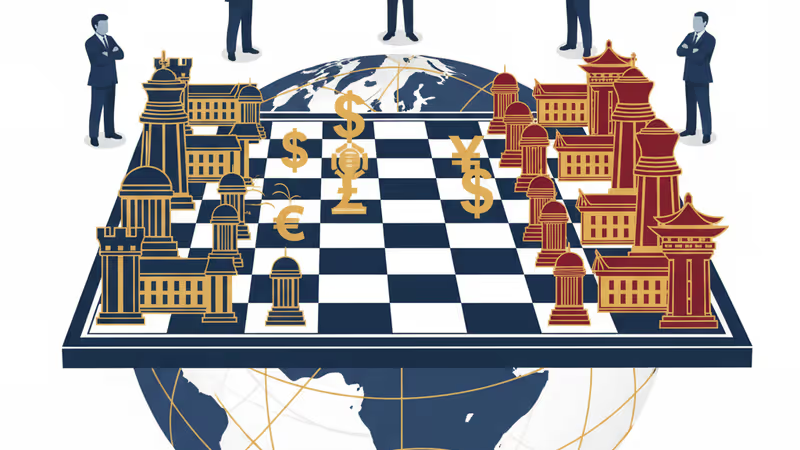
The EU and US debate seizing frozen Russian assets for Ukraine, a move that could fund the war but risks fracturing the global financial system. An analysis.

An ICJ ruling on AI weapons is reshaping geopolitics. Discover the impact on US-China relations, the tech industry, and the future of international law.
The EU's new anti-subsidy weapon targets Chinese firms, escalating the global trade conflict. We analyze the critical impact on supply chains and investments.