
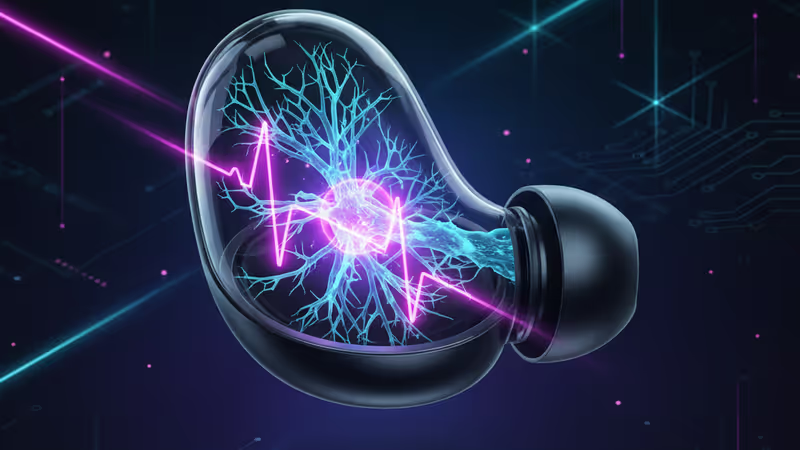
The Trojan Horse in Your Ears: How Apple is Turning AirPods into a Health and AI Powerhouse
Our analysis reveals Apple's hidden strategy: The new AirPods Pro 3 aren't just earbuds, they're the foundation for a major health and AI computing platform.
The Lede: Beyond Audio
While the market buzzes about the improved noise cancellation and sound quality of the new AirPods Pro 3, a far more significant transformation is underway. The real story isn't the audio fidelity—it's the integration of sophisticated sensors and AI-driven features. PRISM's analysis shows Apple is strategically evolving AirPods from a simple audio accessory into a powerful, on-body computing platform for health, communication, and artificial intelligence, effectively building its next major ecosystem lock-in right inside your ear canal.
Why It Matters
This shift has profound implications. For consumers, the earbud is becoming a health tracker and a personal assistant. For the industry, it signals a major escalation in the wearables war. Apple is no longer just competing with Bose and Sony on audio quality; it's now challenging health-tech players like Oura and WHOOP, and positioning AirPods as the primary human interface for the coming age of ambient AI. The second-order effect is a dramatic deepening of Apple's ecosystem moat. By embedding essential health and AI functions into its 'hearables', Apple makes the cost of switching to a competitor's ecosystem not just inconvenient, but a genuine disruption to a user's digital and physical life.
The Analysis: Deconstructing Apple's 'Hearables' Playbook
From Accessory to Platform: The Strategic Evolution
The journey of the AirPods reveals a deliberate, multi-generational strategy. The original AirPods (2016) solved a single problem: wireless convenience, powered by the W1 chip. The first AirPods Pro (2019) targeted the premium audio market with Active Noise Cancellation (ANC). But the new AirPods Pro 3 represents a fundamental pivot. The inclusion of a heart rate sensor for 'standalone workout tracking', the expansion of hearing aid-like features, and the introduction of real-time translation are not iterative audio updates. They are foundational elements for a new category of device. Apple is conditioning its 100-million-plus user base to view their earbuds as indispensable tools for living, not just for listening.
The Health Data Goldmine: Why The Ear is the New Wrist
The Apple Watch proved the viability of on-body health monitoring. Now, Apple is colonizing a new, data-rich territory: the ear. The inner ear is an excellent location for capturing accurate biometric signals like heart rate, and potentially in the future, body temperature and even blood oxygen levels. The addition of a heart rate sensor in the AirPods Pro 3 is the first shot in this new campaign. It positions the earbuds as a legitimate fitness device, potentially decoupling basic activity tracking from the necessity of an Apple Watch. This dual-pronged approach—wrist and ear—allows Apple to capture a far more comprehensive picture of a user's health, creating an invaluable dataset that further solidifies the dominance of the Apple Health platform.
Building the AI On-Ramp
While the hardware itself is impressive, its true purpose is to serve as the perfect vehicle for Apple Intelligence. Features like 'live translation' are just the beginning. The constant proximity to the user's ear, combined with advanced microphones for voice isolation, makes the AirPods the ideal input/output device for a seamless, voice-first AI experience. Forget pulling out your phone to ask a question. The future Apple envisions is one where you interact with your AI assistant ambiently through your earbuds, whether you're getting directions, summarizing a meeting, or controlling your smart home. The AirPods are being meticulously engineered to be the physical bridge between you and Apple's AI, making the experience frictionless and ever-present.
PRISM Insight: The Ambient Computing Endgame
Technology Trends & Future Outlook: Apple's AirPods strategy is a masterclass in building towards an 'ambient computing' future—an environment where technology is seamlessly integrated and largely invisible. The AirPods, Apple Watch, and Vision Pro represent the three key pillars of this vision: personal audio/AI, on-body health/notifications, and spatial/visual computing. Each device is a powerful standalone product, but together they form an interconnected personal ecosystem that is incredibly difficult for competitors to replicate. The AirPods Pro 3, with its blend of health sensors and AI-ready features, is the most personal and pervasive piece of this puzzle. It's the device that connects the digital world directly to your senses, paving the way for a future where the interface is no longer a screen, but your own environment.
PRISM's Take
Apple is no longer selling headphones; it's selling access points. The features being lauded in the latest AirPods Pro 3—health tracking, translation, improved call clarity—are not disparate upgrades. They are carefully chosen components designed to make the AirPod an essential node in Apple's ecosystem. While competitors remain locked in a battle over bass levels and noise cancellation specs, Apple is playing a different game entirely. It is building a comprehensive health and AI platform that lives in your ears, ensuring its dominance in the next decade of personal computing will be heard, not just seen.
Related Articles

Analysis of the recent iOS update backlash. Discover why user frustration signals a deeper strategic risk to Apple's brand and competitive moat.

Apple opens iOS to third-party app stores in Japan, mirroring EU changes. PRISM analyzes the new fees and the global regulatory assault on the App Store.

Apple opens iOS to third-party app stores in Japan. PRISM's analysis reveals Apple's global playbook to manage regulators and protect its App Store monopoly.

The AI boom is causing a memory chip shortage, set to drive up smartphone prices by 6.9% in 2026. Our expert analysis explains why your next phone will cost more.