
The Surveillance Singularity: AI, Drones, and Data Breaches Fuel a New Era of Digital Distrust
From government drones to AI-powered scams and massive data breaches, the digital trust fabric is tearing. PRISM analyzes the new high-risk reality for leaders.
The Lede: The Trust Stack Is Collapsing
This week’s security headlines aren't isolated incidents; they are tremors signaling a seismic shift. US government agencies are normalizing mass surveillance with drones and internal monitoring. Sophisticated AI tools for creating 'perfect' deepfakes are being actively sold to criminal syndicates. And another 200 million user records from a major website are being used for extortion. For the C-suite, the takeaway is stark: the foundational layer of digital trust is cracking under the combined weight of state power, democratized AI, and persistent cybercrime. This isn't just an IT problem; it's a strategic crisis that threatens everything from brand reputation to operational integrity.
Why It Matters: A World Where Seeing Is No Longer Believing
The convergence of these threats creates second-order effects that are far more dangerous than any single event. The normalization of advanced surveillance and the proliferation of AI-driven deception are creating a new, high-risk operational environment for every organization.
- The Erosion of Authenticity: The use of AI-generated images to defraud e-commerce sites is a canary in the coal mine. When 'perfect' deepfake tools like Haotian are commercially available to scammers, how do you trust a video KYC (Know Your Customer) process? How does your customer service team verify a complaint? Every digital interaction is now suspect, adding a layer of friction and cost to business.
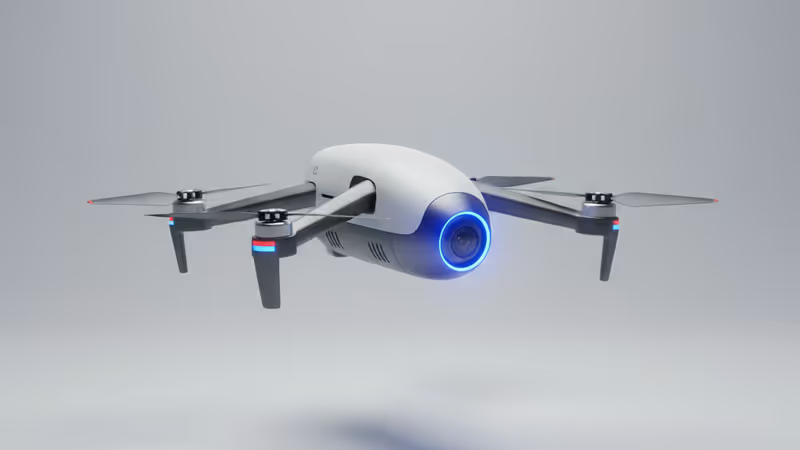
- The Expanding State Dragnet: CBP’s move to operationalize drones and ICE’s plan to expand employee surveillance signal a significant trend. The tools of state security are no longer confined to borders or specific threats; they are becoming part of the standard operating procedure. This has profound implications for corporate privacy, employee rights, and the potential for government overreach into corporate data.
- Third-Party Risk Is Existential: The PornHub breach, originating from their analytics vendor MixPanel, is a brutal reminder that your security is only as strong as your weakest partner. In an era of highly sensitive data collection, a vulnerability in your supply chain is a vulnerability in your boardroom. The extortion attempt shows that hackers are now weaponizing personal shame at an unprecedented scale.
The Analysis: The Asymmetric Battlefield Gets an AI Upgrade
We've moved beyond the post-Snowden era of clandestine, state-level surveillance programs. Today's threats are defined by the democratization of those same capabilities. A decade ago, creating a convincing deepfake required a research lab; today, it’s an app marketed on Telegram. This creates a dangerous asymmetry: low-level criminals and rogue actors can now wield tools that can fool even sophisticated detection systems.
Simultaneously, the state's appetite for data hasn't waned; it has industrialized. CBP’s drone program isn't an experiment; it's the scaling of an aerial surveillance infrastructure. This parallels the commercial sector's own drive to collect and analyze data at scale. The state and cybercriminals are essentially operating on the same battlefield, using increasingly similar tools to exploit the same digital ecosystem that businesses rely on.
The international dimension, highlighted by Venezuela's accusation against the US, adds another layer of complexity. Cyber operations are now a standard component of geopolitical conflict, placing multinational corporations squarely in the digital crossfire. An attack on a state-owned enterprise can easily have cascading effects on its global partners and suppliers.
PRISM Insight: The 'Trust Tech' Boom is Here
The collapse of implicit trust will trigger a massive investment wave into a new category of 'Trust Technology'. This goes beyond traditional cybersecurity defenses. We are on the cusp of a boom in sectors dedicated to proving digital reality.
- Liveness & Presentation Attack Detection (PAD): Expect a surge in funding for startups that can reliably detect deepfakes and AI-generated content in real-time during video calls, onboarding processes, and media uploads.
- Digital Provenance & Watermarking: Technologies that can cryptographically sign and trace the origin and manipulation history of digital assets (images, videos, documents) will become critical infrastructure for media, finance, and legal sectors.
- Zero-Trust Supply Chains: The concept of 'Zero Trust' network architecture will be applied to vendor relationships. Companies will demand radical transparency and continuous, automated verification of their partners' security posture, creating a new market for supply chain security platforms.
PRISM's Take: Assume a Zero-Trust Reality
The strategic playbook for digital risk is now obsolete. Defense-in-depth is no longer sufficient when the very nature of reality can be convincingly faked. Leaders must shift their mindset from risk mitigation to resilience in a zero-trust world. This means assuming that any digital communication, identity, or piece of media could be fraudulent until proven otherwise. The most critical question for leaders is no longer 'Are we secure?' but 'How do we operate effectively when we can't trust what we see and hear?' The organizations that build the technical and cultural infrastructure to answer that question will be the ones that survive and thrive in this new era of digital distrust.
Related Articles

Free public Wi-Fi isn't a utility; it's a transaction. PRISM analyzes the hidden security risks and why treating every connection as hostile is the new standard.

Generative AI is fueling a new wave of ecommerce fraud with fake damage photos. Learn how this 'deepfake refund' trend is breaking digital trust and what it means.

Analysis: A new US defense bill unites AI, climate, and military goals to fast-track next-gen nuclear power, solving Big Tech's energy crisis.
Analysis of Russia's multi-year cyberattack on AWS. The true threat isn't a flaw in the cloud, but the weaponization of customer misconfigurations.