
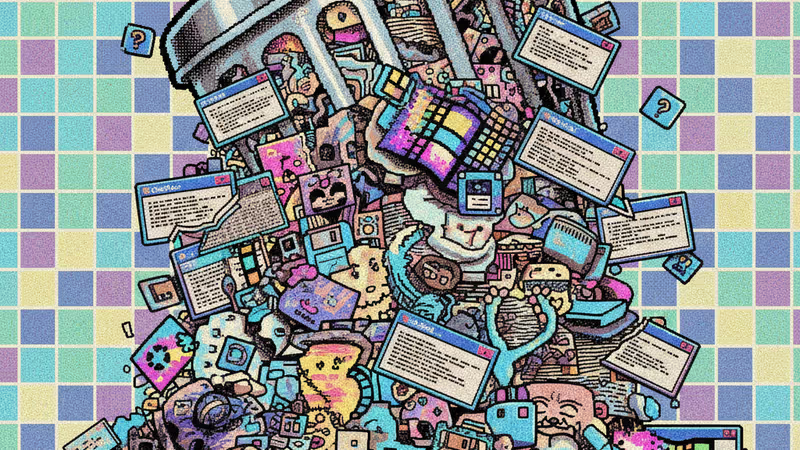
The Slop Era: How Generative AI Is Turning Social Media into a Digital Landfill
Generative AI is flooding social media with low-quality 'slop,' eroding user trust and threatening platform business models. An analysis of the new attention economy.
The Lede: The Infinite Scroll Becomes the Infinite Landfill
Your social media feed is becoming a wasteland of low-quality, AI-generated 'slop.' For the C-suite, this isn't just an aesthetic annoyance; it's a systemic erosion of the digital attention economy. The very platforms that built empires on user engagement are now facing a crisis of authenticity that threatens their core business model. The cost of content creation has collapsed to zero, and the resulting flood of digital noise is drowning out the value, devaluing user attention, and creating an existential threat to platforms and brands alike.
Why It Matters: The Second-Order Effects of Slop
The proliferation of AI slop triggers a cascade of strategic challenges that extend far beyond a messy user experience. This is a fundamental shift in the digital landscape.
- The Trust Recession: As users learn to distrust their feeds, engagement becomes shallow and cynical. This erodes the effectiveness of advertising and influencer marketing, forcing brands to work harder to prove their authenticity in a sea of fakes.
- The Creator Economy Under Siege: Human creators, the lifeblood of these platforms, are now in direct competition with infinite, low-cost AI content farms. This devalues creative skill and risks a mass exodus of talent towards closed communities or subscription platforms where quality is valued over quantity.
- The Platform's Dilemma: Social giants like Meta and TikTok are caught in a lethal bind. Their algorithms are designed to reward engagement, regardless of source. Throttling AI content could create content vacuums and hurt short-term metrics, but allowing it to run rampant poisons the well for long-term user retention. Their moderation systems are fundamentally outgunned.
The Analysis: History Doesn't Repeat, It Scales
This isn't a new problem; it's the hyper-scaled evolution of an old one. We've seen this playbook before with SEO spam, keyword-stuffing, and the content farms of the 2010s. The goal has always been to game the algorithm for attention at the lowest possible cost.
What’s different now is the velocity and sophistication. Generative AI is not just a tool for spam; it's an entire factory. It can mimic virality, generate plausible (but soulless) text and images, and overwhelm human-powered content through sheer volume. This transforms the competitive dynamic from a battle for creativity into a war of computational attrition. The platforms that were built on the 'social graph' (your friends) and pivoted to the 'interest graph' (the algorithm) are now seeing that algorithm exploited at an unprecedented scale.
PRISM Insight: The Rise of the 'Authenticity Stack'
The market is reacting. We are witnessing the emergence of a new category of technology and investment we call the 'Authenticity Stack.' This isn't just about AI detection, which is a losing game of cat-and-mouse. Instead, the smart money is flowing into solutions that proactively verify and signal human origin.
Key investment trends to watch:
- Content Provenance Tech: Startups and initiatives (like C2PA) creating verifiable, cryptographic 'birth certificates' for digital content, proving it was created by a specific human or device at a specific time.
- Human-Gated Networks: A resurgence of platforms and communities where human curation, not algorithmic amplification, is the core value proposition. Think premium newsletters, paid communities, and new social networks built on verification.
- The New Creator Tools: Software that doesn't just help create, but also helps creators prove the authenticity of their work and manage their reputation in a low-trust environment.
PRISM's Take: The Attention Economy's Extinction Event
The 'Slop Era' is more than a trend; it's an extinction-level event for the social media model as we've known it for the past 15 years. The model of monetizing undifferentiated engagement is fundamentally broken when the cost of generating that engagement approaches zero. Users are becoming numb, and the value of a 'view' or a 'like' is in terminal decline.
The winners of the next decade will not be the platforms with the most sophisticated discovery algorithms, but those with the most robust trust and verification layers. The future of digital community isn't about finding more content faster; it's about finding real content from real people. For platforms, brands, and creators, the mandate is clear: abandon the quest for infinite scale and begin building moats of human authenticity. In the Slop Era, trust is the only scarce resource that matters.
Related Articles

An analysis of how Justin and Hailey Bieber leverage their relationship as a powerful brand ecosystem to drive their business empires, Rhode Skin and Drew House.

Danielle Fishel's diagnosis is more than a headline. It's a key signal for the future of health tech, parasocial influence, and the creator economy.

Beyond celebrity romance, the potential Taylor Swift-Travis Kelce union represents a historic media merger, creating a new economic and cultural force.

A viral TikTok story about a family dispute reveals a darker trend: the commodification of personal conflict and the weaponization of authenticity.