
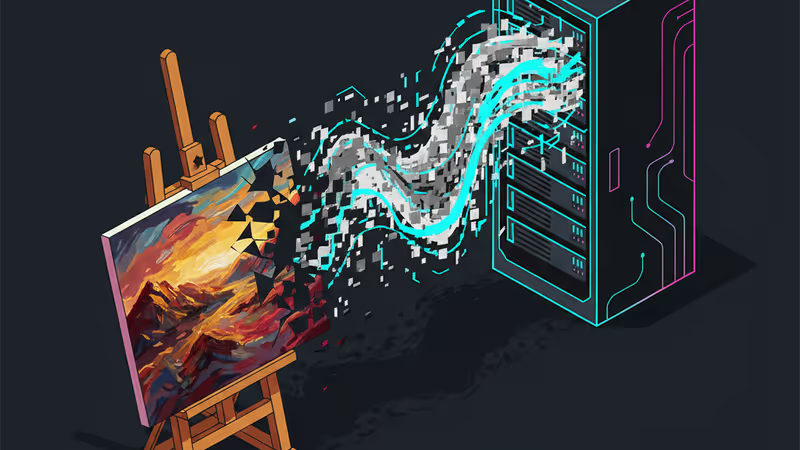
The Oz Debacle: AI Art Controversy Signals a Looming Crisis of Trust for Creatives
A comic book controversy over alleged AI art use reveals a looming crisis of trust for creative industries. PRISM analyzes the impact on tech, trust, and IP.
The Lede: More Than a Comic Book Controversy
A dispute over the art in a new Wizard of Oz comic book might seem like niche industry drama, but for executives and investors, it’s a canary in the coal mine. The accusations against veteran artist Mike Deodato Jr. of using low-effort AI-generated images—and his subsequent denial—spotlight a critical stress test for the future of creative production, intellectual property integrity, and, most importantly, consumer trust in the age of generative AI. This isn't about one artist; it's about the emerging, chaotic reality of integrating AI into professional creative workflows.
Why It Matters: The Second-Order Effects
The controversy surrounding AWA's 'Ultimate Oz Universe' reveals foundational cracks appearing in the creative economy. The core issue is a breakdown of the implicit contract between creator and consumer. When audiences perceive a work as an inauthentic, hastily assembled product of automation rather than human craft, the value proposition collapses. This has cascading consequences:
- Brand Dilution: Publishers like AWA are now caught in the crossfire. Associating a brand with low-quality, potentially AI-generated content risks alienating core fans and devaluing their entire catalog.
- The Authenticity Tax: Artists are now facing a new burden: the need to prove their work is human-made. This defensive posture consumes time and energy, shifting focus from creation to validation.
- Economic Devaluation: If AI is perceived as a shortcut to bypass skill and effort, it threatens to deflate the market value of all digital art. Why pay a premium for a human artist if a machine can produce a similar—albeit inconsistent—product for pennies?
The Analysis: A Tool, Not a Panacea
Historically, technology has always disrupted art—from the camera challenging portrait painting to Photoshop revolutionizing digital illustration. However, generative AI represents a paradigm shift. Previous tools augmented the artist's hand; generative AI threatens to replace it at the point of ideation. The Oz controversy demonstrates the immaturity of this new paradigm in a professional setting.
The alleged artwork is notable not just for its AI-like tells (inconsistent details, strange artifacts) but for its lack of artistic cohesion. It appears less like an artist using a new tool and more like a tool using an artist as a basic operator. This is the critical distinction. High-end creators are exploring AI for mood boarding, texture generation, or background assistance—integrating it thoughtfully. This case, however, is being held up as an example of a low-effort "image-bashing" workflow, where prompts replace draftsmanship. It exposes the vast chasm between the promise of AI as a creative partner and the reality of its use as a cheap shortcut.
PRISM Insight: The Emerging Provenance Economy
The fallout from this and similar incidents points directly to a burgeoning investment sector: digital provenance and authentication. The market is now desperate for solutions that can verify the creation process. We're not just talking about a simple "Made by Human" label. The winning technologies will offer a complete, verifiable history of a digital asset.
Expect to see a surge in startups developing:
- Creative Process Verification: Tools that log and timestamp an artist's brushstrokes, layer adjustments, and edits, creating an auditable trail of human effort.
- Sophisticated AI Detection: Moving beyond simple image analysis to forensic tools that can identify the statistical fingerprints of specific generative models within a piece of work.
- Hybrid Asset Management: Platforms that allow creators to transparently declare which parts of their work are AI-assisted versus human-originated, creating new standards for creative attribution.
The value proposition is clear: in a world flooded with synthetic media, verifiable authenticity will become a premium, bankable asset.
PRISM's Take: A Mandate for Transparency
The debate over whether Mike Deodato Jr. used AI is ultimately less important than the audience's reaction. The visceral rejection of the art demonstrates that consumers have an innate, powerful sense of creative authenticity. They are not buying pixels; they are buying an artist's vision, skill, and time. Abusing that trust with what appears to be low-effort automation is a fatal error.
The path forward is not to ban AI, but to demand a new standard of radical transparency. Creators and companies that embrace AI as a powerful, specialized tool—and are honest about how and where they use it—will build trust. Those who use it as an opaque shortcut to cut costs and corners will find themselves on the wrong side of their audience and, ultimately, the market. This Oz controversy is a cautionary tale: in the creative economy, trust is the only currency that matters.
Related Articles

PRISM analyzes OpenAI's new youth safety rules. This is more than a policy update; it's a strategic move to preempt regulation and shape the future of AI.

Rian Johnson calls AI "slop," but his real insight is a strategic defense of human-made art. PRISM analyzes the coming "Authenticity Premium" in Hollywood.
YouTube's ban on two AI movie trailer channels is a critical warning. PRISM analyzes why this signals a new era of accountability for AI content creators.
OpenAI's new AI literacy guide is more than a safety manual; it's a strategic move to normalize AI, pre-empt regulation, and secure future market dominance.