

The New Cold War: China & Russia Forge an Arctic Silk Road
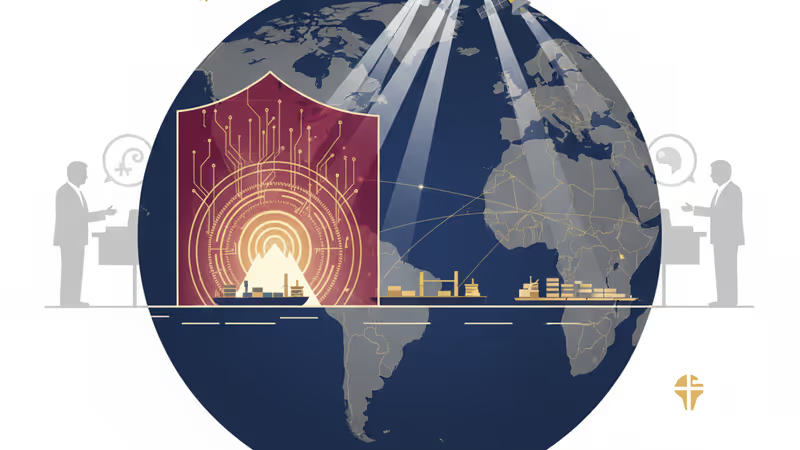
China and Russia are forging a new Arctic trade route to bypass Western chokepoints. This isn't about faster shipping—it's a geopolitical power play.
The Executive Summary
For decades, global trade has flowed through a handful of maritime chokepoints policed by the West. Beijing is now making a strategic play to bypass them entirely. A senior Chinese official's call to prioritize the Arctic's Northern Sea Route (NSR) isn't just about faster shipping; it's a clear signal that China is building a sanction-proof economic lifeline with Russia. This move weaponizes climate change, turning melting ice into a strategic asset that aims to fundamentally re-route global power and trade, insulating a new Eurasian bloc from Western economic pressure.
Why It Matters: De-Risking for the East, Re-Risking for the West
This isn't merely a logistics upgrade; it's a geopolitical tectonic shift with profound second-order effects. For Beijing, securing the NSR is the ultimate 'de-risking' strategy. It mitigates the long-feared 'Malacca Dilemma'—the vulnerability of having 80% of its oil imports pass through the US-patrolled Strait of Malacca. For the West, it presents a new set of risks:
- Supply Chain Bifurcation: A viable, non-Western-controlled shipping route could accelerate the fragmentation of the global economy into competing blocs. Companies may have to choose sides or build redundant supply chains.
- Resource Control: The route runs through Russia’s Exclusive Economic Zone, giving Moscow immense leverage over transit and access to the Arctic’s vast, untapped energy and mineral resources. China provides the capital and demand; Russia provides the access and resources.
- Security Vacuum: The Arctic has traditionally been a low-tension region focused on scientific cooperation. Increased commercial and potential dual-use (civilian-military) traffic from China and Russia forces a military and security rethink for NATO and Arctic nations like the US, Canada, and Nordic countries.
The Analysis: A Convergence of Climate, Commerce, and Conflict
Beijing's focus on the Arctic is the culmination of a long-term strategy, accelerated by three powerful forces. First, the geopolitical realignment of the Sino-Russian 'no limits' partnership. Sanctioned and isolated by the West, Russia needs Chinese capital and technology to develop the NSR. In return, China gets a secure route and preferential access to Russian energy, bypassing traditional sea lanes.
Second, climate change acts as an unwilling accomplice. The very environmental crisis Western nations decry is physically opening a strategic corridor for their primary rivals. Satellite data shows rapidly diminishing summer sea ice, making the route increasingly viable for longer periods each year. While environmental risks are immense, from an amoral, geopolitical perspective, melting ice is a strategic boon for Moscow and Beijing.
Third, this reflects a global pivot from 'just-in-time' to 'just-in-case' economic thinking. The source article's mention of preparing for 'worst-case scenarios' and a 'major international crisis' is the key insight. This isn't about saving a few days on a shipment from Shanghai to Rotterdam in peacetime; it's about ensuring essential goods can flow during a conflict, such as a crisis over Taiwan, when routes like the Suez Canal or Strait of Malacca could be interdicted.
PRISM Insight: The 'Harsh Tech' Investment Frontier
The build-out of the Northern Sea Route creates a new investment category we call 'Harsh Tech.' Beyond shipping lines, the real growth is in the enabling technologies and infrastructure required to operate in one of the world's most extreme environments. This includes:
- Next-Generation Icebreakers: A new fleet of nuclear-powered and LNG-fueled icebreakers capable of year-round operation.
- Satellite & Sensor Networks: Advanced remote sensing to monitor ice-flow, provide real-time navigation, and conduct surveillance in a region with limited ground infrastructure.
- Hardened Infrastructure: The construction of deep-water ports, search-and-rescue centers, and communication nodes along Russia’s Siberian coast, all designed to withstand permafrost and extreme cold.
Investors and tech firms should monitor the development of these specialized sectors, as they will form the technological backbone of this new strategic corridor.
PRISM's Take: The Arctic is No Longer a Postscript
For too long, Western policymakers have viewed the Arctic as a remote scientific preserve or an environmental issue. That view is dangerously outdated. The Northern Sea Route is rapidly becoming a strategic corridor for a new Eurasian economic and military bloc. While full, year-round commercial viability is still a decade or more away, the strategic intent is locked in. The failure of the US and its allies to match Sino-Russian investment in Arctic infrastructure, from icebreakers to ports, is ceding the 'High North' by default. The next great power competition won't just be in cyberspace or the South China Sea; it will be fought on the ice at the top of the world.
Related Articles

US-led talks on the Gaza deal move to Miami, involving Qatar, Egypt, and Turkiye. PRISM analyzes the geopolitical and economic implications of this tactical shift.
China fines a foreign vessel for using SpaceX's Starlink, a clear signal of its digital sovereignty goals and a new challenge for global tech and shipping.

From Ukraine to Venezuela, leaders are increasingly using scapegoating to justify conflict and deflect blame. A PRISM analysis of the growing global risk.

Putin's latest speech isn't just rhetoric; it's a strategic move to frame the Ukraine endgame. We analyze the geopolitical and financial implications.