
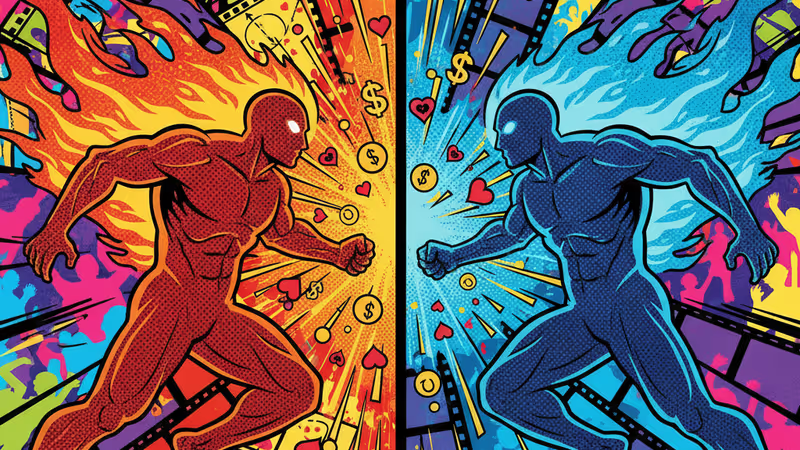
The 'Heated Rivalry' Playbook: How Niche Fandoms Became Hollywood's Most Valuable Asset
A hit show's success reveals a new playbook for Hollywood. Discover how niche fandoms and fan labor are de-risking content and creating a new class of media assets.
The Lede: Beyond the Hype
A Canadian gay hockey romance, 'Heated Rivalry,' just shattered streaming records on HBO Max and Crave. For the C-suite, this isn't just a pop culture blip; it's a critical signal. It demonstrates a new, de-risked model for content success where hyper-engaged, pre-existing fan communities act as a project's market research, marketing department, and quality assurance—all before a single scene is shot. The playbook has been flipped: success is no longer about finding an audience, but about acquiring content that already has one.
Why It Matters: The ROI of Resonance
The 'Heated Rivalry' phenomenon reveals a tectonic shift in media strategy. The value of intellectual property (IP) is now inextricably linked to the depth and passion of its existing fandom. This creates powerful second-order effects:
- Predictive Power: Platforms like BookTok and fanfiction archives are no longer just social networks; they are the most effective focus groups in the world. The intense discourse, from character analysis to shipping wars, provides a rich dataset on a story's commercial viability and narrative strengths.
- Organic Marketing Flywheel: The show's explosion wasn't driven by a nine-figure marketing budget. It was propelled by the fan community's own content creation—memes, video edits, and elaborate theories. This user-generated promotion is authentic, relentless, and has a reach traditional advertising cannot buy.
- Cultural Friction as Engagement: The controversy surrounding the show's intimacy and actors' private lives, while a PR challenge, paradoxically fuels the engagement engine. Every debate, defense, and hot take deepens the audience's emotional investment and keeps the property at the center of the cultural conversation.
The Analysis: From Fan-Service to Fan-Powered
Hollywood has a long history of adapting popular IP, from comic books to video games. The difference now lies in the source and the feedback loop. The old model was a top-down broadcast: studios acquired a known property and marketed it to a broad audience. The new model, exemplified by 'Heated Rivalry,' is bottom-up and community-first. The source material often originates from self-publishing or niche genres, validated not by gatekeepers but by the viral passion of a digital tribe.
Author Rachel Reid’s surprise at her work being analyzed like "The Great Gatsby" highlights a crucial misunderstanding by many legacy creators. She created the text, but the fandom built the multi-layered, analytical 'metatext' around it. It is this metatext—the theories about neurodivergence, the debates on masculinity—that contains the immense cultural capital studios are now desperate to tap. This transforms the audience from passive consumers into active, unpaid co-creators of the brand's value.
PRISM Insight: Mining the Fandom Economy
The strategic imperative for media and tech investors is clear: shift from funding individual projects to investing in systems that identify and quantify high-potential fandoms. The next breakout hits won't be found in pitch meetings; they'll be found by algorithms scraping Reddit, Tumblr, TikTok, and Archive of Our Own (AO3) for engagement velocity, sentiment analysis, and community stickiness. The true IP isn't just the book or script; it's the entire ecosystem of fan labor surrounding it.
Expect a new arms race in martech and data analytics, with firms developing proprietary tools to map these digital subcultures. The winning studios will be those that can acquire a story's IP and its community's passion in a single strategic move, effectively buying a guaranteed hit.
PRISM's Take: The Future is Niche at Scale
‘Heated Rivalry’ is not an outlier; it is the prototype. We are entering the era of 'Audience-First IP,' where the most valuable media properties will be those that have already cultivated a deeply loyal and evangelistic following in a digital niche. The challenge for streaming giants is no longer about achieving massive, homogenous reach, but about successfully scaling these intense, niche passions without alienating the core community that created the value in the first place. The brands that master this delicate balance of commercialization and authenticity will own the future of entertainment.
Related Articles
A viral Instagram account's literal translations reveal the critical 'translation gap' that AI struggles with. Here's why it matters for global business.
As Russia retreats behind a digital curtain, one photographer's work provides a rare, human API into its complex reality. This is a new form of cultural intelligence.
Online roasting isn't just memes. It's a complex social signal that reveals the current limits of AI and points to the future of authentic digital engagement.
An analysis of why genuine, off-camera celebrity encounters are the most valuable asset in the digital economy, outperforming traditional PR and marketing.