
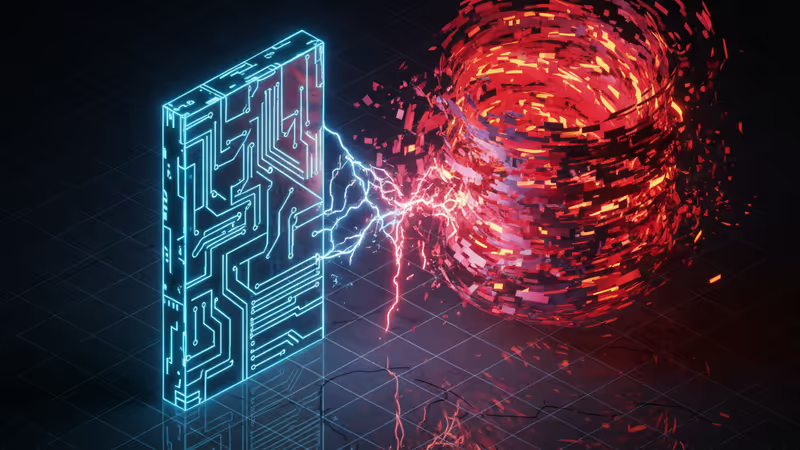
The Gatekeeper vs. The Chaos King: Why Elon Musk is on a Collision Course with Trump's Inner Circle
A quiet power struggle is brewing between Elon Musk and Trump's inner circle. Discover why this clash of ideologies signals major volatility for tech and markets.
The Lede: A Power Struggle in the Making
In the high-stakes world of a potential second Trump administration, a critical fault line is already emerging. It’s not between parties, but between operating philosophies. Susie Wiles, the disciplined White House Chief of Staff credited with taming the Trump political machine, has drawn a line in the sand regarding Elon Musk. Her description of the tech billionaire as a "complete solo actor" who created "unnecessary crises" is more than a personal critique; it’s a warning shot in a battle for control, pitting traditional political discipline against radical tech disruption.
Why It Matters: The Predictability Premium
For tech leaders, investors, and political analysts, this isn't just palace intrigue. It’s a crucial indicator of the political risk and operational style of a potential future US government. The core conflict reveals two potential paths:
- A Disciplined Administration: If Wiles' perspective prevails, it suggests an attempt to impose a more conventional, message-controlled structure on the presidency, potentially sidelining unpredictable actors like Musk.
- An Administration by Disruption: If Musk retains significant influence, it signals a doubling-down on a 'move fast and break things' approach to governance, introducing unprecedented volatility into federal policy, from tech regulation and space exploration to international relations.
The outcome of this quiet power struggle will directly impact market stability and the ability of businesses to forecast and navigate the American political landscape.
The Analysis: A Clash of Worldviews
The "Solo Actor" vs. The Political Machine
At its heart, this is a conflict between two fundamentally different models of power. Susie Wiles has built her reputation on corralling chaos, transforming a notoriously backstabbing operation into a disciplined force. Her model is one of hierarchy, message control, and strategic coherence. Musk, by contrast, embodies the Silicon Valley ethos of the singular visionary. His power stems from his direct-to-consumer communication via X, his unilateral decision-making at SpaceX and Tesla, and a profound belief in first-principles thinking that inherently disrespects established institutions. The source's mention of his role in a "Department of Government Efficiency" that "decimated the United States federal workforce" is a case in point—what a political operator like Wiles sees as a self-inflicted "crisis," Musk and his supporters would likely view as a necessary, if brutal, act of innovation.
Historical Precedent: The Outsider's Dilemma
Washington is littered with the failed ambitions of powerful private-sector executives who believed they could reshape government. From CEOs in cabinet positions to business advisory councils, outsiders consistently underestimate the inertia of bureaucracy and the unique dynamics of political capital. However, Musk is a different breed. Unlike a traditional CEO, his power base is independent of the administration he seeks to influence. He controls a global communications platform (X) and critical national infrastructure (Starlink). This makes him less a subordinate and more a rival power center—one that a traditional Chief of Staff, whose primary role is to protect the President and manage the flow of influence, would naturally view with extreme suspicion.
PRISM Insight: The Tech-Politics Fault Line
This conflict reveals a new fault line in American power structures. The old paradigm was a simple negotiation between Silicon Valley's lobbying power and Washington's regulatory power. The new paradigm, personified by Musk, is a direct challenge to the very operating system of government. The idea of shuttering a major agency like USAID isn't a policy debate; it's a rejection of the post-war consensus on American soft power. For businesses, this signals a dangerous new environment.
- For Investors: The "Musk Factor" in a future administration would necessitate an "unpredictability premium" to be priced into assets. Federal contracts, green energy subsidies, and regulatory frameworks could be upended not by legislation, but by the whim of a single influential advisor.
- For Tech Companies: The pressure to choose sides will intensify. Aligning with the established political machine offers stability, but aligning with a disruptor like Musk offers a chance to rewrite the rules entirely. This creates a high-stakes gamble that will force tech companies to become more politically sophisticated than ever before.
PRISM's Take
The friction between Susie Wiles and Elon Musk is a proxy war for the soul of a potential Trump 2.0 administration. It is the ultimate test of whether the raw, chaotic energy that defines both Trump and Musk can be harnessed by the disciplined structures of traditional political power. Wiles' on-the-record comments are the first clear signal that the GOP's professional class sees unbridled tech disruption not as an asset, but as a critical liability. For the global tech and financial sectors, the message is stark: the era of treating politics as a spectator sport is over. The very methodologies that built Silicon Valley are now on a direct collision course with the levers of global power, and the outcome is far from certain.
Related Articles
An exclusive analysis of Trump's plan to block state AI laws. This is a strategic move to centralize power and give Big Tech control over AI's future.
X Corp is suing to block a new 'Twitter', but the lawsuit reveals a deeper truth: the strategic failure of the X rebrand and the enduring power of a brand Musk tried to kill.
X's legal fight over the 'Twitter' trademark is more than a lawsuit—it's a public admission of a costly, self-inflicted rebranding blunder by Elon Musk.
xAI Grok's failure during the Bondi Beach attack wasn't just a bug. It reveals a fatal flaw in real-time AI, posing a major risk to X and the industry.