
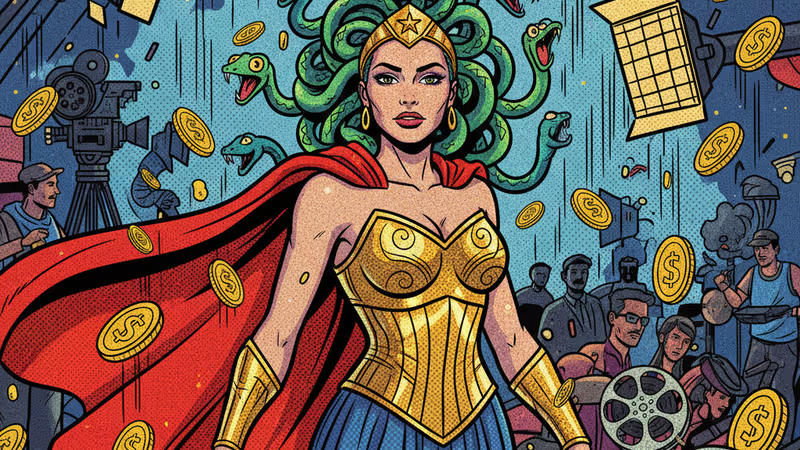
The Ancient IP Gold Rush: Why Greek Monsters Are Hollywood's New Superheroes
Franchise fatigue is real. Discover why ancient mythological IP is the untapped, public-domain goldmine fueling the next generation of entertainment.
The Lede: The Trillion-Dollar IP Hiding in Plain Sight
While executives obsess over the cinematic universes of Marvel and DC, a more ancient, powerful, and cost-effective source of intellectual property is being rebooted for the 21st century. The bizarre and complex creatures of Greek mythology—from the single-eyed Graeae to the shapeshifting Empusae—are not just historical artifacts. They represent the open-source code for the next wave of blockbuster franchises, AAA video games, and immersive virtual worlds. In an era of acute franchise fatigue, this ancient IP is the ultimate strategic asset.
Why It Matters: De-Risking the Content Arms Race
The global entertainment industry is locked in a high-stakes war for attention, where launching a new, original IP can cost hundreds of millions and still fail. Mythological IP offers a powerful antidote. These stories and characters are public domain, eliminating massive licensing fees. More importantly, they possess millennia of brand recognition, deeply embedded in the global cultural consciousness. This isn't just about saving money; it's about leveraging a pre-existing narrative foundation to build new worlds. The success of franchises like God of War or the book-to-screen hit Percy Jackson isn't an accident; it's a model. The second-order effect is a creative renaissance, allowing writers and developers to remix, subvert, and modernize archetypes without seeking permission from a corporate rights-holder.
The Analysis: Ancient Code, Modern Execution
The true genius of this mythological IP lies in its raw, often contradictory, complexity—a stark contrast to the frequently flattened characters of modern blockbusters. These aren't just monsters; they are sophisticated narrative platforms.
- The Graeae (The Original Shared Network): Described as three sisters sharing one eye and one tooth, the Graeae are more than just witches. In a modern context, they represent a biological network, a living embodiment of shared intelligence, surveillance, or even the perils of a centralized data source. They are a ready-made concept for a high-tech thriller or a cautionary tale about distributed consciousness.
- The Sphinx (The Ultimate Gatekeeper): The Greek Sphinx is not a stoic Egyptian monument; she is a manipulative predator who controls access through knowledge—a riddle. This is the perfect antagonist for our information age. She embodies the concept of a lethal paywall, a deadly algorithm, or a sentient AI that guards critical data. Her defeat isn't about brute force, but intellectual superiority.
- The Empusae (The Shapeshifting Threat): As servants of Hecate with mismatched legs (one of bronze, one of a donkey), these demons are masters of deception and body horror. Their ability to shift form makes them the ultimate adaptable villain. They are the ancient prototype for the uncanny valley, a perfect fit for psychological horror, stories about digital deepfakes, or social commentary on duplicity.
PRISM Insight: Mythology-as-a-Service (MaaS)
The next frontier isn't just adapting these stories; it's systemizing their creation. We are on the cusp of "Mythology-as-a-Service." Imagine generative AI platforms trained on the entire corpus of global mythology. These systems could generate endless, market-tested plot variations, character designs, and world-building concepts based on these foundational archetypes. The smart investment isn't just in the next movie studio, but in the tech companies building the AI-powered engines that can mine, remix, and monetize this vast public-domain library at scale. This transforms storytelling from a craft into a scalable industrial process.
PRISM's Take: The Unfadable IP
In a digital culture defined by fleeting trends and disposable content, Greek mythology represents a permanent, endlessly renewable resource. Its characters and conflicts tap into the fundamental code of human fear, ambition, and tragedy. They have survived for millennia precisely because their core concepts are so robust and adaptable. While today's superhero franchises may eventually fade, the narrative power of the Sphinx's riddle or the horror of a shapeshifting demon will remain. The creators and companies who recognize this ancient IP not as a relic of the past, but as a blueprint for the future, will be the ones who build the next generation of enduring cultural empires.
Related Articles
A quirky film about sheep solving a murder isn't just a joke—it's a serious signal for the future of IP, VFX technology, and Hollywood's content strategy.
A deep analysis of the Elf on the Shelf business model. Discover how a simple toy became a viral content platform and a masterclass in modern IP strategy.

An analysis of the ugly Christmas sweater phenomenon, from its ironic origins to a case study in viral commerce, nostalgia marketing, and the meme-to-merch pipeline.
The DOJ's botched release of the Epstein files is more than a scandal. It's a critical lesson in data transparency, digital trust, and information warfare.