
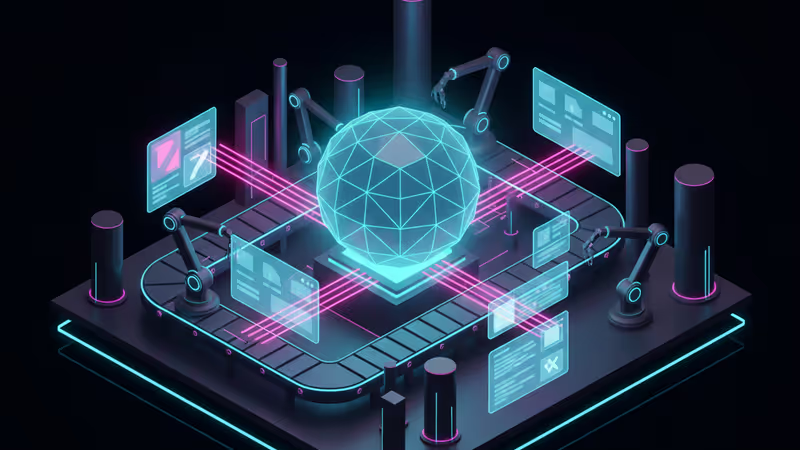
The AI Software Factory: Why Lovable's $6.6B Valuation Signals the End of Coding as We Know It
Lovable's $330M raise from Nvidia and Google at a $6.6B valuation isn't just a funding round. It's a strategic bet on the AI software factory. Here's why.
The Lede: A Funding Round or a Platform Shift?
When a two-year-old startup triples its valuation to $6.6 billion in a few months, it’s not just about hype. When the investors include the venture arms of Alphabet and Nvidia—the brain and the brawn of the AI revolution—it’s a declaration. The $330 million Series B for Swedish "vibe coding" platform Lovable isn’t just another mega-round; it’s a coordinated, strategic bet by tech’s titans that the very process of creating software is being fundamentally re-platformed. For executives, investors, and developers, this signals an urgent need to understand the shift from writing code to orchestrating AI.
Why It Matters: The New Tech Stack Emerges
The implications of this move extend far beyond the startup ecosystem. This is about the creation of a new, massively accessible layer on top of the entire digital infrastructure.
- Democratization of Creation: Lovable’s promise—turning text prompts into functional applications—dramatically lowers the barrier to entry for software creation. This unlocks productivity for non-technical teams, allowing marketing, finance, and operations to build their own tools without waiting on engineering backlogs. The result is not just faster development, but a Cambrian explosion of bespoke, internal applications tailored to specific business needs.
- The Enterprise Land Grab: CapitalG’s comment about “demand from Fortune 500 companies” is the core signal here. This isn't a consumer toy. The enterprise is adopting AI-native development to gain a competitive edge. This creates a massive new software category and threatens the traditional seats of IT departments and external development agencies.
- The Strategic Alliance: Look at the investor list. It’s a blueprint for the AI software factory of the future. Nvidia (NVentures) provides the GPU-powered hardware. Alphabet (CapitalG) provides the foundational models and cloud infrastructure. Salesforce, Databricks, and Atlassian represent the enterprise ecosystems where these new AI-generated applications will be deployed and integrated. This isn't a bet on one company; it's the formation of a vertically-aligned ecosystem to dominate the next era of software.
The Analysis: From Low-Code to No-Effort
We’ve seen the precursors to this moment for years. The first wave of no-code/low-code platforms like Bubble and Webflow proved there was an appetite for visual development. However, they were often clunky, limited, and required significant learning. What’s changed is the interface layer. Generative AI, powered by LLMs from OpenAI and Anthropic, replaces complex drag-and-drop UIs with natural language—the most intuitive human interface.
This transforms the competitive landscape. The battle is no longer just about who has the best visual builder. It’s now a three-front war:
- The Interface & Workflow: How seamlessly can a platform translate human intent into a functional, secure, and scalable application? This is where Lovable is currently winning, as evidenced by its meteoric rise from $1 million to $200 million in ARR in under a year.
- Enterprise-Grade Plumbing: Can these platforms handle the security, compliance, data governance, and integration demands of a global enterprise? This is where the backing from Salesforce and Atlassian becomes a critical competitive moat.
- The Developer Flywheel: While these tools empower non-coders, their ultimate potential lies in augmenting professional developers. The winner will be the platform that successfully becomes the new "IDE" (Integrated Development Environment) for an AI-first world, a space where competitors like Replit ($3B valuation) and Vercel ($9.3B valuation) are also fiercely competing.
PRISM Insight: The Race to Own the Abstraction Layer
The history of technology is a history of abstraction. We moved from direct machine manipulation to assembly language, then to high-level languages like Python, and then to APIs. Each layer hid complexity and unlocked massive productivity gains. Natural language is the ultimate abstraction layer. The company that owns the dominant "prompt-to-product" platform will hold a position of power analogous to Microsoft's ownership of the desktop OS or Google's ownership of search.
This is why the valuation isn't based on a simple multiple of Lovable's $200M ARR. Investors are pricing in the capture of a significant slice of the multi-trillion-dollar global IT and software development market. They are betting that Lovable isn't just a better SaaS tool; it's a fundamental re-platforming of how economic value is created in the digital world.
PRISM's Take: The Evolving Role of the Engineer
This is not the death of the developer; it is the radical transformation of the role. The most valuable engineers of the next decade will not be the ones who can write the most elegant code, but those who can most effectively architect systems and orchestrate AI agents to build them. The focus will shift from the syntax of code to the semantics of system design and the logic of business outcomes. The tedious work of writing boilerplate, APIs, and front-end components will be largely automated. The true value will lie in problem-solving, architectural vision, and the ability to guide AI towards complex, novel solutions. The future of coding is not typing; it's thinking.
Related Articles
China's LightGen optical chip claims 100x+ gains over Nvidia. Is this a lab curiosity or China's strategic answer to crippling US tech sanctions?

Analysis: Indian spacetech startup EtherealX's funding signals a major shift. We break down why its pre-launch contracts are the real story for the global launch market.

Micron's record results signal a major shift. The AI boom isn't just about GPUs; it's about the high-performance memory that feeds them. Analysis on the new AI bottleneck.

Oracle's $10B data center funding issue signals a new risk for the AI boom. Our analysis reveals the financial fragility threatening the AI hardware sector's growth.