
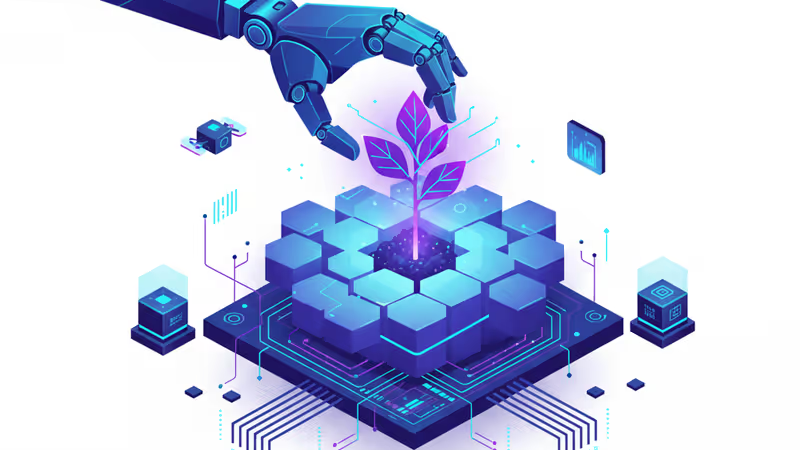
From Sawdust to Edible Fat: 14 Food & AgTech Startups Redefining Your Plate, Handpicked by TechCrunch
Discover 14 innovative AgTech and FoodTech startups from TechCrunch's Startup Battlefield 200 that are using AI, robotics, and biotech to change the future of food.
The future of food may not be on the farm, but in the code. Every year, thousands of companies apply for TechCrunch's Startup Battlefield, a fierce competition for a $100,000 prize that often signals the next wave of technological innovation. In its recently revealed list of the top 200 contenders, a cohort of AgTech and FoodTech startups are standing out for their bold attempts to rewrite the rules of our food system.
AI Becomes the New Farmer
Farming is rapidly shifting from an intuition-based practice to a data-driven science, powered by artificial intelligence (AI). For instance, Aquawise uses AI to analyze satellite imagery, providing real-time water quality monitoring for shrimp and fish farms without the need for expensive sensors. Meanwhile, Tensorfield Agriculture deploys AI-powered robots that identify newly sprouted weeds and kill them with injections of superheated vegetable oil, eliminating herbicides and leaving crops undisturbed.
Indoor farming is also getting an AI upgrade. Greeny Solutions offers software and IoT tools that automate nutrient dosing, climate control, and disease monitoring to maximize yields. Another standout, Clave, is developing AI agents to help fast-food franchises make smarter, data-backed decisions.
Waste Not, Want Not: The Circular Economy
Sustainability was a major theme, with startups transforming waste into valuable resources. The most striking example is ÄIO, which has developed a process to turn agricultural waste like sawdust into edible fats suitable for both food and cosmetics. Similarly, Unibaio creates biodegradable polymers from shrimp waste. These microparticles deliver agrochemicals more efficiently and are suitable for over 35 different crops.
Tackling plastic waste, Kadeya operates beverage vending stations that use a closed-loop system of reusable, cleanable bottles. It's a model designed to eliminate single-use plastics from the workplace entirely.
Biotech and Robotics on the Menu
The future kitchen and farm will be staffed by robots and driven by biotech. Shin Starr Robotics is building autonomous kitchens inside delivery trucks that cook meals like Korean BBQ while en route to their destination, ensuring restaurant-quality food timed perfectly for arrival. In the biotech space, Verley uses precision fermentation to manufacture bioidentical dairy proteins. This technology offers a way to maintain the supply of dairy products while drastically reducing the environmental footprint of traditional dairy farming.
This content is AI-generated based on source articles. While we strive for accuracy, errors may occur. We recommend verifying with the original source.
Related Articles

European startups saw €43.7 billion in funding in 2025, but the market's recovery lags behind the U.S. Is a turnaround imminent, fueled by AI investment and renewed interest from American VCs?

Meet 9 innovative biotech startups from TechCrunch's Startup Battlefield 200. Discover the technologies set to change the future of medicine, from CRISPR gene editing to AI diagnostics and nanotechnology.
Nest founder's startup Mill will deploy its AI-powered food waste bins across all Whole Foods stores starting in 2027. The deal goes beyond disposal, using data analytics to cut costs and optimize grocery operations.
Five years after its debut, Google DeepMind's AlphaFold is evolving from a protein structure predictor into an 'AI co-scientist.' Built on Gemini 2.0, it's generating hypotheses and tackling the grand challenge of simulating a human cell.
European startups saw €43.7 billion in funding in 2025, but the market's recovery lags behind the U.S. Is a turnaround imminent, fueled by AI investment and renewed interest from American VCs?
Meet 9 innovative biotech startups from TechCrunch's Startup Battlefield 200. Discover the technologies set to change the future of medicine, from CRISPR gene editing to AI diagnostics and nanotechnology.
Nest founder's startup Mill will deploy its AI-powered food waste bins across all Whole Foods stores starting in 2027. The deal goes beyond disposal, using data analytics to cut costs and optimize grocery operations.
Five years after its debut, Google DeepMind's AlphaFold is evolving from a protein structure predictor into an 'AI co-scientist.' Built on Gemini 2.0, it's generating hypotheses and tackling the grand challenge of simulating a human cell.