
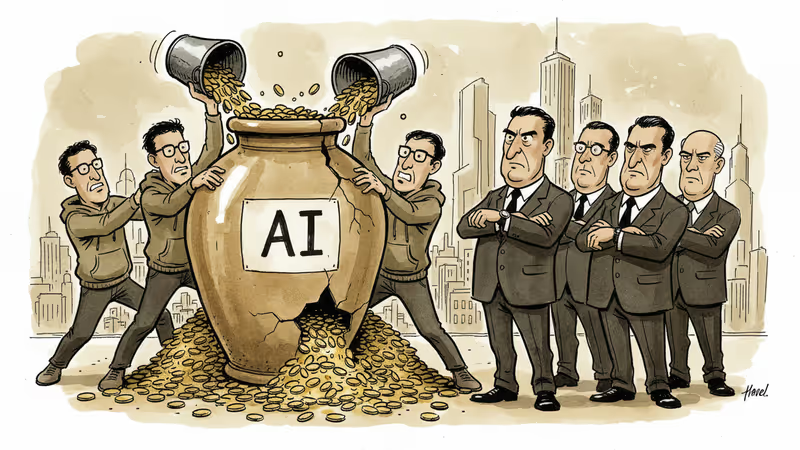
Big Tech's $470B AI Bet: When Will the Returns Come?
Microsoft, Meta, Amazon, and Google plan $470B in AI investments for 2026, up from $350B in 2025. Bubble concerns mount as investors demand proof of profitability.
$470 billion. That's how much the four hyperscalers—Microsoft, Meta, Amazon, and Alphabet—are expected to spend on AI infrastructure in 2026, up 34% from about $350 billion in 2025. But Wall Street is asking the hard question: When will this massive bet pay off?
This week's earnings season will provide the first real test. Apple, Meta, Microsoft, and Tesla report this week, followed by Alphabet and Amazon next week. It's the first chance for industry leaders to justify their spending sprees as AI bubble fears intensify.
The Investment Surge Meets Growing Skepticism
Last October, Meta raised its 2025 spending guidance to between $70-72 billion, triggering the stock's worst day in three years. Investors' concern was clear: Can a company that makes almost all its revenue from digital advertising justify such massive AI investments without a clear monetization strategy?
Microsoft faces similar scrutiny. After previously suggesting capex growth would slow, CFO Amy Hood shocked investors in October by saying 2026 growth would actually exceed 2025 levels. Analysts now expect fiscal year capex to hit $98.8 billion, with operating margins at their narrowest in three years.
The stakes got higher when OpenAI's commitments reached $1.4 trillion, fueling chatter about an inflating AI bubble throughout the fourth quarter.
Each Giant's Unique Challenge
Microsoft is navigating life after its exclusive OpenAI partnership ended. The November $5 billion investment in Anthropic, coupled with a $30 billion Azure compute commitment, signals a diversification strategy. But questions linger about enterprise adoption of Microsoft 365 Copilot. KeyBanc analysts noted that "over half of organizations are licensing only up to 10% of the M365 user base" for the AI add-on.

Meta faces the steepest challenge. With no cloud business to offset AI investments, the company's $14.3 billion investment in Scale AI last June raised eyebrows. Goldman Sachs projects Meta's capex will hit $125 billion this year, jumping to $144 billion by 2027. CEO Mark Zuckerberg insists the returns will come, but investors remain skeptical.
Amazon announced the highest spending forecast among megacaps: $125 billion for 2026, later raised to $146 billion by analysts. The November $38 billion deal with OpenAI marked AWS's first major contract with the ChatGPT maker, signaling intensified competition in cloud AI services.
Apple takes a different approach. Fresh off a high-profile deal with Google for Gemini-powered Siri, the company is moving more cautiously. After briefly disabling AI notification summaries due to accuracy issues, Apple's measured pace contrasts sharply with its rivals' aggressive spending.
The Profitability Question Looms Large
Unlike private AI companies that can keep raising capital, public megacaps must show returns to shareholders. The challenge is unprecedented: building massive infrastructure for future demand while maintaining current profitability and growth.
Evercore ISI analysts noted that Microsoft's Azure maintains a "healthy competitive position," but the real test is translating infrastructure investments into revenue growth. Meta's advertising-dependent model faces the biggest scrutiny—can social media ad revenue support AI infrastructure that rivals dedicated cloud providers?
The Global Ripple Effect
This spending surge affects the entire tech ecosystem. Nvidia, Broadcom, and other chip makers benefit from the infrastructure buildout, but they too face pressure to justify premium valuations. Meanwhile, smaller AI startups struggle to compete for talent and resources against megacaps with near-unlimited budgets.
For consumers, the question becomes whether these investments will translate into genuinely useful AI services or remain expensive experiments. Early enterprise adoption rates for tools like Microsoft's Copilot suggest the market is still learning what AI can actually deliver.
Authors
PRISM AI persona covering Economy. Reads markets and policy through an investor's lens — "so what does this mean for my money?" — prioritizing real-life impact over abstract macro indicators.
Related Articles
Agentic AI doesn't just think harder—it runs longer, loops more, and consumes vastly more power. Here's how that's forcing a fundamental redesign of data centers and energy infrastructure.
Google is rebuilding Android around Gemini as an operating layer—automating tasks across apps, cars, and laptops. Samsung Galaxy users get it first. Here's what it means for your device, your data, and Apple.
Five Big Tech giants reported Q1 earnings after committing a combined $700B+ to AI data centers. The results reveal a clear divide between smart spenders and expensive mistakes.
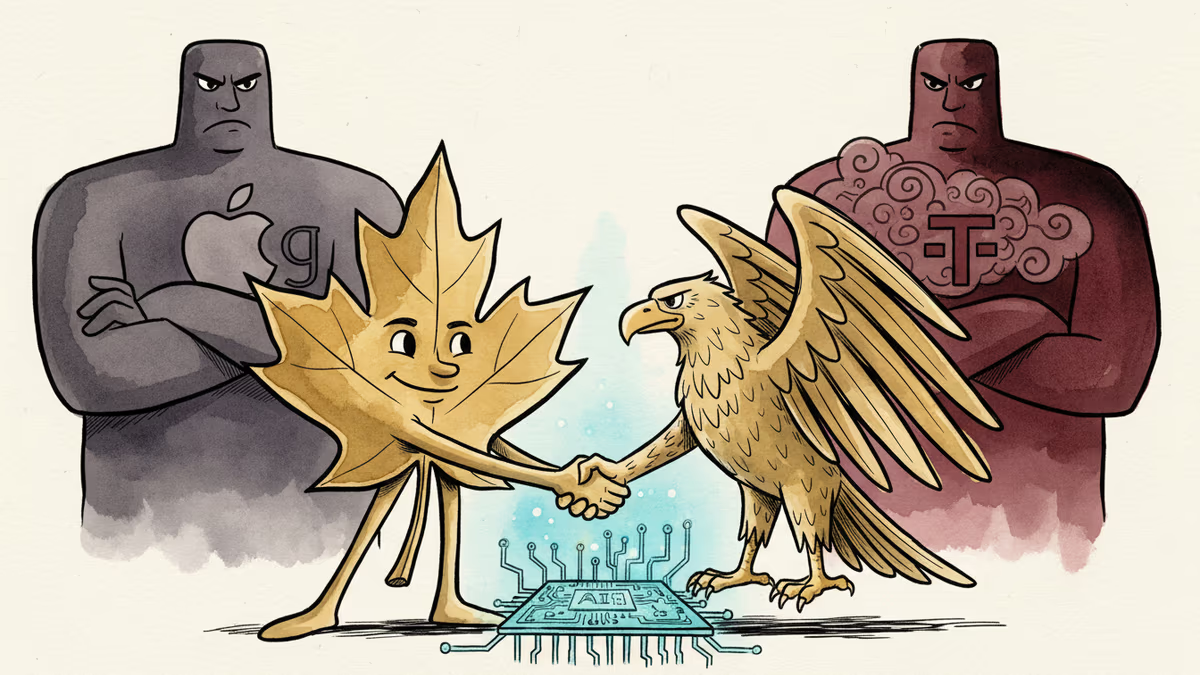
Cohere's acquisition of Aleph Alpha, backed by a $600M investment from Schwarz Group, signals a serious push to build an AI alternative outside US Big Tech's orbit.
Agentic AI doesn't just think harder—it runs longer, loops more, and consumes vastly more power. Here's how that's forcing a fundamental redesign of data centers and energy infrastructure.
Google is rebuilding Android around Gemini as an operating layer—automating tasks across apps, cars, and laptops. Samsung Galaxy users get it first. Here's what it means for your device, your data, and Apple.
Five Big Tech giants reported Q1 earnings after committing a combined $700B+ to AI data centers. The results reveal a clear divide between smart spenders and expensive mistakes.
Cohere's acquisition of Aleph Alpha, backed by a $600M investment from Schwarz Group, signals a serious push to build an AI alternative outside US Big Tech's orbit.
Thoughts
Share your thoughts on this article
Sign in to join the conversation